This guide is built from studies and reports published in recent months. Sources include a large matched study tracking more than 100,000 real GitHub developers, a meta-analysis pooling 23 separate productivity studies, telemetry-based reports from engineering-analytics vendors covering thousands of teams and tens of thousands of developers, large multi-country surveys of developers and technology buyers, a six-month longitudinal academic study of professional engineers, and a literature synthesis attempting to reconcile the field’s contradictory findings. Each claim below was checked against its original source, and every item is paired with its strongest counterargument rather than presented as settled fact.
Table of Contents
- Output Volume vs. Delivered Value
- The Downstream Bottleneck
- Does Organizational Maturity Change the Outcome
- The Perception Gap
- Quality, Reliability, and Technical Debt
- Who Benefits, and From What Kind of Work
- Implications for How Engineering Organizations Should Operate
Output Volume vs. Delivered Value
Coding Activity Surges, Shipped Software Barely Moves
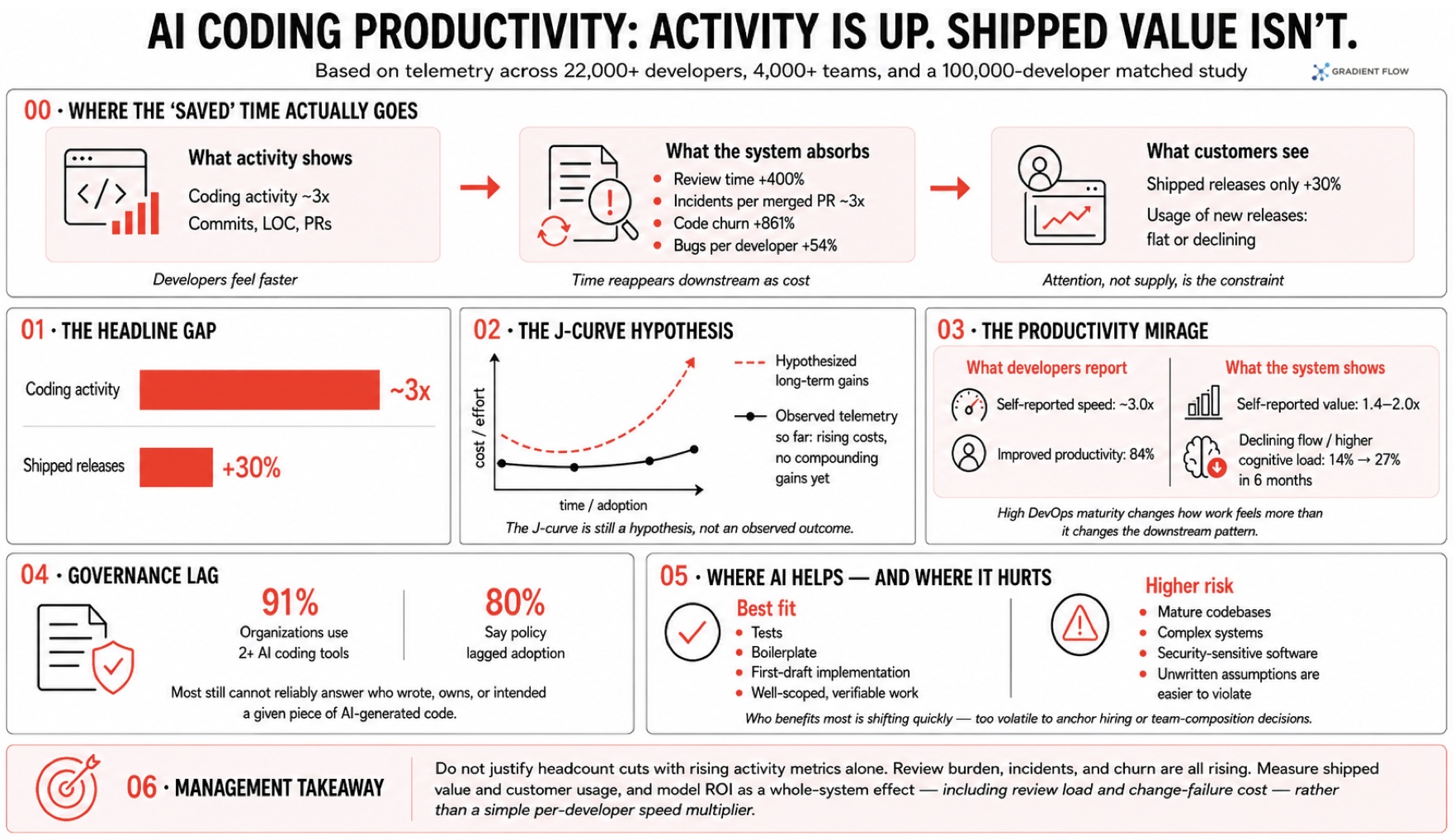
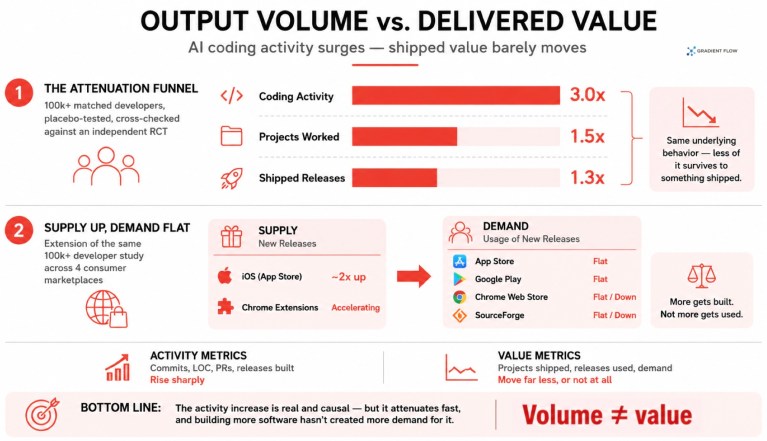
The most methodologically rigorous evidence available comes from a matched study of more than 100,000 real GitHub developers, comparing each adopter of an AI coding tool to a near-identical developer from a year earlier. As tools progressed from autocomplete to interactive coding agents to autonomous agents that work unsupervised, coding activity roughly tripled, and the researchers validated the causal story with placebo tests against non-AI tools and by cross-checking one estimate against an independent randomized field experiment. This is about as strong a case as exists that AI coding tools change developer behavior at scale.
- Counterpoint: The same study found that tripling in coding activity produced only about 50% more projects worked on and roughly 30% more shipped releases. This attenuation pattern is consistent with a broader critique that shows up across the literature: metrics like commit counts, lines of code, and pull request volume systematically overstate business impact, because they measure the stage of the pipeline where AI’s effect is largest and stop looking before the stage where the effect is smallest. Any dashboard that leads with code volume is very likely reporting an inflated number.
More Software Supply Has Not Created More Software Demand
The same 100,000-developer study extended its analysis into four consumer software marketplaces (the Apple App Store, Google Play, the Chrome Web Store, and SourceForge) and found that new app releases increased unevenly but genuinely, with iOS releases roughly doubling and Chrome extension releases also accelerating, coinciding with the growth of AI-assisted development. That is a real, measurable expansion of what gets built and published, and a plausible early sign that lower production costs are translating into more attempts at building software.
- Counterpoint: Total usage of each new cohort of apps, measured in the months after release, stayed flat or declined across every marketplace studied. In other words, supply expanded while demand did not follow. This suggests the constraint on software’s economic impact may not be production capacity at all, but customer attention and discovery, which AI does nothing to expand. It is a caution against equating “we can build more” with “we are creating more value.”

The Downstream Bottleneck
Review Time Is Absorbing the Time AI Saves
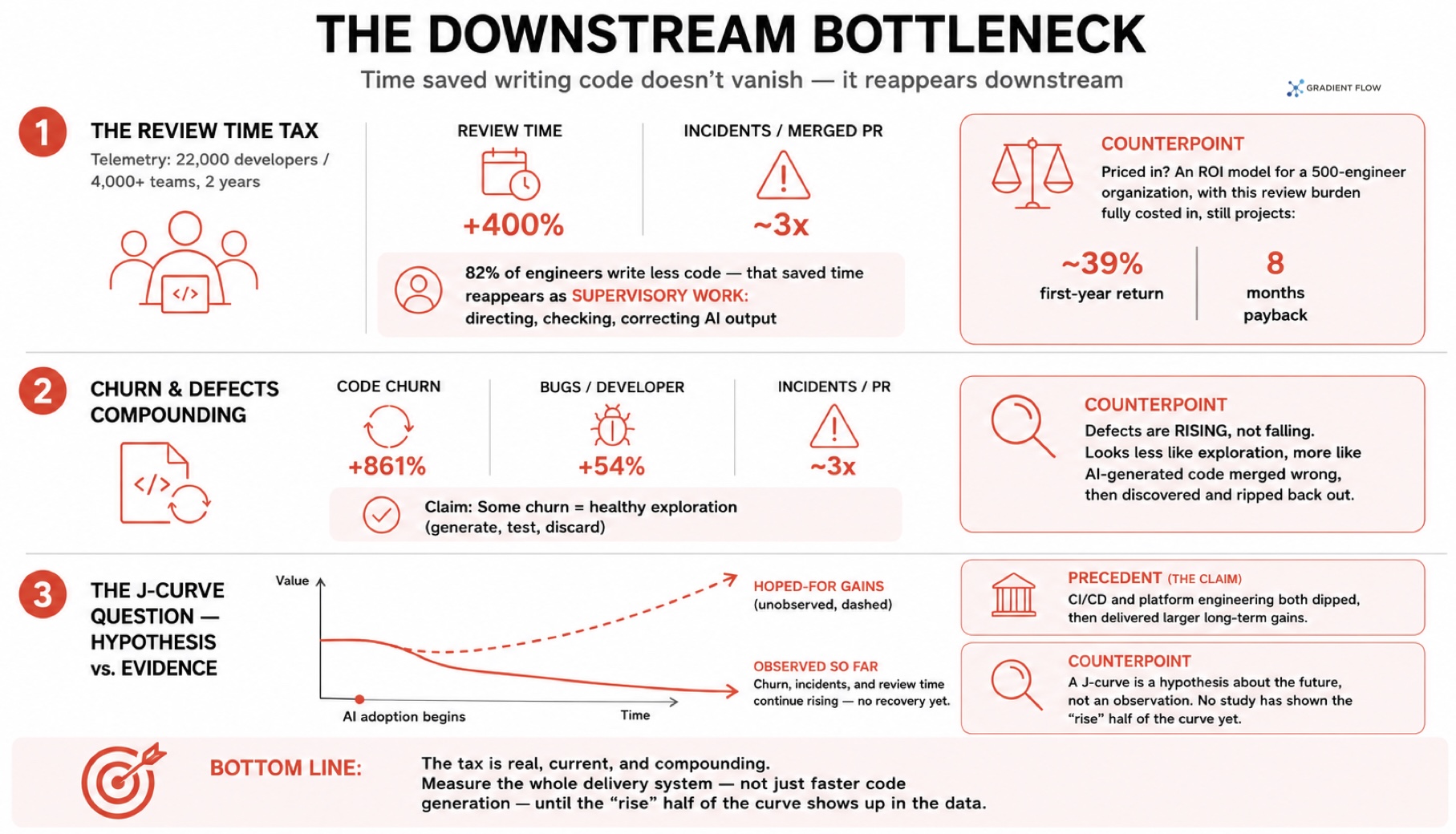
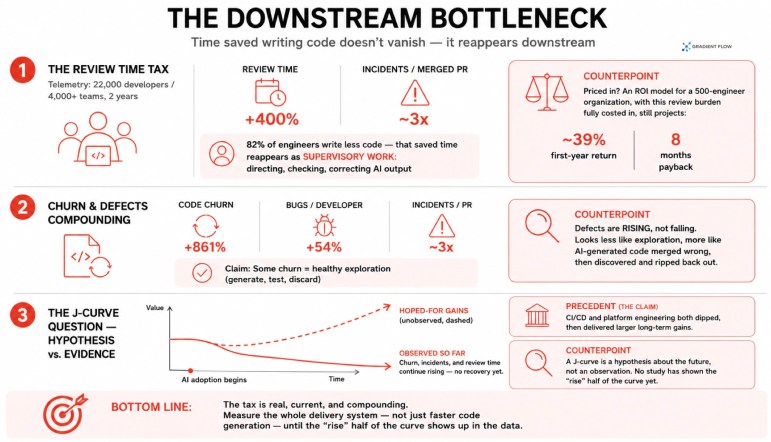
A telemetry study covering two years of workflow data from 22,000 developers across more than 4,000 teams found that as AI adoption rises, median time spent in code review increases by more than 400%, and the incident rate per merged pull request roughly triples. A separate academic survey of professional engineers corroborates this from the human side: 82% reported spending less time writing code, but that time is being redirected into what the researchers term supervisory work, meaning directing, checking, and correcting AI output rather than producing new code.
- Counterpoint: This tax is not necessarily fatal to the economics of AI adoption. One ROI model from a major DevOps research group explicitly prices in a rise in change-failure rate and elevated review burden as a known cost, and still projects a roughly 39% first-year return with an eight-month payback for an illustrative 500-engineer organization. If the review burden is a one-time cost of adapting workflows to a new mode of production, rather than a permanent feature of it, the math can still work out favorably even with review time fully accounted for.
Code Churn and Defect Rates Are Compounding Faster Than Throughput
Some increase in churn, meaning code that is rewritten or discarded shortly after being written, is a reasonable and even healthy side effect of faster iteration. If AI makes it cheap to generate multiple candidate implementations, test them, and discard the weaker ones, some additional churn is simply the visible cost of a faster exploration process, not evidence of a problem.
- Counterpoint: The scale observed in telemetry data is difficult to explain as healthy exploration alone. The same 22,000-developer study found code churn up 861% under high AI adoption, alongside bugs per developer up 54% and incidents per pull request roughly tripling. A near-tenfold jump in churn, combined with rising defect rates rather than falling ones, looks less like productive iteration and more like a large volume of AI-generated code being merged, discovered to be wrong, and removed after the fact, at a cost that is not currently reflected in most teams’ throughput dashboards.
The J-Curve: Temporary Adjustment or Permanent Tax
A dip-then-rise pattern, sometimes called a J-curve, has precedent in how organizations previously absorbed continuous delivery and platform engineering, both of which reportedly produced short-term productivity declines before delivering larger long-term gains. Applied to AI adoption, the argument is that today’s elevated review time and defect rates reflect a temporary mismatch between AI’s output and an organization’s testing, release, and workflow discipline, a mismatch that closes as the surrounding system matures rather than one that persists indefinitely.
- Counterpoint: A J-curve is a hypothesis about the future, not a description of what has been observed. Every telemetry-based study reviewed here captures rising churn, rising incident rates, and rising review time, with no comparable evidence yet of the compounding gains that are supposed to follow the dip. It is equally plausible that some organizations remain stuck in the dip indefinitely without deliberate investment in the testing and release infrastructure the model assumes will materialize on its own.

Does Organizational Maturity Change the Outcome
Strong Engineering Foundations as an Amplifier, or a Claim Telemetry Doesn’t Support
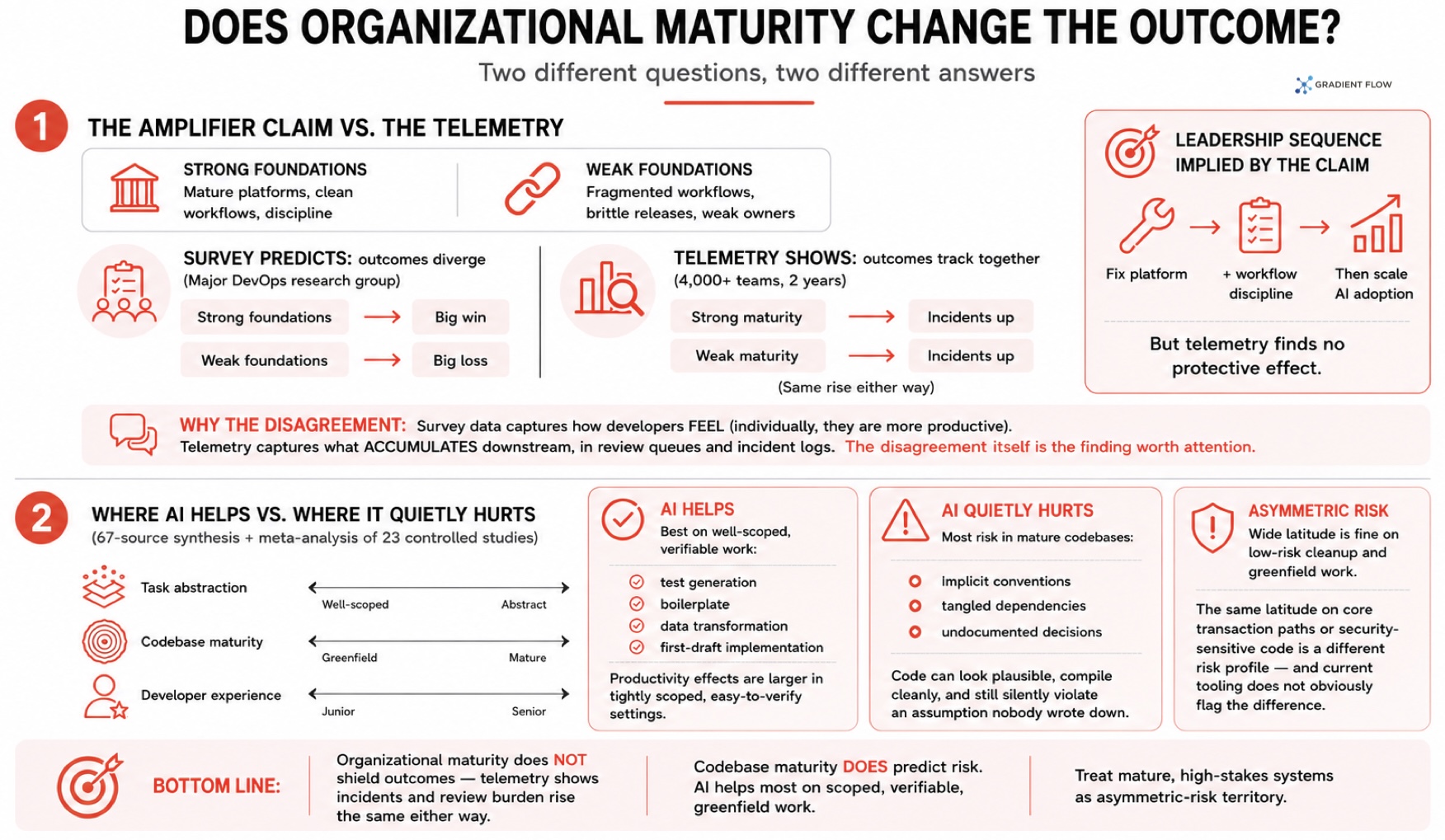
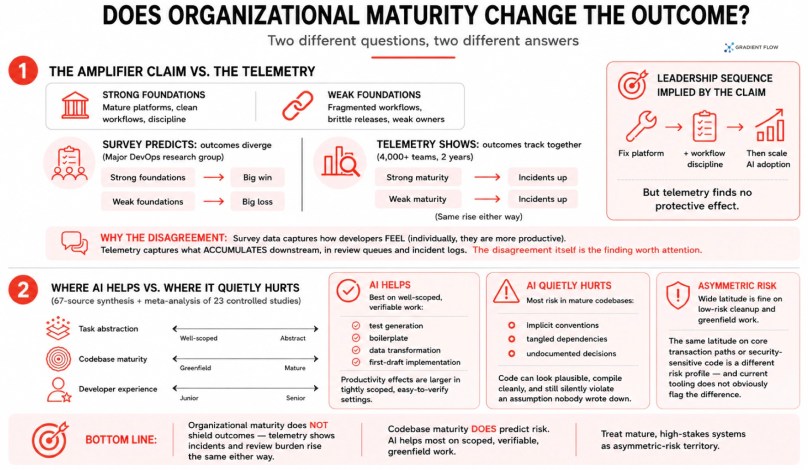
A major DevOps research group’s survey-based research argues that AI functions as an amplifier of existing organizational conditions: teams with mature internal platforms, clean workflows, and disciplined engineering practices extract outsized benefit from AI adoption, while teams with weak foundations see AI amplify their dysfunction instead. This is an actionable claim, because it implies a clear sequencing for leaders (fix the platform and workflow discipline first, then scale AI adoption) rather than treating AI rollout as tool procurement.
- Counterpoint: A competing telemetry study explicitly tested this claim against two years of workflow data across 4,000-plus teams and found no such protective effect. Organizations with strong DevOps maturity scores showed the same increases in incidents, bugs, and review burden as organizations with weak engineering practices. The study’s own explanation for the discrepancy is notable: survey data captures how developers feel, and developers feel more productive because individually they are, but that self-report does not capture what accumulates downstream in review queues and incident logs. Telemetry and survey evidence disagree directly on this point, and the disagreement itself, not just the underlying question, is worth attention.
Task Type and Codebase Maturity Decide Where AI Helps or Hurts
A synthesis paper pulling together 67 sources proposes that three variables largely determine whether AI coding tools help or hurt on a given piece of work: how abstract the task is, how mature the codebase is, and how experienced the developer is. This lines up with a meta-analysis of 23 controlled studies, which found productivity effects are consistently larger in tightly scoped, easy-to-verify settings than in real open-source or enterprise codebases. Together, this gives a reasonably concrete heuristic: AI performs best on well-scoped, verifiable work such as test generation, boilerplate, data transformation, and first-draft implementation.
- Counterpoint: The same logic that identifies where AI helps also identifies where it is most likely to quietly cause harm. Mature codebases carry the most implicit conventions, tangled dependencies, and undocumented product decisions, which is exactly the context in which AI-generated code is most likely to look plausible, compile cleanly, and still violate an assumption nobody wrote down. The practical implication is asymmetric risk: AI can be given wide latitude on low-risk cleanup and greenfield work, but the same latitude applied to core transaction paths or security-sensitive systems carries a meaningfully different risk profile that current tooling does not obviously flag.

The Perception Gap
Developers Feel Far Faster Than the Value Data Supports
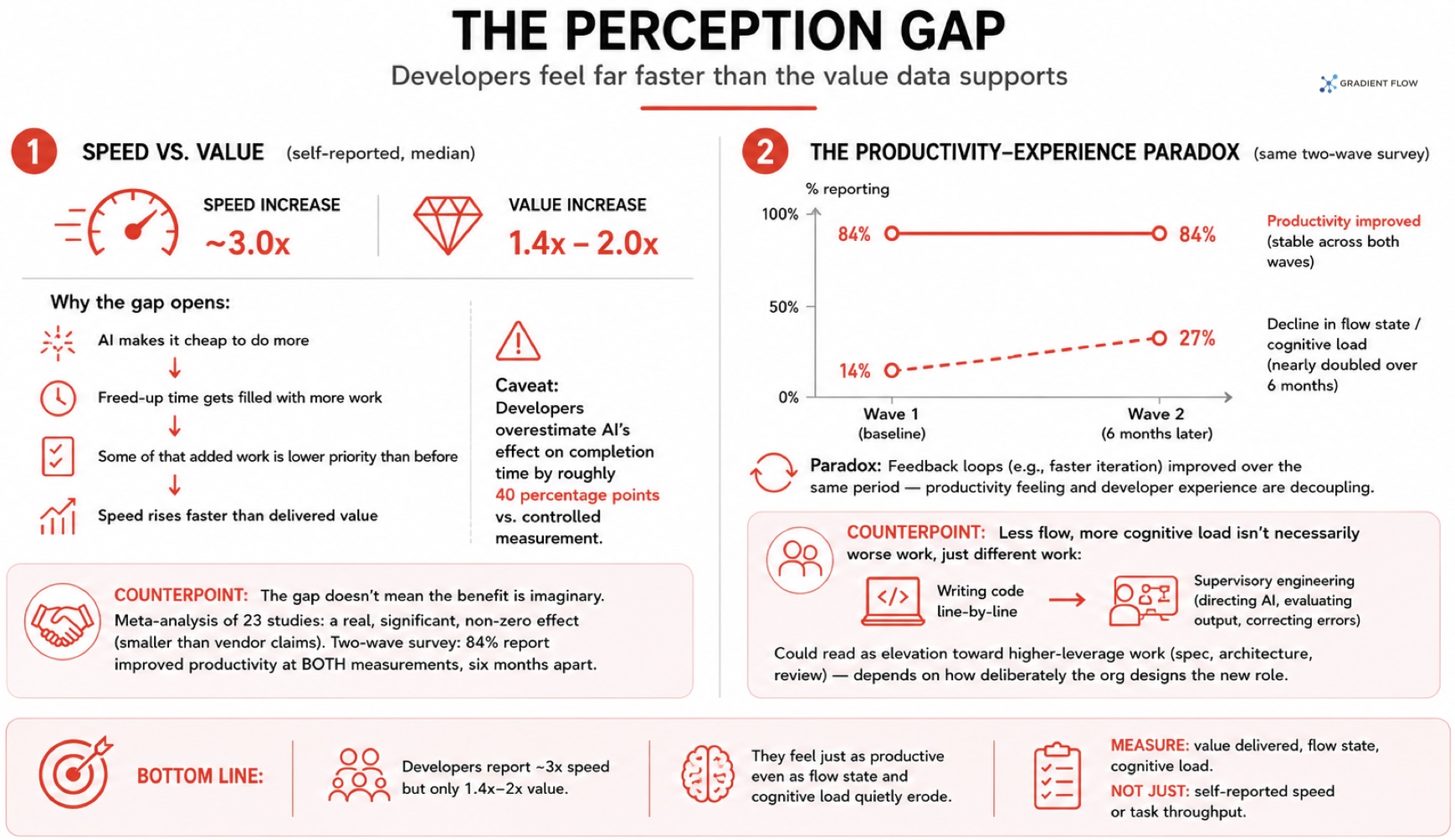
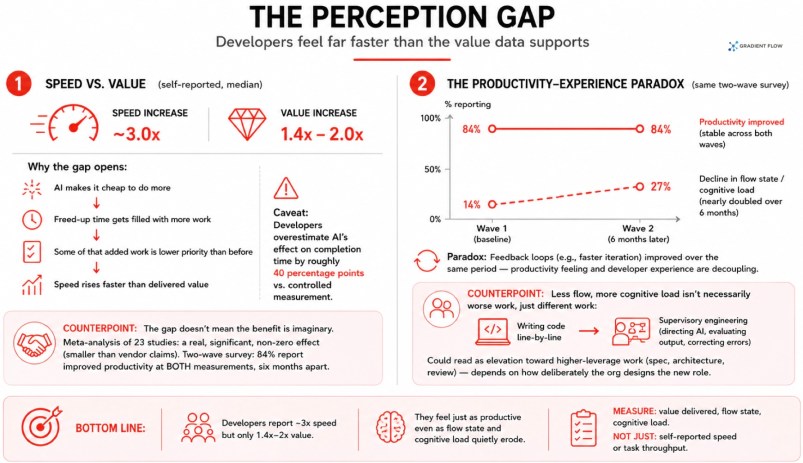
A survey designed specifically to separate perceived speed from perceived value found a median self-reported speed increase of roughly 3x, but a median self-reported value increase of only 1.4x to 2x. The gap is explained by task substitution: because AI makes it cheap to do more, developers fill freed-up time with additional work, some of which is lower priority than what they would have prioritized without AI, inflating the speed number without proportionally increasing the value delivered. The researchers’ own caveats reinforce the caution here, including a documented tendency for developers to overestimate AI’s effect on completion time by roughly 40 percentage points relative to controlled measurement.
- Counterpoint: The gap between speed and value does not mean the underlying benefit is imaginary. A meta-analysis pooling 23 productivity studies found a real, statistically significant average effect, smaller than headline vendor claims but clearly non-zero. And a two-wave academic survey of professional engineers found 84% reporting improved productivity at two separate measurement points six months apart, a consistency that is harder to attribute to novelty or hype than a single one-time survey result would be.
Stable Productivity Perceptions Mask a Decline in Developer Experience
The same two-wave survey that found stable, high productivity perceptions also tracked developer experience separately, and found something the researchers call a productivity-experience paradox. While 84% consistently reported improved productivity, the share reporting a decline in some dimension of developer experience, particularly flow state and cognitive load, nearly doubled over six months, from 14% to 27%, even as feedback loops (such as faster iteration speed) improved. This suggests productivity and developer experience, previously assumed to move together, may be decoupling under heavy AI use.
- Counterpoint: A decline in flow state and an increase in cognitive load are real costs, but they are not necessarily evidence that the work has become worse overall, only that it has changed in character. The same study documents a shift toward what it calls supervisory engineering work, meaning directing AI, evaluating its output, and correcting its errors, which some engineers may experience as a legitimate elevation toward higher-leverage work (specification, architecture, review) rather than a pure degradation. Whether this shift reads as a loss or a promotion likely depends heavily on how deliberately an organization designs the new role, a variable the survey data cannot fully capture.

Quality, Reliability, and Technical Debt
AI-Generated Code Is Creating a New, Less Visible Form of Technical Debt
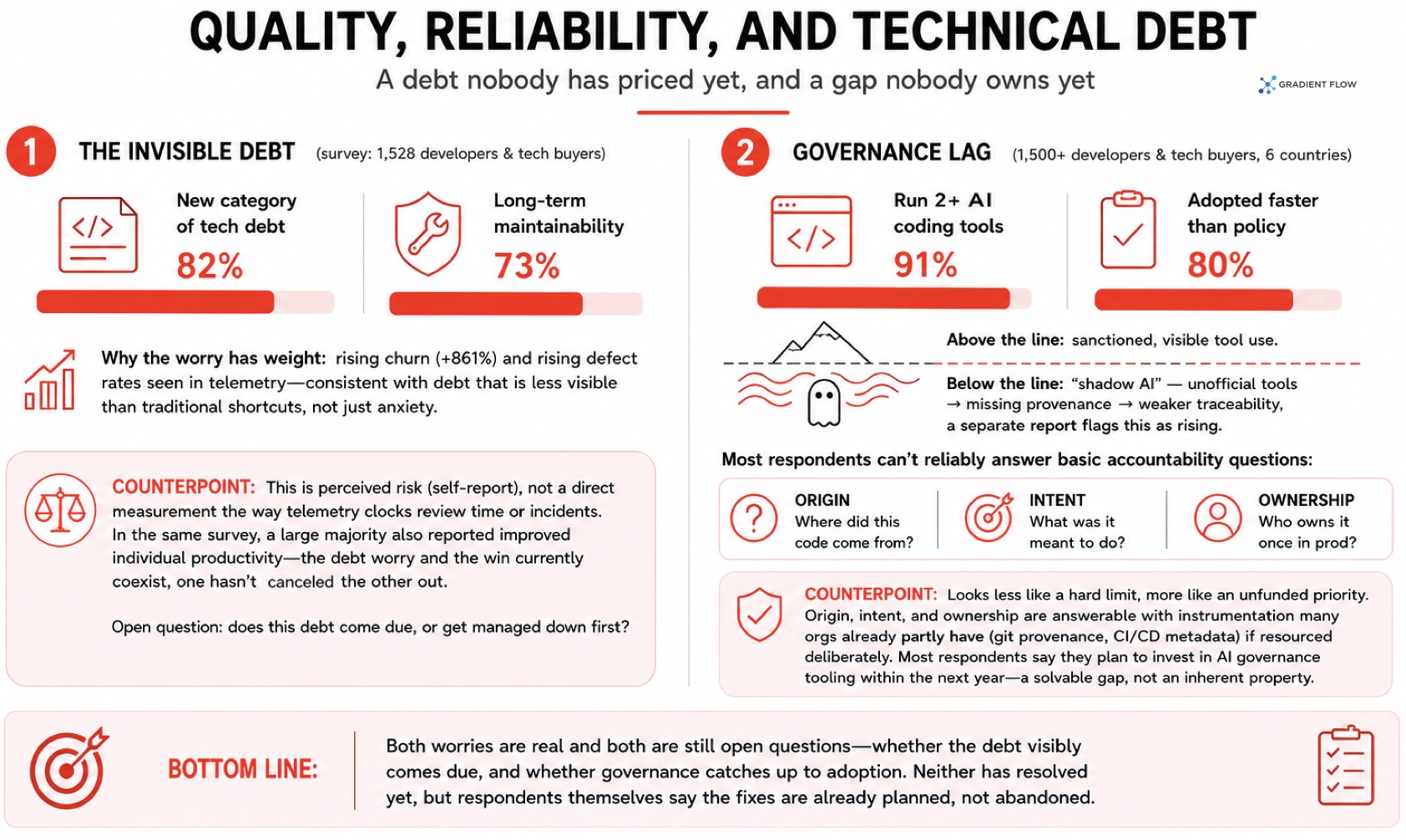
A large international survey of 1,528 developers and technology buyers found 82% of respondents believe AI-generated code risks creating a new category of technical debt, and 73% expressed concern about the long-term maintainability of that code. This concern is echoed by the telemetry evidence on rising churn and defect rates described above, giving the maintainability worry some grounding beyond pure anxiety.
- Counterpoint: This finding is a measure of perceived risk collected through self-report, not a direct measurement of realized cost the way the telemetry studies measure actual review time or incident rates. Notably, a large majority of respondents in the same survey also reported that individual productivity had improved, meaning the technical debt concern and the productivity win currently coexist in respondents’ own accounting rather than one visibly canceling out the other. It remains an open question whether this is a debt that will visibly come due, or a risk that gets managed down before it materializes.
Governance and Accountability Have Not Kept Pace With Adoption
A survey of over 1,500 developers and technology buyers across six countries found that 91% of organizations already run two or more AI coding tools, while 80% admitted their organization adopted AI faster than it built policies to govern it. Most respondents could not reliably answer basic accountability questions about a given piece of AI-generated code, including where it came from, what it was intended to do, and who owns it once it reaches production. A related quarterly benchmarking report separately flags a rising “shadow AI” problem, meaning developers using AI tools outside officially sanctioned and monitored channels, which compounds the traceability gap described above.
- Counterpoint: Unlike the review-time tax, this looks less like a structural limit and more like an unfunded priority. The accountability questions the survey highlights (code origin, intended behavior, ownership) are answerable with instrumentation many organizations already partially have, such as git provenance data and CI/CD metadata, if resourced deliberately. Most respondents in the same survey said they plan to invest in AI governance tooling within the next year, suggesting this is understood as a solvable gap rather than an inherent property of AI-assisted development.


Who Benefits, and From What Kind of Work
Junior Developers Are Closing the Speed Gap With Senior Engineers
A quarterly benchmarking report pooling data from more than 400 companies found junior engineers now save slightly more weekly time using AI (4.9 hours) than senior “Staff+” engineers (4.8 hours), a reversal from the same report’s prior quarter, when senior engineers had been gaining the most. This is a meaningful, measured shift in where AI’s time-saving benefit concentrates, and a plausible reflection of democratized access to capabilities (unfamiliar APIs, first-draft implementations) that used to require more mentoring.
- Counterpoint: The fact that this ranking flipped within a single quarter should temper any confident claim about who benefits most from AI tools. The underlying tools, models, and workflows are changing fast enough that a snapshot from one quarter is not a stable basis for structural decisions, such as hiring mix or team composition, built around the assumption that a given group will keep benefiting most.
Speed Gains Are Not Translating Into Faster Skill Development
The meta-analysis of 23 pooled studies found no statistically significant effect of GenAI assistance on programming learning outcomes, directly contradicting any assumption that AI tools double as an accelerant for building programming skill in junior developers. If offloading the difficult parts of a task to AI also offloads the struggle that builds expertise, faster task completion today could come at the cost of a less capable engineer later.
- Counterpoint: The learning outcomes measured in the pooled studies were largely exam-style or short-term assessments, which may not capture longer-horizon skill development, such as exposure to unfamiliar codebases, architectural reasoning, or debugging practice gained while supervising AI output rather than writing code line by line. The finding is strong evidence against treating AI as an automatic teaching tool, but weaker evidence against the possibility that AI could support learning if paired with deliberate coaching and structured review, a scenario the existing studies were not designed to test.
AI Is Blurring Who Counts as a Developer
The same 400-company benchmarking report found engineering managers who use AI daily now shipping roughly four times as much code as they did two quarters earlier, effectively returning some managers to hands-on development. This points to a broader pattern of AI lowering the barrier for non-specialist roles, including product managers, designers, and founders, to produce functional code directly rather than routing every change through a dedicated engineer.
- Counterpoint: More people producing code does not automatically mean more useful software, and it may simply move more raw material into an already strained review and ownership process. Notably, the same report observed that none of the organizations it tracked had yet restructured their teams around this shift, describing most leaders as still in a “watch and learn” posture. That hesitation is itself informative: even the source reporting this trend is not confident it represents a durable, net-positive change rather than a short-term novelty that creates downstream cleanup work for someone else.


Implications for How Engineering Organizations Should Operate
The Headcount Temptation
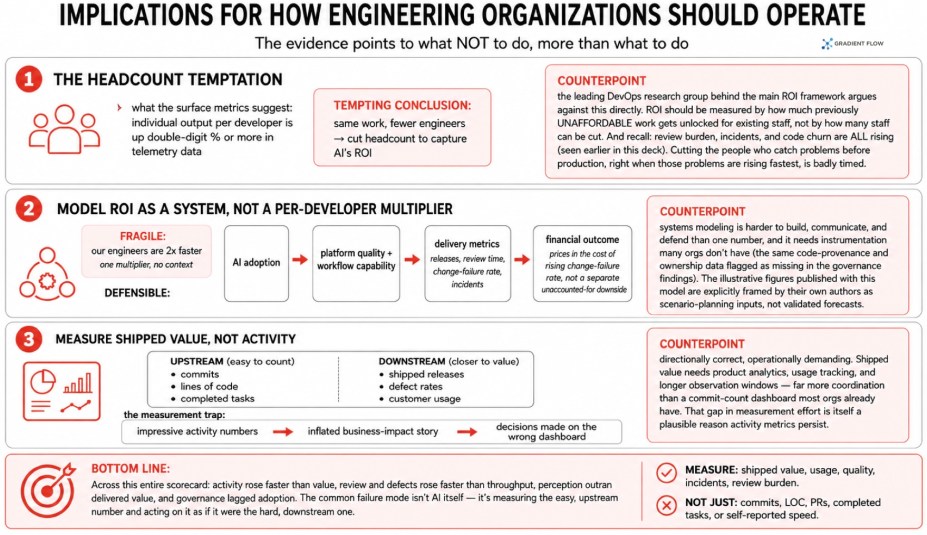
Individual-level output metrics across nearly every study in this set are climbing, in some cases sharply (completed work per developer up by double-digit or higher percentages in telemetry data), which makes the argument for reducing headcount based on AI-driven efficiency gains appear, on the surface, straightforward and numerically supported.
- Counterpoint: The same DevOps research group that built the leading ROI framework explicitly argues against this. Their position is that return on AI investment should be measured by how much previously unaffordable work gets unlocked for existing staff, not by how many staff can be eliminated. Given that review burden, incident rates, and code churn are all rising in the evidence reviewed here, removing the people responsible for catching problems before they reach production is a particularly poorly timed way to capture AI’s supposed efficiency gains.
ROI Should Be Modeled as a Systems Effect, Not a Per-Developer Multiplier
The more defensible framing for communicating AI’s financial impact treats it as a change to the entire software delivery system rather than a simple speed multiplier applied per developer. One published model explicitly chains AI adoption through platform quality and workflow capabilities to delivery metrics and finally to financial outcomes, pricing in the cost of rising change-failure rates rather than treating instability as a separate, unaccounted-for downside. This is a more honest basis for a conversation with a finance team than a claim like “our engineers are twice as fast.”
- Counterpoint: This kind of systems-level modeling is harder to build, communicate, and defend than a single multiplier, and it depends on instrumentation many organizations do not yet have, including the same code-provenance and ownership data described as missing in the governance findings above. The illustrative figures published alongside this type of model are explicitly framed by their own authors as scenario-planning inputs meant to prompt discussion, not validated forecasts, which limits how much weight they should be given on their own.
Measure Shipped Value, Not Activity
The clearest lesson from the evidence on output volume is that activity metrics, such as commits, lines of code, or completed tasks, systematically overstate AI’s business impact relative to metrics further downstream, such as shipped releases, defect rates, and, ultimately, customer usage. Organizations that anchor their AI measurement strategy on outcomes closer to the customer are less likely to be misled by upstream numbers that look impressive but do not reflect delivered value.
- Counterpoint: This recommendation is directionally correct but operationally demanding. Measuring shipped value requires product analytics, customer usage tracking, and longer observation windows than a commit-count dashboard, all of which take more time and cross-functional coordination to build than the activity metrics most organizations already have readily available. That gap in measurement difficulty is itself a plausible explanation for why so many organizations continue to lead with activity metrics despite their known limitations.

Subscribe to our weekly newsletter