

AI has made me pay more attention to a Chinese term that has been circulating for years: involution (内卷). The basic idea is hyper-competition in which everyone has to work harder and improve constantly just to keep up, while the rewards keep shrinking. Companies cut prices, add features, improve service, and adopt new technology, only to discover that competitors have done the same thing. What looked like an advantage becomes the new minimum requirement.
Subscribe to our weekly newsletter

China is an especially interesting place to watch this play out because involution is showing up in AI, robotics, e-commerce, electric vehicles, and other technology-intensive industries. It complicates the usual story that better technology leads to higher productivity, which then leads to better economics. Sometimes productivity improves while margins fall. And in AI, the technology itself may be making this cycle move faster.
When Improvement Becomes the Baseline
The easiest way to understand involution is to look at the consumer experience. China can be a very good place to spend money while being a difficult place to make it. Restaurants discount because competitors discount. Delivery gets faster because rivals get faster. Ratings and recommendation systems make mediocre service harder to hide. Consumers get lower prices and better products, while businesses have to keep improving just to maintain their position.
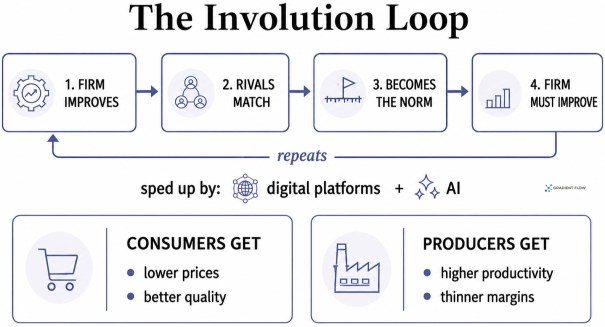

The counterintuitive part is that this can happen while productivity is rising. A company finds a cheaper way to operate, but competitors soon match it and prices adjust. Digital platforms make this cycle faster by making prices and quality easier to compare. AI could accelerate it further. Better technology creates real value, but there is no guarantee that the company creating that value gets to keep much of it.
Why Involution Scales in China
It’s tempting to think of involution as companies simply competing too aggressively. In China, the mechanism is broader. Cities and provinces compete too. They want investment, companies, jobs, tax revenue, and political credit. When Beijing identifies AI, semiconductors, robotics, or computing as strategic industries, many local governments have perfectly good reasons to support their own versions of them.
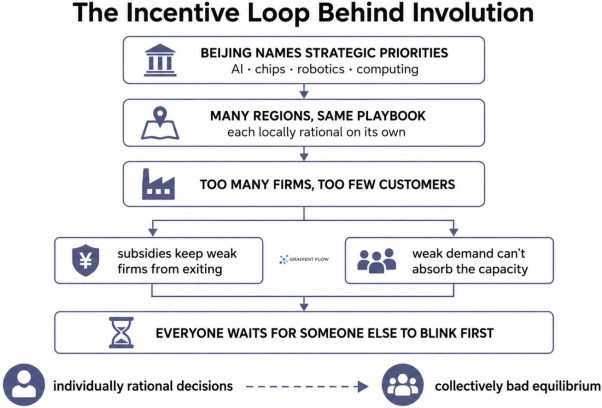

The problem appears when individually sensible decisions add up. Subsidies and cheap credit can keep companies in crowded markets longer. New capacity keeps arriving. Domestic demand may not grow fast enough to absorb it. The result can be too many firms chasing the same customers, with everyone reluctant to be the first to cut investment or raise prices. Involution is therefore not simply bad corporate behavior. It is an equilibrium created by incentives.
AI Accelerates Involution, It Doesn’t Escape It
China’s AI model market gives us a clean example. ByteDance, Xiaomi, Tencent, MiniMax, Alibaba, DeepSeek, and others have competed through aggressive price cuts and promotions. As inference gets cheaper and capability gaps narrow, providers have a harder time holding on to the savings. Better models and lower costs can translate into lower prices for customers rather than higher margins for model companies.
But price is only the visible part of the competition. Chinese AI companies also compete for engineers, capital, customers, compute, and government backing. One working paper, based on nearly 26,000 observations from publicly traded Chinese manufacturers, finds that greater AI adoption is associated with greater corporate involution, particularly through forms of competition other than price. I would not put too much weight on one working paper, but the mechanism makes sense. If AI makes my company more productive, my competitors have a reason to adopt it too. Eventually AI stops being an advantage and becomes the price of admission.
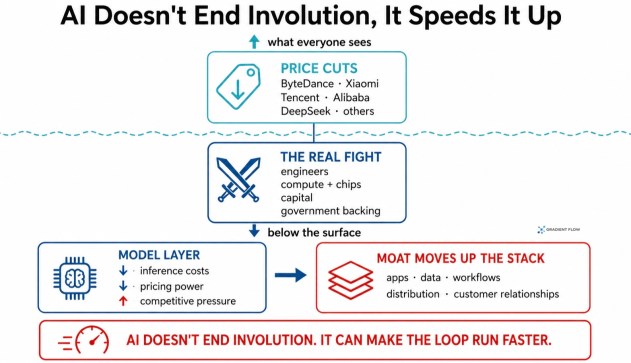

There is an interesting business implication here. If capable models keep getting cheaper and more interchangeable, some of the economic moat may move above the model layer, toward applications, proprietary data, distribution, customer relationships, and integration into actual workflows. What is painful for model providers could be quite attractive for the companies building on top of them.
The Robot Market Is Already Crowded
Humanoid robotics shows how early involution can begin. More than 200 robotics companies appeared at China’s 2026 World AI Conference, while another account counted more than 140 humanoid-robot manufacturers and more than 330 products. Industry participants are already using the language of involution, particularly in lower-barrier categories where prices are falling. This is happening even though many durable commercial applications are still being worked out.
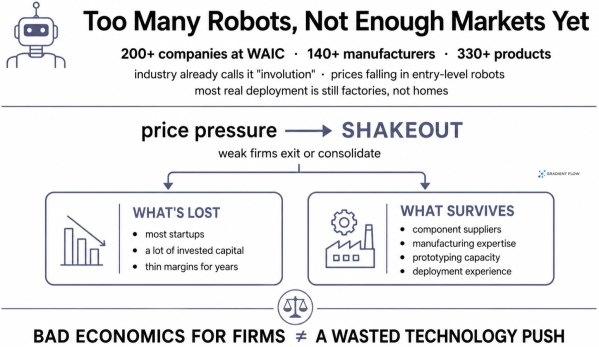

That does not mean China’s robotics push is simply wasteful. Even if a large number of startups disappear, the component suppliers, manufacturing expertise, prototyping capacity, and deployment experience they helped create do not disappear with them. This distinction matters. Involution can produce bad economics for individual companies while strengthening the underlying technology ecosystem.
Workers Are on the Same Treadmill
The same dynamic applies to workers. If AI lets one person produce more, that person initially has an advantage. But once everyone in a field has access to similar tools, higher output can simply become the new expectation. For a gig worker, involution may mean working longer to maintain the same income. For a knowledge worker, it may mean adopting AI simply to keep pace.
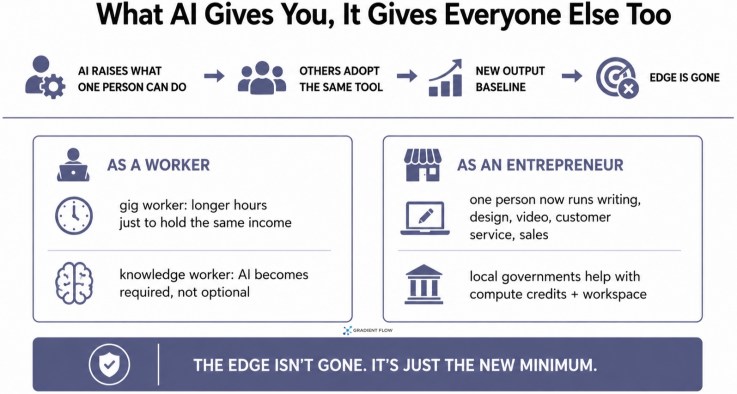

There is a more optimistic version of this story. Generative AI is also letting individuals handle work that once required several specialists, from writing and design to video and customer service. In China, this is contributing to a new kind of small-scale entrepreneur, sometimes supported by local governments with compute credits and workspace. AI lowers the barrier to becoming a company. The catch is that it also lowers that barrier for everyone else.
Beijing’s Involution Problem
Beijing now has a difficult problem. It wants rapid progress in AI, robotics, semiconductors, and other strategic technologies. Those priorities encourage local governments to invest aggressively, which helps create the crowded markets Beijing increasingly wants to clean up. China is effectively trying to preserve the useful parts of intense competition while suppressing price wars, redundant capacity, and weak companies that refuse to exit.
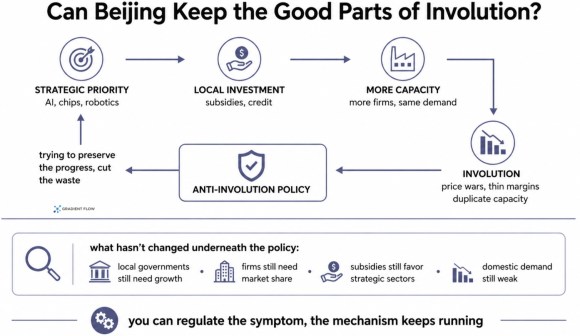

That is harder than telling companies to stop cutting prices. Local governments still need growth. Companies still need customers. Subsidies still favor strategic industries. Weak domestic demand remains part of the backdrop. Unless those incentives change, anti-involution policies risk treating symptoms rather than the mechanism. Beijing may be able to make competition less wasteful, but eliminating involution without weakening the forces that helped China scale these industries will be much harder.
Is Involution a Weakness or an Advantage?
This is the part of the story I find most interesting. Involution is clearly costly. It destroys margins, wastes capital, and pushes companies and workers to run harder just to stay in place. But China’s experience in solar, batteries, and other industries suggests that the same process can also produce extremely efficient companies. Firms that survive brutal domestic competition may emerge with low costs, experienced supply chains, and a willingness to compete aggressively overseas. AI and robotics may follow some version of that pattern.
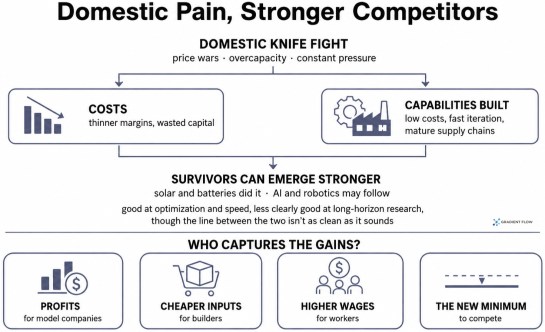

There is also a distinction worth making between different kinds of innovation. Involution creates strong incentives to lower costs, optimize systems, ship quickly, and commercialize. It is less obvious that the same incentives are ideal for expensive, long-horizon research with uncertain returns. But I would not draw that line too sharply. Optimization and systems engineering are real innovation too, and enough incremental improvements can eventually change what is possible.
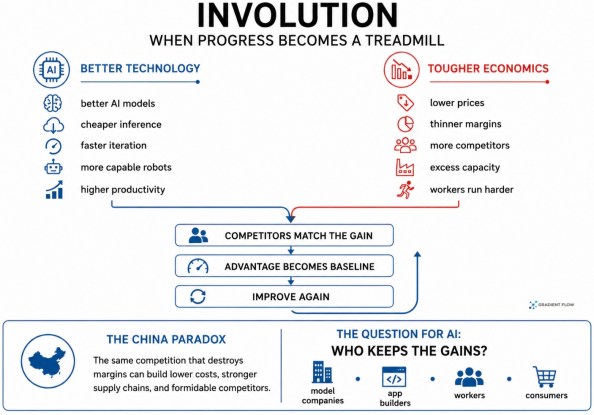

The question I keep coming back to is not whether involution produces progress. It clearly can. The more useful question for AI is who captures the gains. Do better models produce higher profits for model companies? Do they become cheaper inputs for application developers? Do productivity gains show up in wages? Or does higher productivity simply become the new minimum required to compete? That is a useful lens for evaluating China’s AI boom, and probably AI markets elsewhere as well.


