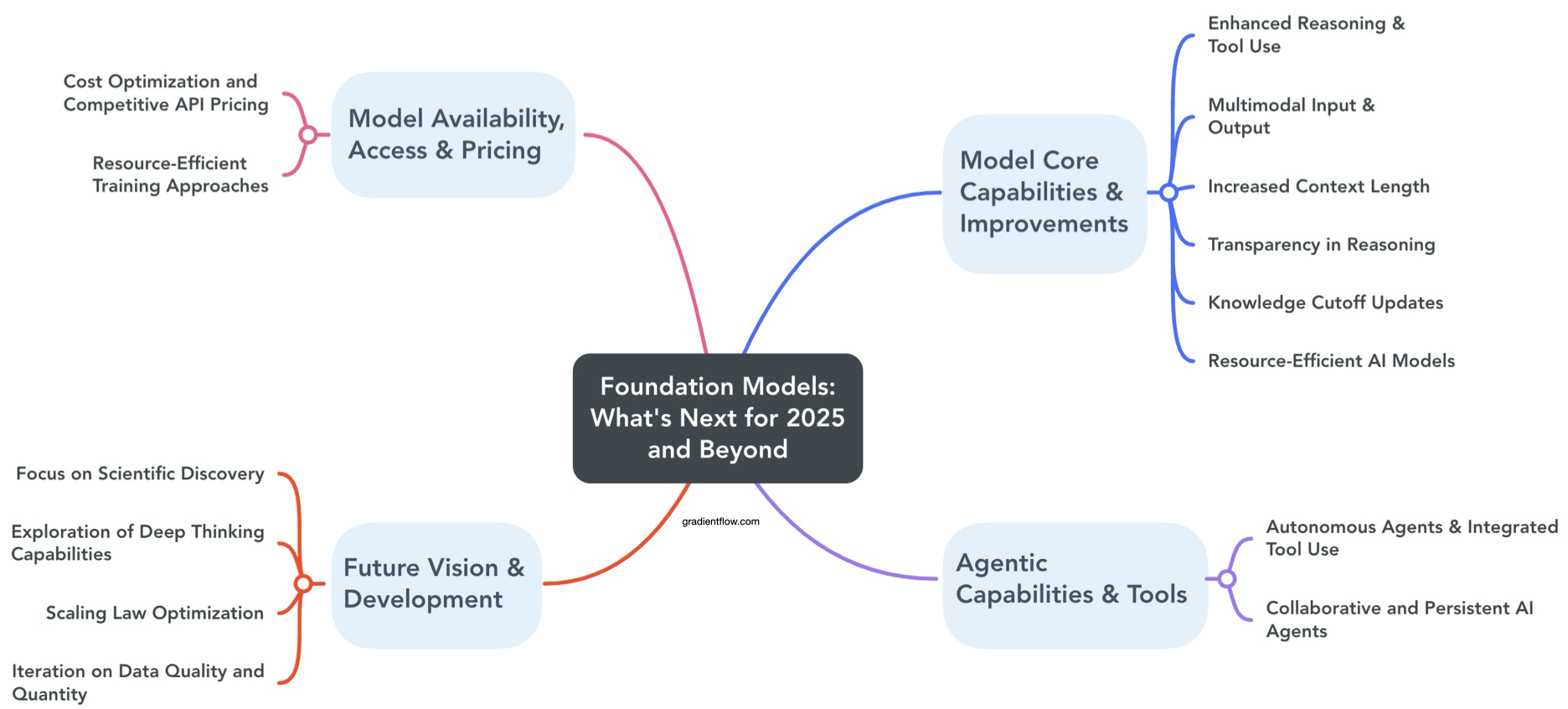
Recent releases from Google (Gemini 2.0 Flash), OpenAI (o1 & o3), and particularly DeepSeek (V3 & R1) have underscored the rapid pace of innovation in the foundation model space. This prompted me to compile a list of developments I’m closely monitoring, especially in the realm of reasoning-enhanced models—a topic I’ve explored in depth recently, including the renewed interest in reinforcement learning. While the selection reflects my personal interests, it also offers a valuable summary of technical innovations and practical enhancements that AI teams building enterprise applications can look forward to, from improved model reasoning and multimodal capabilities to cost-effective deployment strategies and persistent, autonomous agents.
I. Model Core Capabilities & Improvements
Enhanced Reasoning & Tool Use
Foundation Model builders are investing in significantly boosting model capabilities by improved reasoning and by integrating tool use. Models will be able to determine which external tools (e.g., web search, data retrieval, custom tools) to invoke, execute the tool call, and then reprocess the output. This iterative, multi-step process is being designed to handle complex problem-solving tasks.
- Why It Matters: This capability is essential for applications that require more than simple text generation—especially those needing integration with external data sources or dynamic task execution.
Multimodal Input & Output
Future models will natively support multiple modalities—including image generation (with updates to models like DALL‑E), video output (with improvements in visual consistency and lip-syncing), enhanced voice modes (including custom voices), and file attachments (such as PDFs and images) for richer multimedia analysis.
- Why It Matters: This capability is essential for applications that require more than simple text generation—especially those needing integration with external data sources or dynamic task execution.
Increased Context Length
Companies behind the leading models are working on extending the context window so that models can ingest and retain larger amounts of information. This improvement will enhance performance in long conversations and tasks that require broader context awareness.
- Why It Matters: Extended context is critical for applications managing long-form documents, continuous dialogues, and complex multi-turn interactions.
Transparency in Reasoning
Leading AI model builders are exploring methods to expose more of the model’s internal “thought process” (e.g., via “thinking tokens”) to help developers understand decision-making pathways.
- Why It Matters: Greater transparency aids in debugging, performance tuning, and builds trust when integrating AI systems into critical applications.
Knowledge Cutoff Updates
Top AI model developers will maintain a regular release schedule for foundation models. These updates will incorporate more recent knowledge cutoffs and, combined with integrated search, address limitations caused by outdated training data.
- Why It Matters: Real-time applications and systems that require current information will benefit from more up‑to‑date model outputs.
Resource-Efficient AI Models: Advancements in Smaller Models and Architectures
Ongoing efforts are focused on improving the efficiency and accessibility of AI models through two key avenues. First, smaller models like o3-mini and o1-mini are being enhanced with improved tool support, refined agentic frameworks, and optimized cost‑performance trade‑offs. Second, innovative model architectures—such as Mixture‑of‑Experts (MoE) and Multi‑Head Latent Attention (MLA)—are being developed to significantly reduce computational costs and memory usage during inference.
- Why It Matters: These combined advancements make AI solutions more accessible across a wider range of applications. Enhanced smaller models allow AI deployment in environments with limited resources or budget constraints, while resource‑efficient architectures enable the use of larger, more capable models without prohibitive costs. Together, these developments represent promising directions for the future of AI, ensuring both high performance and cost‑effectiveness.


II. Agentic Capabilities & Tools
Autonomous Agents & Integrated Tool Use
AI models are rapidly evolving to interact with external tools and systems, thereby expanding their functional capabilities. This evolution includes the development of autonomous agents that can interact with web browsers, operating systems, and complex applications to drive tasks such as Robotic Process Automation (RPA) and execute end-to-end autonomous workflows. At the same time, reasoning models are being enhanced to integrate and execute a variety of tools—including retrieval systems—as part of their operational processes.
- Why It Matters: These empower AI models to perform complex, multi-step processes and manage tasks on behalf of users, significantly broadening the scope of AI deployment in both enterprise and consumer settings. By integrating with external systems, models can fetch real‑time data, execute dynamic actions beyond static text generation, and automate intricate tasks, ultimately leading to more powerful and versatile AI applications.
Collaborative and Persistent AI Agents
Advances are driving the development of agents that not only communicate collaboratively but also operate persistently in the background. Researchers are exploring methods to enable multiple agents to engage in coordinated conversations—facilitating multi‑agent collaboration in tasks such as customer service, project management, or complex decision‑making. In parallel, efforts are underway to create continuous background agents capable of managing long‑running tasks and periodically checking in with users without constant prompting.
- Why It Matters: By integrating collaborative communication with persistent operation, AI agents can more effectively handle complex, multi‑step workflows and extended tasks. This dual capability enhances overall efficiency and outcome quality, streamlining processes in dynamic environments while reducing the need for continuous user oversight. Together, these advancements pave the way for more robust and autonomous AI applications across a wide range of settings.
III. Model Availability, Access & Pricing
Cost Optimization and Competitive API Pricing
Model providers are actively pursuing strategies to reduce the cost of deploying & using foundation models. This includes optimizing model efficiency and cost‑performance—leading to more price reductions—and offering API access at significantly lower price points, all while maintaining high performance.
- Why It Matters:These combined efforts to cut costs are crucial for broadening the adoption of advanced AI capabilities. Lower operational expenses make high-performance AI accessible to startups and teams with constrained budgets, while competitive API pricing facilitates higher-volume usage and seamless integration across diverse organizations. Ultimately, this enhanced affordability is key to democratizing access to cutting‑edge AI technology.
Resource-Efficient Training Approaches
Novel training methodologies focusing on achieving competitive performance with significantly lower computational resources, including FP8 mixed precision training and optimized pipeline parallelism.
- Why It Matters: Makes advanced model training more accessible to teams with constrained budgets while maintaining high performance. This will also lead to more frequent model updates.

IV. Future Vision & Development
Focus on Scientific Discovery
OpenAI and DeepMind have underscored the importance of accelerating scientific discovery as one of the most significant impacts of AI, influencing both research and product development.
- Why It Matters: A focus on scientific progress can drive breakthroughs that translate into practical, innovative applications across industries.
Exploration of Deep Thinking Capabilities
There is a focus on exploring and iterating on the deep thinking capabilities of models, aiming to enhance their intelligence and problem-solving abilities by expanding their reasoning length and depth.
- Why It Matters: This demonstrates a commitment to improving the model’s ability to handle complex reasoning tasks.
Scaling Law Optimization
Model providers are actively optimizing the complex relationship between model size, training costs, and performance gains. This involves identifying the most efficient paths along the capability curve to ensure that increases in model scale yield proportional improvements without incurring excessive computational costs. Efforts include exploring techniques like parameter-efficient fine-tuning and developing more efficient model architectures.
- Why It Matters: For teams building AI applications, a deep understanding of scaling laws is crucial for making informed decisions about resource allocation and model selection. Optimized scaling enables you to achieve better performance with reduced computational overhead, allowing the deployment of more powerful models within your budget and infrastructure constraints. This leads to more cost-effective model development and deployment strategies.
Iteration on Data Quality and Quantity
Model developers are increasingly emphasizing the critical role of data in driving performance. This involves a continuous process of enhancing both the quality and the volume of training data by exploring additional training signal sources. Techniques such as data augmentation, synthetic data generation, and rigorous dataset curation are being employed to ensure that models are trained on the most relevant and effective information available.
- Why It Matters: For AI teams, a sustained focus on data quality and quantity translates to more reliable and higher-performing models. High-quality, diverse datasets help reduce bias and improve generalization, resulting in robust and effective AI solutions. Additionally, continuous improvements in data strategies enable more impactful model updates, ensuring that performance enhancements are both tangible and sustainable over time.
If you enjoyed this post, please consider supporting our work by leaving a small tip💰 here and inviting your friends and colleagues to subscribe to our newsletter📩

Related Content
- Inference Scaling for Enhanced Reasoning
- Beyond Imitation: How Reinforcement Learning is Reshaping AI Reasoning
- What AI Teams Need to Know for 2025
- DeepSeek: What You Need to Know
- AI Unlocked – Overcoming The Data Bottleneck