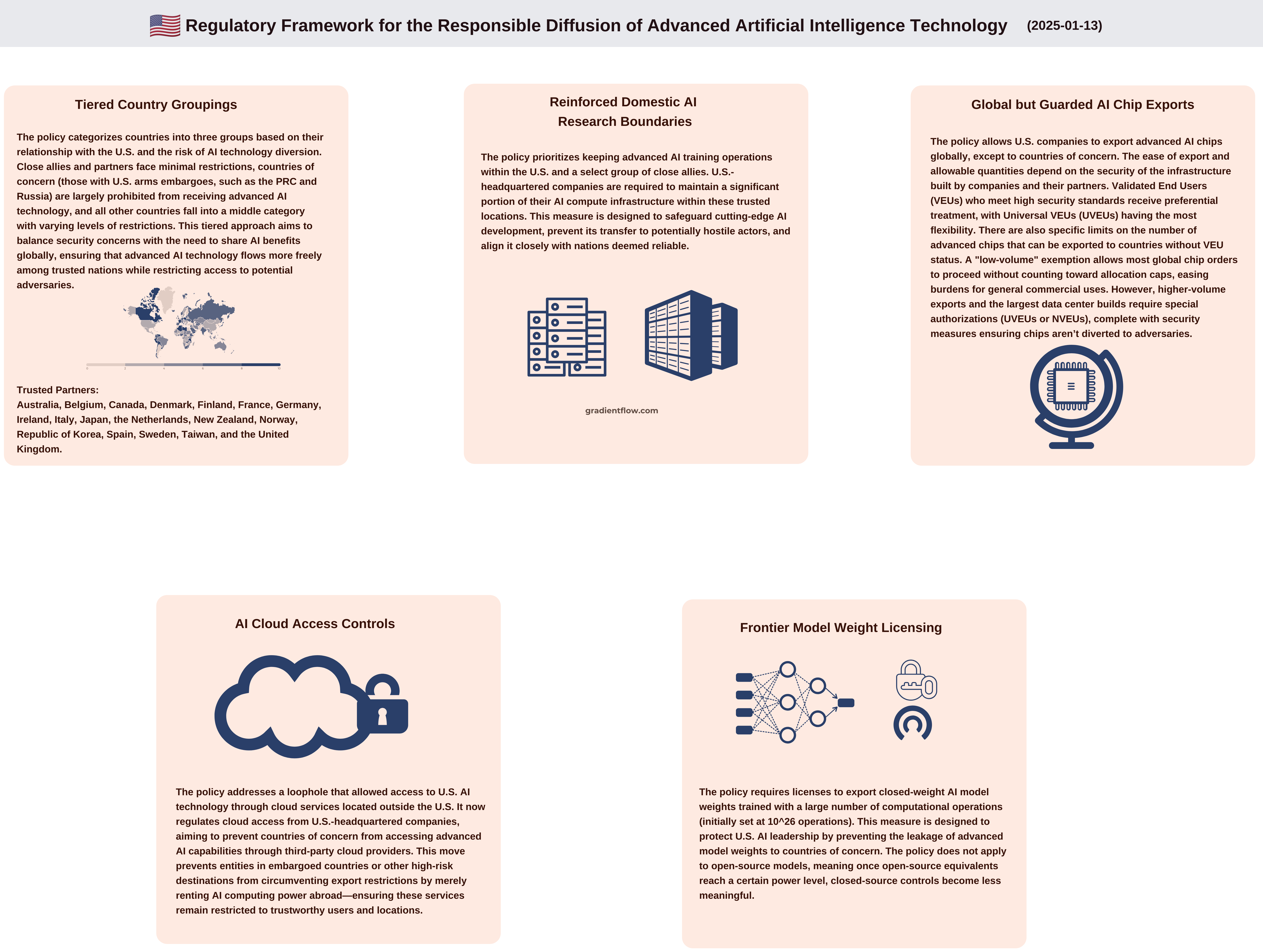
In the wake of the export controls that shook the semiconductor industry, as detailed in our earlier piece, Circuit Breaker: America’s Semiconductor Defense Strategy, the U.S. government has now turned its attention to frontier AI technologies. The Commerce Department’s Bureau of Industry and Security (BIS) has published a comprehensive policy aimed at regulating advanced AI exports, from high-performance chips to state-of-the-art model weights. On one hand, the policy offers American companies clearer channels to tap into global AI markets by reducing certain bureaucratic hurdles. On the other, it imposes stricter measures to limit access by the People’s Republic of China (PRC) and other high-risk entities. This new regulatory framework underscores Washington’s attempt to walk a tightrope between promoting commercial leadership and guarding against the potential misuse of powerful AI tools.


Tiered Country Groupings
Under the new AI export policy, countries are categorized into three groups based on trust and the risk of technology diversion. The “trusted allies” group faces minimal restrictions on AI exports, while “countries of concern” (such as those under U.S. arms embargoes) are effectively barred from receiving advanced AI. All remaining nations fall into a middle category with moderate controls. This tiered scheme aims to balance safeguarding critical AI technologies from adversaries while fostering collaboration with reliable partners. The list of trusted allies omits a few countries who are making a push in AI and/or data centers needed for AI (Israel, UAE, Saudi Arabia, Malaysia, Singapore, among others).
Trusted Allies:
- Australia
- Belgium
- Canada
- Denmark
- Finland
- France
- Germany
- Ireland
- Italy
- Japan
- Netherlands
- New Zealand
- Norway
- Republic of Korea
- Spain
- Sweden
- Taiwan
- United Kingdom
Here are some counterpoints to this tiered system:
- Diplomatic Tensions: Restricting advanced AI to close allies or labeling certain NATO countries “medium risk” can strain relations.
- Alienation and Brain Drain: Tighter controls might deter international collaboration and push talented researchers out of the U.S. sphere. OTOH, with the right immigration and deregulation policies the U.S. can become a magnet for foreign talent.
Reinforced Domestic AI Research Boundaries
To protect cutting-edge AI capabilities, the policy encourages—or requires—U.S.-headquartered companies to keep their most sophisticated AI training operations within the United States or among a small set of close allies. By anchoring advanced compute infrastructure domestically and in trusted nations, the U.S. aims to mitigate the risk of sensitive AI developments being transferred to hostile entities.
Global but Guarded AI Chip Exports
Advanced AI chips may be exported worldwide (excluding countries of concern) under a controlled framework. Companies can ship limited quantities more freely if they have secure, validated infrastructure (e.g., Validated End Users, or VEUs). Larger data center builds, higher-volume exports, or shipments to less-trusted entities often require more rigorous licensing (UVEUs, NVEUs). This ensures broad commercial availability while preventing potential adversaries from stockpiling cutting-edge AI hardware.

AI Cloud Access Controls
Recognizing that adversaries might rent access to AI compute power abroad, the policy closes loopholes in cloud-based AI services. U.S.-headquartered providers must now ensure that entities from embargoed or high-risk countries cannot simply bypass hardware export restrictions by using overseas cloud resources. This helps preserve U.S. oversight of advanced AI capabilities, wherever those services might be physically located.
- Renting US GPUs: Potentially, foreign actors could just rent compute from U.S. providers, circumventing the regulation.
- KYC for Cloud: Government moves toward “Know Your Customer” for cloud resources to identify suspicious usage.
Frontier Model Weight Licensing
Large-scale, closed-weight AI models trained beyond a significant computational threshold (initially around 10^26 operations) now require export licenses. This measure is designed to prevent cutting-edge model architectures and their weights from being transferred to adversaries. Because access to the weights eliminates the need to train from scratch, it drastically reduces reliance on state-of-the-art GPU clusters, making them a critical lever of AI capabilities. Open-source (and open weights) models remain exempt under these new policies. This reflects the understanding that if similarly capable open models appear, curbs on proprietary weights may lose much of its impact, prompting a reevaluation of the regulations.
- Future Algorithmic Efficiency: Rapid improvements in model architectures (e.g., more parameter-efficient approaches) may make the threshold obsolete or too high/low.
- Encouraging Efficiency: Having a cap might motivate researchers to innovate with fewer resources (e.g., quantization, model compression, more efficient training).
- Historical Parallels: The PGP (Pretty Good Privacy) case from the 1990s, where crypto export restrictions led to creative workarounds like publishing source code in books.
- Tension with Open Science: Many cutting-edge AI innovations come from open-source communities; restricting exports may hamper collaborative progress.
- Cybersecurity Gaps: Preventing theft or hacking of large model repositories remains a weak point.
If you enjoyed this post, please consider supporting our work by leaving a small tip here and inviting your friends and colleagues to subscribe to our newsletter: