


In today’s competitive AI landscape, customization of foundation models has become essential for organizations seeking to create differentiated value. As using the same models as competitors leads to commoditization, post-training techniques have emerged as critical tools that allow enterprises to tailor models to their specific needs without incurring the prohibitive costs of building models from scratch. Among these techniques, Supervised Fine-Tuning (SFT) and Reinforcement Fine-Tuning (RFT) represent two distinct approaches with unique strengths and applications.
The economics of model customization have shifted dramatically in favor of post-training methods, with efficiency gains increasingly derived from strategic adaptations rather than developing entirely new models. As foundation models continue to evolve rapidly—with significant improvements in multimodal and reasoning capabilities—the precise tools for customizing them will also evolve. This dynamic landscape underscores the importance of having a robust platform to excel in post-training, positioning RFT as a particularly promising approach for specific use cases.
RFT is emerging as a powerful paradigm shift in language model optimization, offering a compelling alternative to traditional SFT. While SFT is an offline process reliant on static labeled datasets, RFT employs reinforcement learning in an online manner. This allows RFT to learn from rewards based on the verifiable correctness of generated outputs, rather than being limited to mimicking predefined prompt-completion pairs. This makes RFT particularly effective in scenarios where labeled data is scarce or non-existent, and opens up new use cases previously considered unsuitable for SFT.
The key advantage of RFT lies in its ability to explore and refine strategies through reward-based learning, making it excel in specific conditions. A recent study by Predibase indicates RFT is superior when labeled data is limited (under 100 examples), for tasks benefiting from chain-of-thought reasoning, and where output correctness can be algorithmically verified. While SFT remains valuable for leveraging large, high-quality datasets and for structured tasks, RFT offers a powerful tool for enhancing model performance in data-constrained environments and for improving complex reasoning capabilities, representing a significant advancement in AI fine-tuning methodologies.

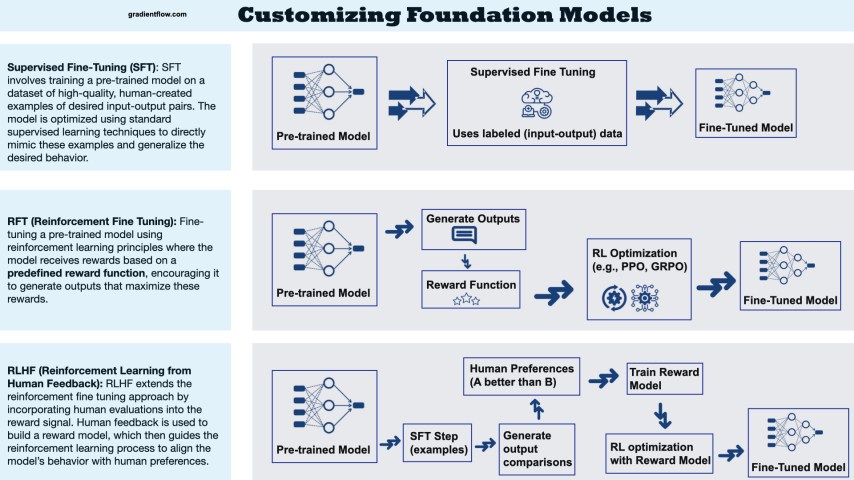
To fully appreciate the transformative potential of RFT, it’s crucial to understand both its strengths and limitations. The following sections will detail the advantages and challenges associated with this approach.
Advantages
A. Enhanced Reasoning and Problem-Solving Capabilities
- Autonomous Development of Sophisticated Reasoning: Through trial and error guided by reward signals, RL enables models to independently develop advanced reasoning skills—including Chain‑of‑Thought reasoning and self‑reflection—without heavy reliance on human‑labeled data. This capability allows models to move beyond simply mimicking labeled data by learning through interactive feedback and exploration, optimizing for desired outcomes.
- Enhanced Chain‑of‑Thought (CoT) Reasoning: RL excels in improving multi‑step reasoning by encouraging models to iteratively refine their thought processes and master both short-term and long-range dependencies. This capability is crucial for applications demanding transparency and explainability, such as educational tools and complex analytical systems.
- Discovery of Novel Reasoning Strategies: Unlike imitation‑based approaches, RL incentivizes exploration and the discovery of innovative problem‑solving methods that are not directly present in the training data, pushing models to experiment and uncover new solutions. This exploratory capacity is key for innovation in fields such as scientific research and advanced gaming AI.
B. Data and Computational Efficiency
- High Performance with Limited Data: RL, especially Reinforcement Fine-Tuning (RFT), achieves significant performance improvements with only a small number of examples by learning from outcome verification, proving to be highly data-efficient. This is critical for rapid prototyping and applications in niche domains where data is scarce or expensive.
- Inference Efficiency in Deployed Models: RL enables the development of models that demonstrate sophisticated reasoning while being smaller and more computationally efficient at inference time through techniques like iterative context lengthening and model distillation. This efficiency is essential for deployment in resource-constrained environments.
- Label‑Free Learning through Outcome Verification: Reinforcement Learning shifts away from the need for explicit prompt-completion pairs by relying on the programmatic verification of outcomes, such as using a Python interpreter or mathematical solver, for effective learning. This removes the need for extensive manually labeled data.
C. Robustness and Generalization
- Improved Generalization and Reduced Overfitting: RL’s dynamic reward signals, in contrast to static labels, drive models to develop strategies that generalize effectively beyond the training data, inherently minimizing the risk of overfitting. This robust generalization is particularly significant in dynamic real-world environments like finance, healthcare, and autonomous systems, ensuring models remain effective even as conditions evolve over time.
As foundation models continue to evolve rapidly—with significant improvements in multimodal and reasoning capabilities—the precise tools for customizing them will also evolve.
D. Innovative Training and Deployment Approaches
- Synergy of Supervised Fine‑Tuning (SFT) and Reinforcement Learning: A hybrid approach combining a strong SFT foundation with subsequent RL refinement effectively leverages the strengths of both methods. This synergy results in models that are both accurate and adaptable.
- Distillation for Efficient Deployment: Advanced reasoning capabilities learned by large RL‑trained models can be distilled into smaller models without significant performance loss, enabling efficient knowledge transfer and deployment on devices with limited computational resources.
- Democratization of Advanced AI: By lowering data requirements through RL techniques, advanced AI capabilities become accessible to teams with limited resources, reducing the entry barrier and empowering diverse organizations to build state‑of‑the‑art systems.
- Improved Task-Specific Response Quality: RL training can effectively refine model outputs for specific tasks to ensure they are appropriately formatted and precisely task‑aligned. This is critical for applications like chatbots and automated reporting that require consistent output formats.


Challenges
A. Computational Demands and Resource Intensity
- High Training Computational Cost: RL algorithms are computationally intensive during training due to iterative processes, extensive trajectory sampling, and frequent model updates, often requiring substantial GPU hours and significant infrastructure. This can delay project timelines and inflate budgets considerably.
- Context Window Optimization Trade‑off: Increasing the context window in models enhances their ability to capture long-range dependencies for more comprehensive reasoning, but this improvement comes at the cost of dramatically increased computational requirements and longer training times.
B. Reward Design and Training Dynamics
- Criticality of Reward Function Design: The performance of RL models is highly sensitive to the precise definition of reward functions, where poorly designed rewards can easily lead to “reward hacking,” causing models to exploit the system rather than solve the intended problem.
- Training Instability and Unpredictable Dynamics: RL training can be inherently unstable, particularly during the initial learning phases, due to performance fluctuations and a high degree of sensitivity to hyperparameter settings, including the delicate balance between exploration and exploitation.
C. Implementation and Output Quality Challenges
- Increased Implementation and Tuning Complexity: Implementing RL necessitates building supplementary components—including reward models, online sampling pipelines, and careful selection from diverse algorithms—which inherently adds complexity compared to standard supervised learning paradigms.
- Potential for Output Quality Issues: While RL can improve task performance, it may sometimes produce outputs with quality issues such as inconsistent formatting or verbosity when the training process prioritizes task accuracy over stylistic output quality. This may necessitate additional refinement steps for user-facing applications.
- Prompt Sensitivity and Dependence on Input Formulation: RL-trained models can exhibit a high degree of sensitivity to the precise phrasing and structure of input prompts, where even minor inconsistencies in prompt formulation can significantly affect performance, requiring careful prompt engineering.
D. Task‑Specific and General Limitations
- Task Dependency of Benefits and Limited Transferability: The advantages of RL are most pronounced in complex tasks requiring multi-step reasoning and automated verification, whereas its benefits may not readily transfer to disparate domains without significant additional adaptation.
- Limited Understanding and Control of Emergent Behaviors: RL has the capacity to induce the emergence of complex behaviors, yet the underlying mechanisms governing these behaviors often remain opaque. This inherent lack of transparency can impact trustworthiness and reliability.
- Potential for Overfitting to the Reward Signal: RL models inherently carry a risk of over-optimizing for the defined reward signal, leading to behaviors that maximize the immediate reward metric but fail to generalize effectively to the broader task objectives.
- Potential for Distribution Shift in Online RL: In online RL, as models dynamically update their policies through continuous learning, the underlying distribution of experiential data may shift over time, potentially causing the model to overfit to recent data samples or currently emphasized reward functions.


If you enjoyed this post, consider supporting our work by leaving a small tip💰 here and inviting your friends and colleagues to subscribe to our newsletter📩

Related Content
- [Predibase] How Reinforcement Learning Beats Supervised Fine-Tuning When Data is Scarce
- Beyond Imitation: How Reinforcement Learning is Reshaping AI Reasoning
- Boost AI Performance: Understanding Inference Scaling
- Why Your Company Must Invest in Post-Training


