

In my conversations with developers and AI teams, I’m struck by how many are exploring moving more of their inference workloads to open models. I’ve touched on some of their reasons before , but here I want to look further ahead. I’ll admit my bias toward open source. I was around during the dot-com era and watched Linux displace Solaris, and open-source databases challenge commercial products like Oracle. I suspect we’re going to see something similar with AI models.
Subscribe to our weekly newsletter

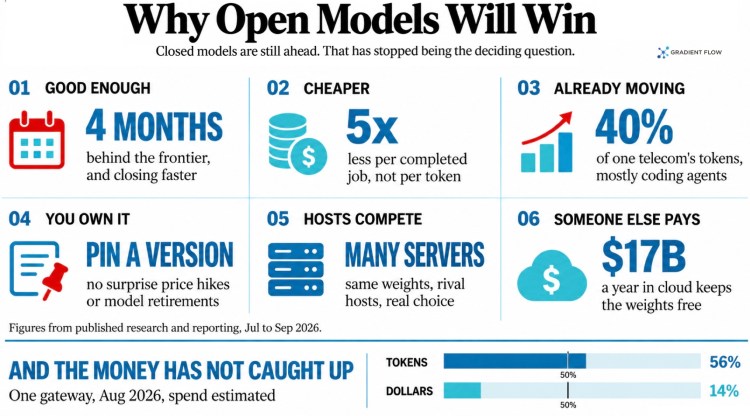
- Open models don’t need to be the best. They just need to be good enough. Proprietary models still lead on difficult tasks, but open models are catching up faster . The performance gap is now estimated at around four months, and that advantage matters less when a cheaper model can already do the job.
- The economics become hard to ignore at scale. One comparison found an open model delivering nearly the same performance as two Anthropic models at roughly one-fifth the cost per completed task. Those savings add up quickly when companies are running billions of tokens through their applications and agents.
- The shift is already happening in production. Open models handled 56% of tokens through Vercel’s AI Gateway in August, up from 7% in December, while accounting for just 14% of estimated spending. Companies are learning to send routine work to cheaper models and reserve expensive frontier models for harder tasks.
- Companies want control over critical infrastructure. Open weights let teams choose where their models run, customize them for specific tasks, and keep validated versions in production. They also reduce dependence on proprietary providers that can change prices, retire models, or move into their customers’ businesses .
- Competition extends beyond the models themselves. Once weights are available, multiple providers can run the same model and compete on price, speed, and reliability. Shared inference software makes this increasingly practical across different hardware, pushing inference toward commodity pricing.
- The open ecosystem has powerful economic incentives. Cloud providers, chipmakers, and application companies all benefit when capable models become widely available. They can make money from infrastructure and services rather than the model weights themselves, giving them reasons to keep investing in open models.

Of course, I could be wrong. Perhaps open models turn out to be Android and closed frontier models become iOS, with open models capturing most usage while proprietary providers capture most of the profits. Closed models could also maintain a meaningful advantage on difficult tasks, particularly if their integrated products remain easier to deploy and manage. Open models still face challenges around tooling, licensing, and the cost of running them.
Still, my bet is that AI models will become too important to leave entirely in the hands of a few proprietary providers. Companies will increasingly want the freedom to run, modify, and control the models they depend on. When all is said and done, I think open models will prevail, much as open source has in other critical layers of computing.


