Foundation Models and the AI Arms Race: Winners, Losers, and Strategic Pivots
The landscape of Large Language Models (LLMs) is rapidly evolving, with recent developments catalyzing significant shifts across the industry. Meta’s unveiling of Llama 3.1 405B, the world’s largest “open weights” foundation model, underscores a continued commitment to democratizing access to cutting-edge AI. This move directly contrasts with OpenAI’s current predicament, as the company grapples with a billion-dollar dilemma, balancing rapid innovation with the soaring costs of operating and scaling their models.
And there’s more! Character.AI co-founders Noam Shazeer and Daniel De Freitas are heading back to Google, and there’s a new licensing deal between the two companies that has everyone talking. This strategic move signals a shift in Character.AI’s direction, mirroring broader trends of consolidation and strategic pivots within the AI industry. In this article, I’ll explore these developments, examining their implications for the future of foundation models and the AI landscape as a whole.


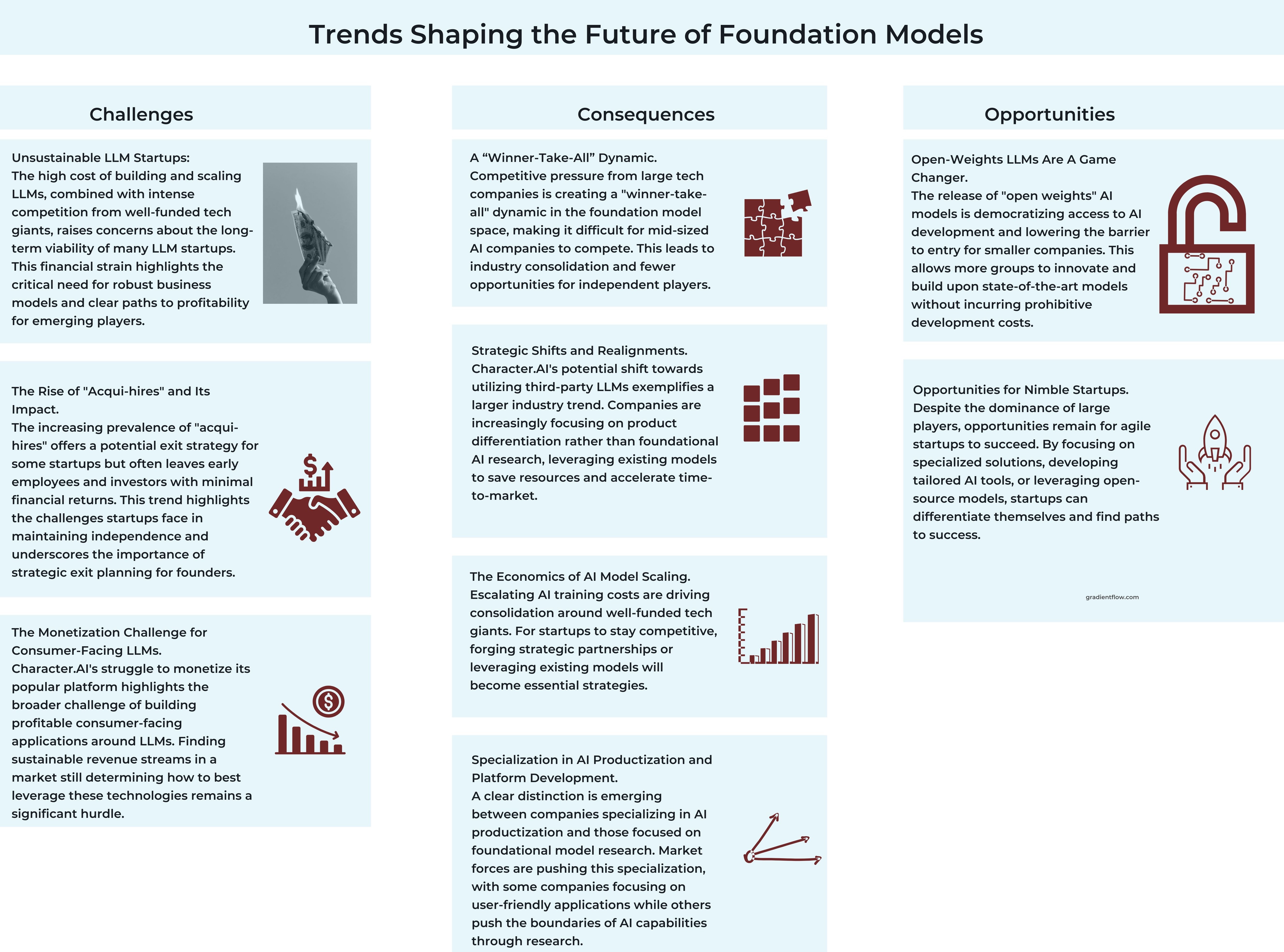
The landscape of companies and teams driving foundation model development is rapidly evolving. As these technologies advance, they are reshaping the competitive dynamics and strategic directions across the sector. Below, I outline the key trends defining the future of AI and the foundation model ecosystem:
- Unsustainable Business Models for Many LLM Startups. Building and scaling LLMs demands significant capital expenditure for training and infrastructure. This factor, coupled with intense competition from well-funded tech giants like Google and Meta, raises concerns about the long-term viability of many LLM-focused startups. I’m seeing a growing divide between those who can sustain these financial burdens and those who cannot, which emphasizes the critical need for robust business models and clear paths to profitability for emerging players.
- The Rise of “Acqui-hires” and Its Impact. The increasing prevalence of “acqui-hires,” where larger companies acquire startups primarily for their talented workforce, is a double-edged sword. While it offers a potential exit strategy for some startups, it often leaves early employees and investors with minimal financial returns.
- The Monetization Challenge for Consumer-Facing LLMs. Character.AI’s struggle to effectively monetize its platform, despite its popularity, exposes a broader challenge – building profitable consumer-facing applications around LLMs. I believe that finding sustainable revenue streams in a market still grappling with how to best leverage and capitalize on these powerful technologies remains a significant hurdle.
- A “Winner-Take-All” Dynamic. The competitive pressure from large tech companies is creating a “winner-take-all” dynamic in the foundation model space. This environment makes it increasingly difficult for mid-sized AI companies to compete, leading to industry consolidation and fewer opportunities for independent players to thrive.
- Strategic Shifts and Realignments. Character.AI’s potential shift away from developing its own foundation models towards utilizing third-party LLMs exemplifies a larger strategic realignment within the industry. Companies are increasingly choosing to focus on product differentiation rather than bearing the cost and complexity of foundational AI research. This trend involves leveraging existing, often open-source, models to save on resources and accelerate time-to-market.
- The Economics of AI Model Scaling. The escalating costs tied to training advanced AI models are inevitably driving consolidation around tech giants with the necessary capital and infrastructure. For many startups, I believe that forging strategic partnerships or effectively leveraging existing models will become essential strategies for staying competitive.
- Specialization in AI Productization and Model Development. A clear distinction is emerging between companies specializing in AI productization and those dedicated to foundational model research. Market forces are pushing companies to specialize – some focusing on developing user-friendly consumer and enterprise applications, while others double down on pushing the boundaries of AI capabilities through fundamental research.
- Open-Weights LLMs Are A Game Changer. The release of “open weights” AI models by companies like Meta is democratizing access to AI development. This movement significantly lowers the barrier to entry, enabling smaller companies and research groups to innovate and build upon state-of-the-art models without incurring the prohibitive costs of development from scratch.
- Opportunities for Nimble Startups. Despite the dominance of large players, opportunities still exist for agile startups to carve out niches and disrupt the market. By focusing on specialized solutions for underserved markets, developing tailored AI-powered tools, or leveraging the power of “open weights” models to create unique products, startups can differentiate themselves and find their paths to success.
The foundation model landscape is in flux, shaped by both technological advancements and evolving business strategies. Those who can adapt to this dynamic environment—by embracing “open weights” models, finding innovative monetization strategies, or focusing on niche markets—will be best positioned for success. The future of AI development will be defined not just by building the biggest and most powerful models but by strategically navigating an increasingly complex and competitive landscape.
Related Content
- The Financial Tightrope: OpenAI’s Struggle for Sustainability
- Llama 3.1: Pioneering Open-Weights AI and its Implications
- The Highs and Lows of Generative AI