


The growth of generative AI is driving demand for AI Engineers across industries as organizations race to leverage this transformative technology. While this role isn’t entirely new, its scope and responsibilities are evolving rapidly with advancements like Large Language Models (LLMs) and other generative AI tools. To understand what this position means today from the demand side, I recently examined job postings worldwide to see what employers are actually seeking, looking beyond traditional definitions to explore how the role is being shaped by current market trends.
Clear patterns emerged in how companies plan to leverage AI Engineering talent. Organizations are seeking professionals to develop and fine-tune LLMs for domain-specific applications, from enhancing financial compliance to building medical diagnosis tools. They’re integrating these models into production systems, emphasizing performance optimization, cost management, and scalability. Rather than focusing on fundamental research, there’s a strong emphasis on practical applications and the seamless integration of AI models into scalable, production-ready systems that deliver real business value.


The technical requirements for AI Engineers reflect a comprehensive stack spanning multiple domains. Python dominates as the primary programming language, with 65% of job postings requiring it, while Java and C++ follow as distant but important secondary languages. For AI frameworks, PyTorch leads the field, followed closely by TensorFlow, with newer tools like LangChain and LlamaIndex also appearing in job requirements. Cloud expertise is crucial, with major platforms AWS, Microsoft Azure, and Google Cloud all showing strong demand. DevOps skills, particularly Docker and Kubernetes, are frequently required for deployment and scaling. Ray is beginning to gain attention for its ability to unify infrastructure and optimize compute resources across AI workloads, potentially offering significant benefits as organizations scale their AI operations. Data management skills round out the technical requirements, with vector databases and SQL being particularly sought after, reflecting the growing importance of efficient data handling in AI systems.
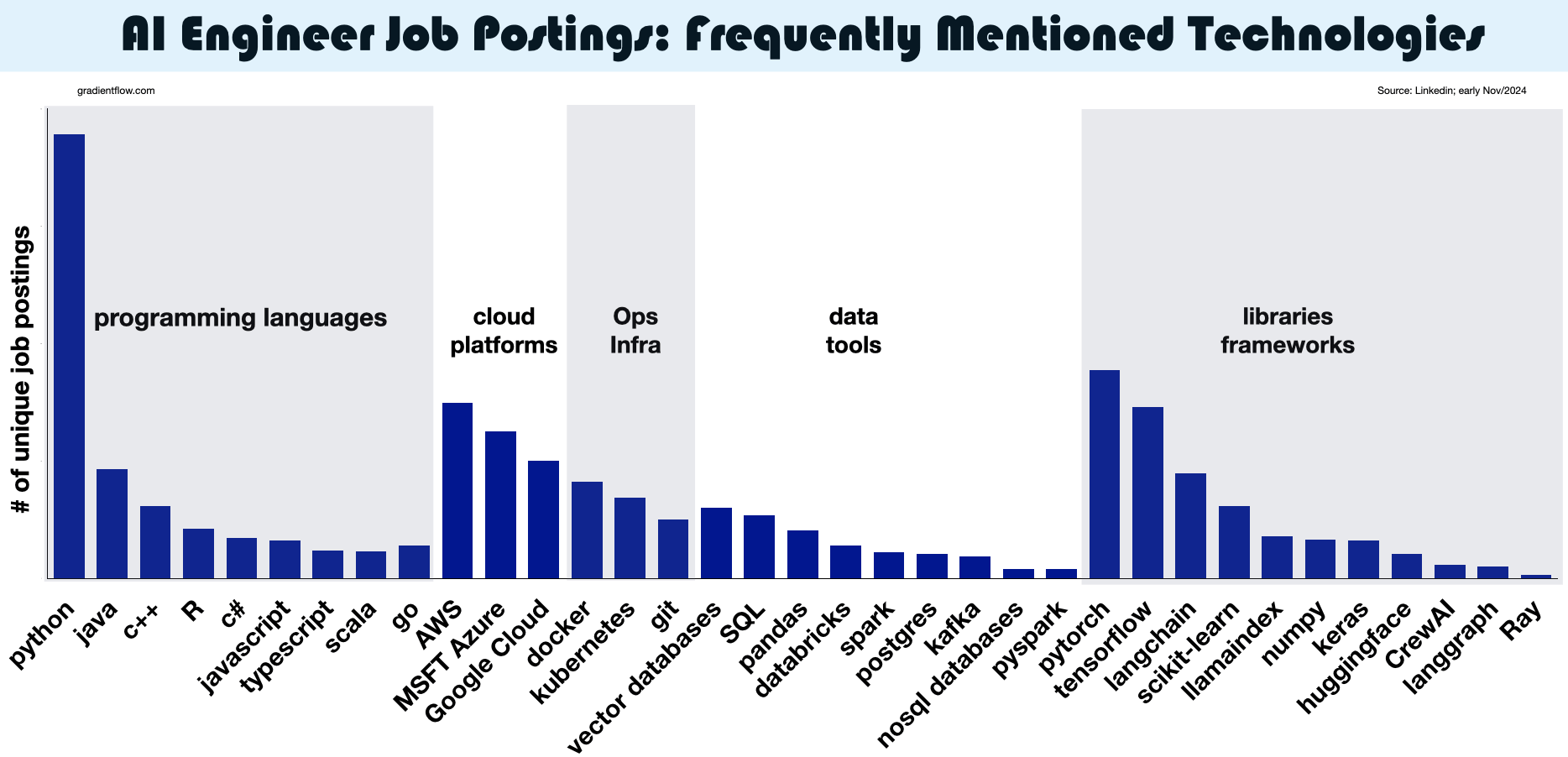

Job postings for AI Engineers reveal a strong demand for professionals who blend foundational AI expertise with cutting-edge skills. Core competencies in machine learning, natural language processing, and deep learning remain essential, underscoring their continued importance. There’s a notable emphasis on emerging areas like LLMs, retrieval-augmented generation, vector databases, prompt engineering, and Agentic AI, reflecting the shift toward generative AI technologies. Post-training processes like fine-tuning are increasingly important, with most teams focusing on refining pre-trained models rather than building from scratch. Proficiency in software engineering practices, including MLOps, CI/CD pipelines, and model inference/deployment, is also highly valued. Additionally, skills in data engineering and building robust data pipelines are important for managing the data essential to AI applications. This highlights the need for engineers who can seamlessly integrate AI models into scalable, production-ready systems.


The Modern AI Engineer: Role, Skills, and Responsibilities
Drawing from recent job postings and market trends, the modern AI Engineer is a diverse role that merges deep technical skills with business insight. While individual companies may emphasize different aspects, the key responsibilities typically include:
Technical Expertise:
- Developing, Fine-Tuning, Post-training frontier models: Crafting, optimizing, and customizing frontier models for domain-specific applications, with emphasis on performance, cost efficiency, and business value
- Applying Emerging AI Techniques: Implementing advanced methods like retrieval-augmented generation (RAG), prompt engineering, Agentic AI, and other specialized solutions to enhance AI capabilities.
- Managing AI Infrastructure and Operations (MLOps/LLMOps): Overseeing the complete deployment lifecycle, including CI/CD pipelines, monitoring, and cloud resource management
- Data Engineering Excellence: Developing robust data pipelines, implementing efficient data storage solutions, and ensuring high-quality data processing
Production and Integration:
- Architecting Scalable Solutions: Designing end-to-end AI system architectures that ensure maintainability and scalability
- Cloud Platform Expertise: Proficiency in major cloud platforms (AWS, Azure, Google Cloud) and associated AI services
- DevOps Integration: Mastery of containerization (Docker) and orchestration (Kubernetes) for production deployment
- Performance Optimization: Implementing cost-effective solutions while maintaining high performance standards
Domain Expertise:
- Industry-Specific Applications: Developing specialized AI solutions for sectors like finance, healthcare, and telecommunications
- Document Intelligence: Building systems for processing and analyzing complex document types
- Compliance and Ethics: Ensuring AI solutions meet regulatory requirements and ethical standards


Business Integration:
- Stakeholder Collaboration: Working effectively with cross-functional teams to align technical solutions with business objectives
- Technical Leadership: Providing guidance on AI strategy and implementation
- Solution Consulting: Translating business requirements into technical specifications and viable AI solutions
- Pre-sales Support: Contributing to technical discussions and solution planning in client engagements
Professional Development:
- Continuous Learning: Staying current with rapid advancements in AI technology and research
- Technical Communication: Effectively explaining complex concepts to both technical and non-technical audiences
- Innovation Leadership: Driving adoption of new AI technologies and best practices
- Community Engagement: Participating in knowledge sharing and professional development activities
The modern AI Engineer is not just a specialist in AI technologies but also a pivotal player in transforming AI research into tangible business outcomes. This position is evolving beyond technical responsibilities into a strategic function essential for any organization looking to thrive in an AI-driven future.
As mentioned in the introduction, many companies are actively hiring AI Engineers and developing this role within their organizations. If you haven’t yet considered integrating AI Engineers into your team, now might be the time to do so—because your competitors probably already are.
Related Content
- Why Your Company Must Invest in Post-Training
- How Tech-Forward Organizations Build Custom AI Platforms: A Feature Breakdown
- Why Digital-First Companies Are Building Their Own AI Platforms
- Why Your Generative AI Projects Are Failing
- Agentic AI: Challenges and Opportunities
- What is an AI Alignment Platform?
If you enjoyed this post please support our work by encouraging your friends and colleagues to subscribe to our newsletter:


