A Silver-Medal Performance in the Mathematical Olympiad
DeepMind’s AI systems, AlphaProof and AlphaGeometry 2, recently reached near-human proficiency in solving complex mathematical problems under International Mathematical Olympiad (IMO) competition conditions. This milestone marks a significant step forward in the realm of artificial intelligence and its application to advanced problem-solving.
AlphaProof and AlphaGeometry 2 exhibited distinct yet complementary strengths. AlphaProof demonstrated its prowess by conquering two algebra problems, one number theory problem, and remarkably, the most challenging problem of the Olympiad – a feat achieved by only five human participants. Meanwhile, AlphaGeometry 2 blazed through the geometry problem in a mere 19 seconds, highlighting its exceptional speed and efficiency.
While the AI systems’ performance was impressive, it wasn’t without its limitations. The two combinatorics problems remained unsolved, exposing areas where AI still grapples with mathematical complexity. However, the speed at which some problems were solved – ranging from minutes to three days – underscores the potential of AI for rapid problem-solving, even as it continues to evolve in tackling more intricate challenges.


The advancements in AlphaGeometry 2 are particularly noteworthy. This iteration boasts an impressive 83% success rate in solving historical IMO geometry problems from the past 25 years, a significant leap from its predecessor’s 53%. This improvement stems from a faster symbolic engine and training on a larger synthetic dataset. Furthermore, AlphaProof not only solved problems but also provided formal proofs of correctness using the Lean mathematical language, directly addressing concerns about potential errors or “hallucinations” in AI-generated proofs.
The Path to Mathematical Mastery
AlphaProof was trained by proving or disproving millions of problems of varying difficulties and topics over several weeks. This training continued even during the contest, with the AI reinforcing proofs of self-generated variations of the contest problems.
To enable the AI systems to understand and solve the problems, manual translation into formal mathematical language was necessary. This step highlights a current limitation in AI’s ability to interpret natural language mathematical problems directly. The solutions were then meticulously scored according to IMO’s point-awarding rules by prominent mathematicians, ensuring accuracy and credibility in the evaluation process.
Translating math problems for AI highlights a key limitation
It’s worth noting that an experimental system built upon Gemini was also employed, showcasing advanced problem-solving skills without the need for formal language translation, indicating future potential for more natural language-based AI problem-solving.
Math-Assisted Proofs: A New Era of Collaboration
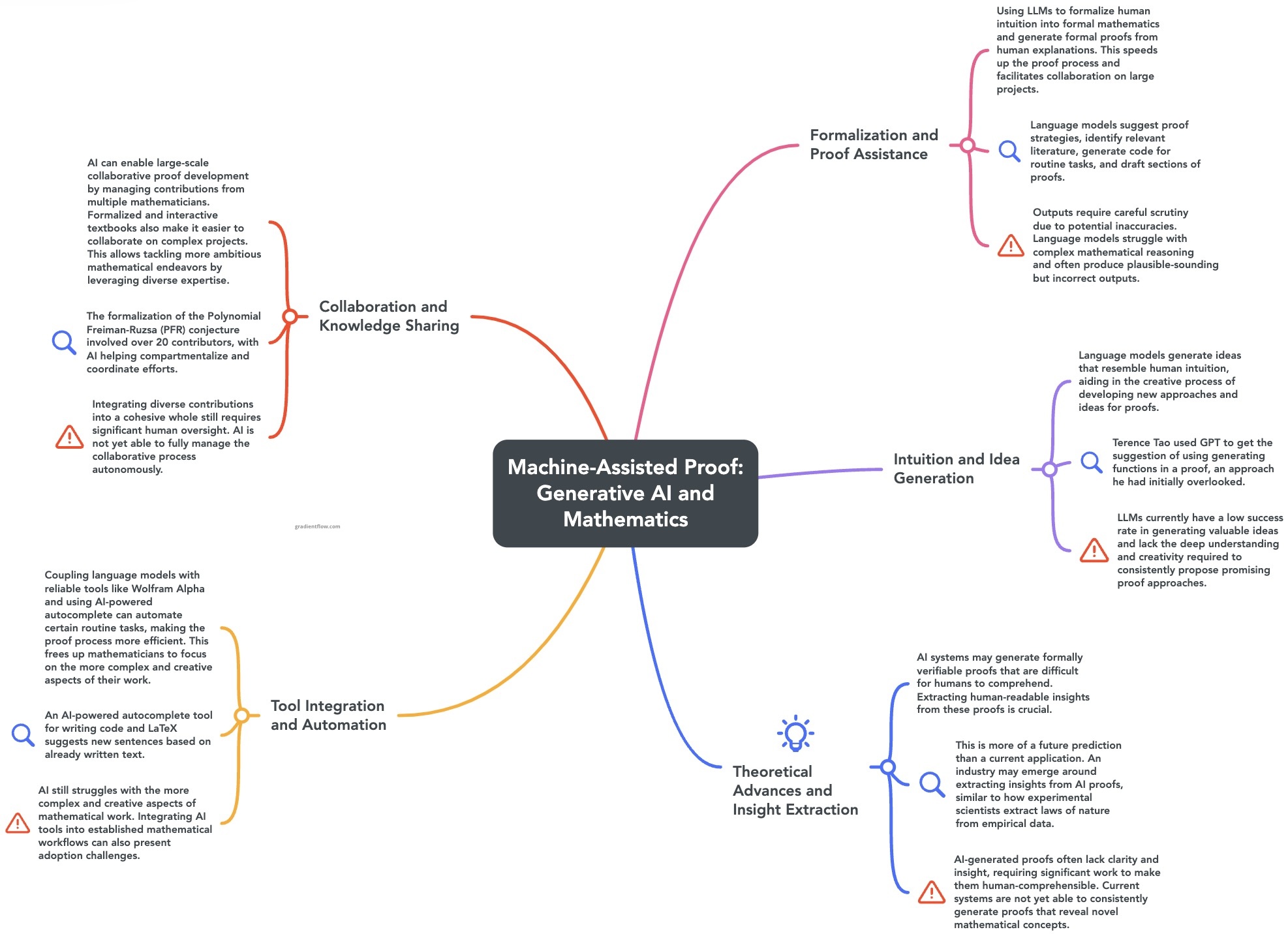
In a previous article, I discussed the impact of AI on mathematics, focusing on the concept of “Machine-Assisted Proof” and how AI tools can assist mathematicians in the proof process. The new findings from AlphaProof and AlphaGeometry 2 provide concrete evidence of the potential discussed in the previous article, validating the excitement and potential described in the broader context of AI in mathematics:
- Proof Assistants. The use of Lean for formal verification aligns with the previous article’s emphasis on proof assistants.
- AI Capabilities. The new findings validate the previous article’s optimism about AI’s potential to revolutionize mathematics.
- Division of Labor. The new findings demonstrate a division of labor, with AI systems handling complex problem-solving while human experts verify and interpret the results.
- Formalization of Mathematics. The use of formal language translation aligns with the previous article’s emphasis on formalizing mathematical knowledge for machine understanding.
- AI-Generated Proofs. The formal verification in Lean addresses concerns about AI hallucinating proofs, ensuring the correctness of the AI-generated proofs.
- Specialization. The results show strengths in certain areas (algebra, geometry) and weaknesses in others (combinatorics), aligning with the previous article’s point about varying ease of encoding different mathematical fields.


Closing Thoughts: Implications and Challenges
While AlphaProof and AlphaGeometry 2 represent significant advancements in AI applications for mathematics, their development and performance offer valuable insights applicable to AI progress across various domains. These systems highlight several key challenges and opportunities:
- Solving Complex Reasoning Tasks. The achievement of AlphaProof in solving challenging IMO problems demonstrates AI’s ability to handle complex reasoning tasks at a level comparable to top human students. This development showcases the potential of AI to tackle cognitive tasks previously thought to require human-level intelligence, encouraging further research and application in various domains.
- Combination of AI Techniques. AlphaProof’s approach integrates multiple AI techniques, including reinforcement learning, neural networks, and formal theorem proving. This highlights the power of integrating diverse techniques to tackle challenging problems, and should inspire AI teams to explore hybrid approaches.
- Environmental Impact. There are valid concerns about the energy consumption and potential environmental impact of training and running computationally intensive AI models like AlphaProof. The lack of transparency regarding these metrics is a point of contention that needs addressing.
- Formalization Challenges. The difficulty of automatically translating informal mathematical problems into formal representations understandable by AI systems remains a significant bottleneck in the problem-solving pipeline. Developing robust formalization techniques is crucial for bridging the gap between human-understandable problems and AI-solvable tasks.
- Limited Understanding of AI Methods. The lack of transparency into AlphaProof’s inner workings, such as its reasoning processes and decision-making paths, is a concern. Understanding the underlying methods of AI systems is crucial for trust, improvement, and successful application in real-world scenarios.
As AI continues to evolve, its role in mathematics will undoubtedly expand, offering new tools and methods to solve problems once thought insurmountable. While celebrating this remarkable achievement in AI-assisted mathematics, we must also remain cognizant of the challenges described above and work towards addressing them. The future of mathematics will be a collaborative effort between human intuition and machine precision.
Related Content
- Lessons From The AI Revolution in Mathematics
- Lessons from the ‘Noisy Factors’ Study
- Financial Machine Learning
- The Financial Services Sector’s March into Generative AI
- Generative AI’s Impact on Healthcare
- 2024 Generative AI in Healthcare Survey Results
- Generative AI in Industrial Applications
If you enjoyed this post please support our work by encouraging your friends and colleagues to subscribe to our newsletter: