What mathematicians figured out about AI that most enterprises haven’t
Recent results suggest that research mathematics is no longer a purely speculative test case for AI. A growing set of examples shows AI contributing not just to short contest puzzles, but to open-ended mathematical work that requires literature search, cross-domain connection-making, revision, and verification. The important lesson for enterprise AI teams is not that AI has suddenly become a mathematician. It is that progress accelerates in settings where outputs can be checked, workflows are iterative, and human experts remain responsible for choosing the right problems. Mathematics makes these conditions unusually visible, but the broader pattern maps directly to enterprise AI systems built around retrieval, structured feedback, and human oversight.


Research mathematics might seem like the last domain to yield to AI, given its reputation for requiring deep intuition and creative leaps. Yet several structural features make it surprisingly well-suited for AI augmentation. Mathematical claims are either correct or incorrect, which means AI outputs can be verified with certainty, either by human experts or by formal proof systems. This eliminates the trust problem that plagues AI in domains where ground truth is subjective. Additionally, a large fraction of research work involves tasks that are tedious but not conceptually deep: writing experimental code, checking computations, finding citations, exploring minor cases, and surveying literature across subfields. AI handles these tasks well, freeing human researchers for higher-level reasoning.
Gradient Flow is a reader-supported publication, consider becoming a paid subscriber.

The existence of formal proof languages and large mathematical libraries creates an infrastructure that is uniquely favorable for AI integration. Tools like Lean and Mathlib translate abstract mathematics into machine-readable, computationally certified code, providing both a training ground for AI systems and a verification layer for their outputs. This ecosystem enables a genuinely new workflow where AI proposes and humans verify, or where AI explores at scale and humans direct the search. The result is not replacement but restructuring: mathematics is becoming a hybrid process where large-scale exploration, formal verification, and human-guided insight combine into a new mode of discovery.


How AI Is Reshaping Mathematical Workflows
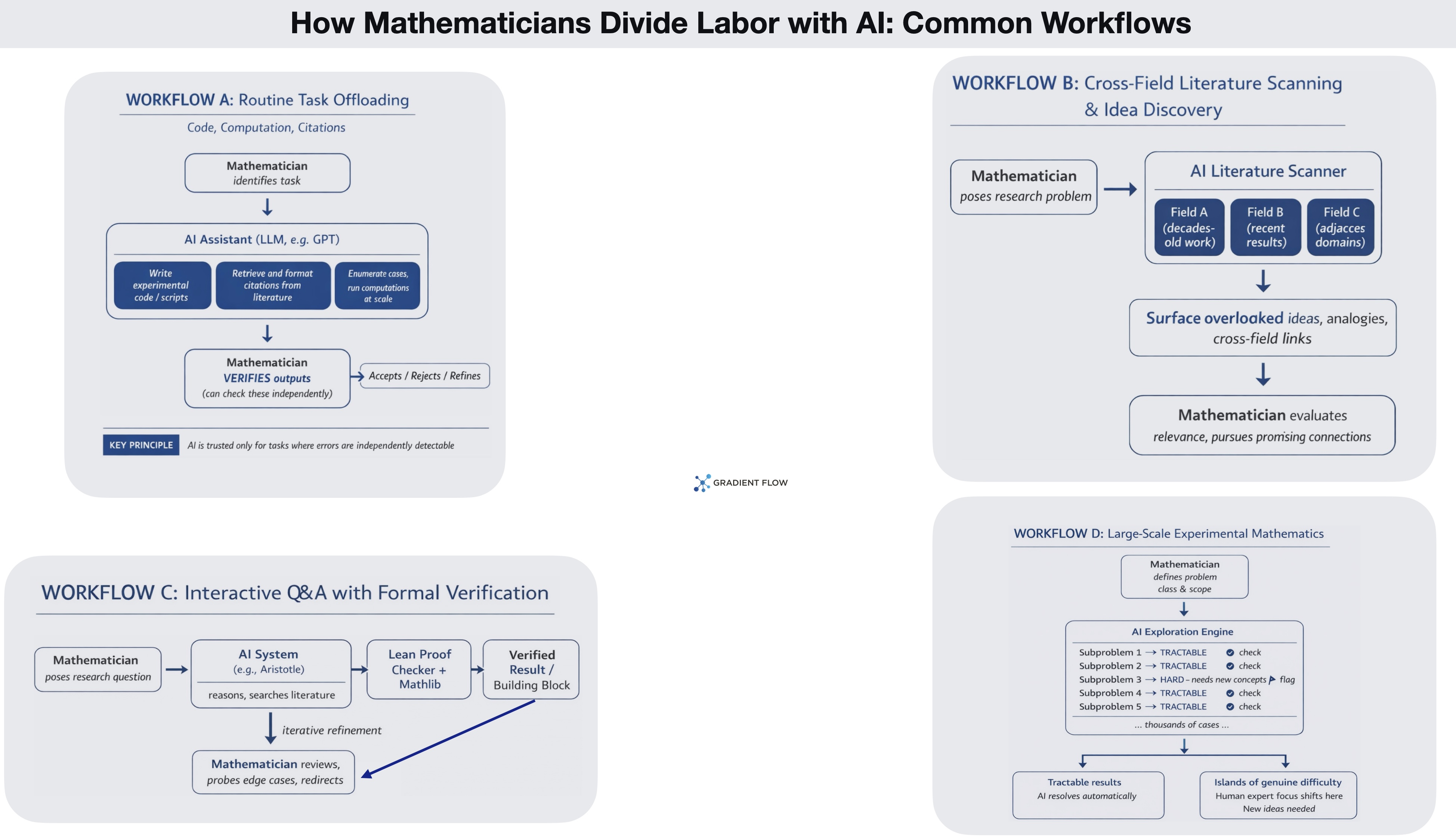
Research mathematicians currently deploy AI across a few workflows, starting as a disciplined assistant for work that is useful but easy to verify. They hand off tasks such as writing experimental code, checking large numbers of computational cases, and finding citations, but only when the result can be tested independently. That trust boundary matters. Researchers are not treating a language model as an oracle, but rather using it where mistakes are visible and fixable. A second pattern is broader literature scanning. Because mathematics is so specialized, important ideas are often buried in distant subfields or older papers. AI helps widen the search, systematically surfacing analogies and relevant results from outside a researcher’s immediate area. The system acts as a multiplier for breadth, while human experts provide the depth of insight needed to judge which connections are genuinely useful.


A more advanced set of workflows is now taking shape where verification is even stronger. Some researchers use systems that combine pattern-based AI with formal logic to get verified answers to specific research questions. The AI performs extended reasoning and translates the result into a formal proof language, ensuring the output is mathematically guaranteed. In parallel, other mathematicians are using AI to conduct large-scale experimental surveys of entire problem classes. The AI systematically maps the landscape, resolving routine cases automatically and flagging the smaller set of problems that still demand new conceptual approaches. The broader lesson is not that AI replaces expert reasoning. It is that AI becomes transformative when paired with structured feedback, clear verification, and a workflow that lets humans concentrate on the genuinely hard parts.


Possible Future Workflows for AI-Guided Mathematical Discovery
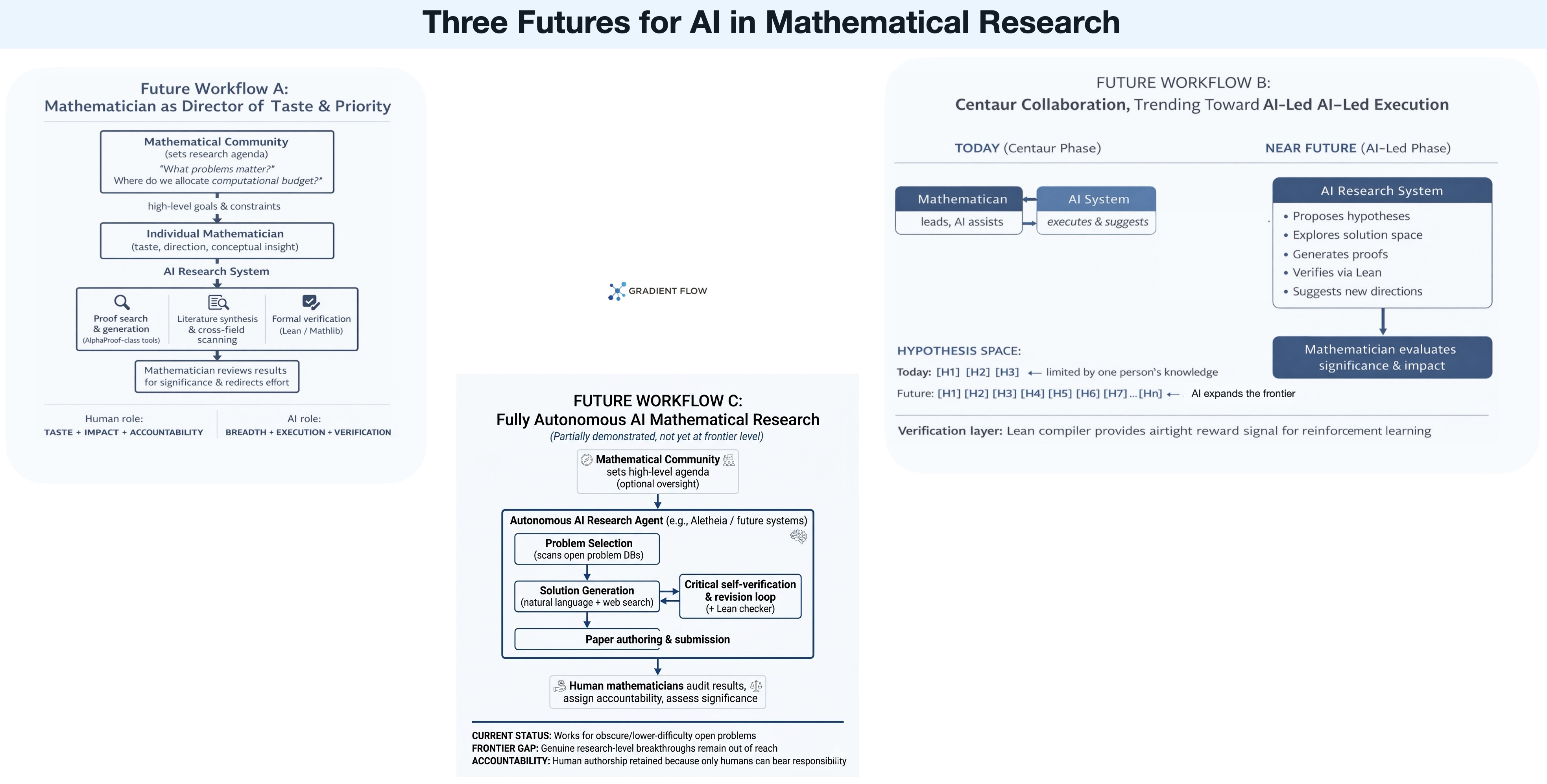
As these systems mature, research mathematics will likely illustrate a broader shift now visible in many knowledge-heavy fields. The mathematician of the future will spend less time carrying out long derivations by hand and more time deciding which problems deserve attention and where scarce computing resources should be focused. The transition mirrors the shift in software engineering from writing individual lines of code to designing system architectures. AI will handle the execution layer by searching for possible proof paths, scanning literature across distant subfields, and checking results in formal verification environments. The human role moves upward toward judgment, priority setting, and significance. For enterprise AI teams, this is a familiar pattern. As systems improve, the bottleneck shifts away from raw execution and toward problem selection, workflow design, and review.
A more ambitious trajectory sees AI moving from a disciplined assistant to an active research partner. In this model, the system proposes hypotheses, surfaces analogies, and explores many more directions than any one person could track alone. In specific settings, this could eventually extend to largely autonomous research loops where the AI identifies tractable open problems, tests candidate solutions, and drafts papers. Early versions of these autonomous agents already exist and have successfully resolved minor historical math puzzles. Yet the likely near-term outcome at the frontier of research is not full autonomy. It is a staged model in which AI expands the search space while humans retain responsibility for deciding what matters, which results are credible, and who bears accountability for the final product. That lesson should resonate well beyond mathematics. In enterprise environments, the most valuable AI systems will not be the ones that fully replace experts. They will be the ones that widen exploration, tighten verification, and make expert attention more selective and strategic.


Beyond Generation: What Math Reveals About Production AI
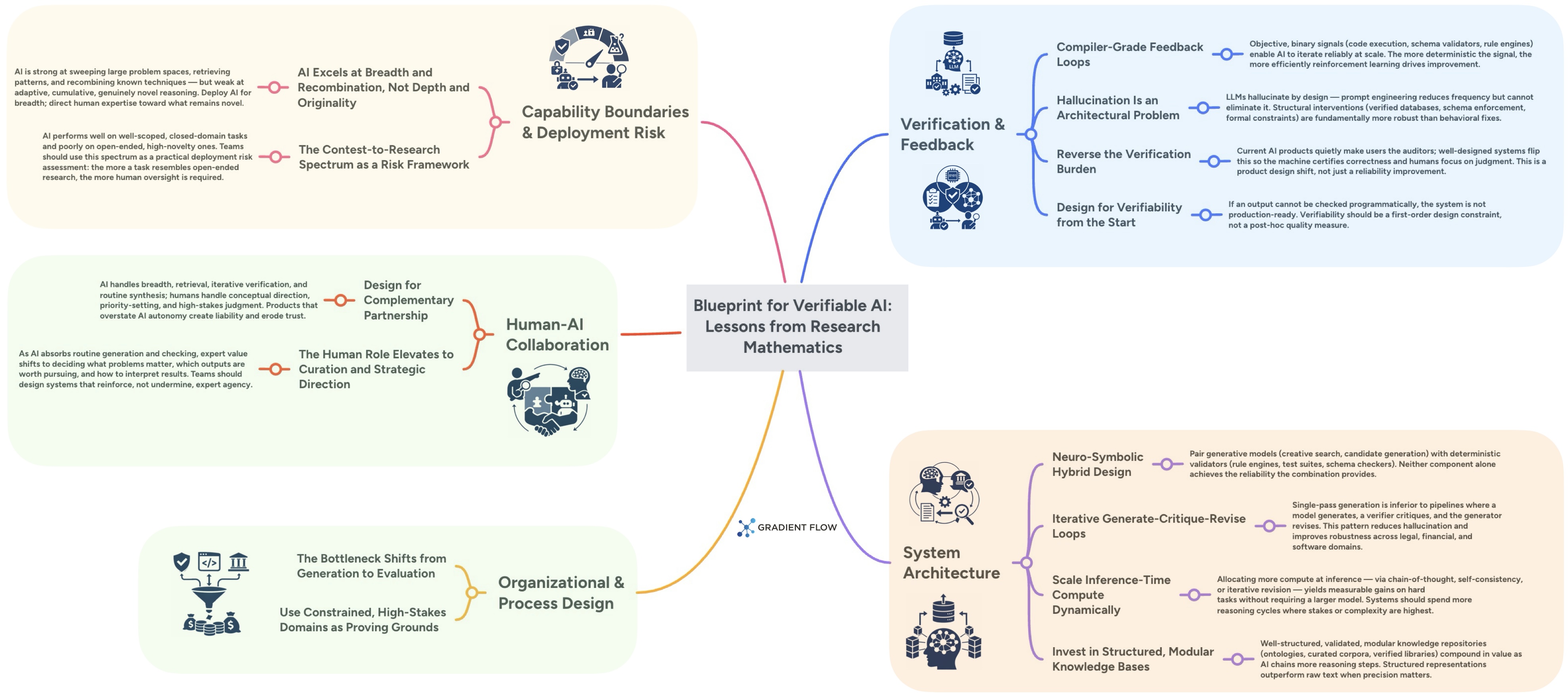
What mathematical AI makes especially clear is that hallucination is not mainly a prompting problem. It is an architectural problem, and it demands structural solutions. For high-stakes enterprise systems, prompt engineering and occasional human spot-checks are too weak to carry the load. The more durable pattern is to combine the breadth and fluency of generative models with deterministic checks: a code model paired with automated tests, a contract assistant constrained by a compliance engine, or an agent whose actions are filtered through policies, schemas, and hard business rules. Once those components are embedded in iterative loops in which the system generates, critiques, and revises, organizations can push AI further without simply scaling the risk. That is the broader lesson from mathematics. As generation gets cheaper and more abundant, the real bottleneck shifts to evaluation. Teams that build strong verification environments will be far better positioned than those that produce large volumes of plausible but weakly checked output.


That design choice also changes the role of the expert. When systems are built for verifiability from the start, the machine can take on more of the first-pass burden of checking, leaving humans to focus on higher-order judgment: deciding what matters, what is worth pursuing, and where ambiguity still requires experience and taste.
Mathematics offers an early preview of that shift. The strongest mathematicians, perhaps even future Fields Medalists, may be the ones who are best at using AI to explore more possibilities, test more ideas, and concentrate their own effort where originality matters most. The same logic applies across the enterprise. The most effective knowledge workers will not simply be those who use AI to move faster. They will be the ones who know how to direct it across a large search space, surround it with structural feedback, and intervene at the moments where human judgment creates the most leverage.
The AI Race Is No Longer Just About Benchmarks


Introducing rote™: Procedural Memory for AI Agents
In a previous piece, I argued that AI teams need operational memory, not just larger context windows or more elaborate prompts. Modiqo’s rote™ pushes that idea into a concrete system: agents should reason through genuinely new work once, then capture what worked as reusable procedural memory. That matters because many teams are now discovering the same failure mode in production agent systems: demos are easy, but reliable, repeatable workflows are hard. The challenge is no longer just connecting a model to tools. It is designing an environment where agents can remember successful work, reuse proven flows, and reduce the cost of rediscovering the same answer over and over. For teams trying to move from impressive prototypes to durable AI infrastructure, Modiqo is worth watching. Check out rote™.