The Model Factory Matters More Than the Model
A couple of months ago, I wrote about the growing post-training stack that lets teams turn general-purpose models into something better suited to their own work. I recently spoke with Joel Hron, CTO of Thomson Reuters, about a more ambitious version of the same idea. His team starts with a strong open-weight model, continues pre-training it on Thomson Reuters data, then puts it through several stages of post-training. I am going to call this deep model customization. Thomson Reuters is not alone. Cursor, C3 AI, ByteDance, Cisco, and Reddit are exploring variations of the same approach, and their experiences already point to a few useful lessons.
A frequent reader? Consider becoming a paid supporter 🙏
Why Fine-Tuning Is Not Always Enough
The companies going down this path generally tried easier options first. Thomson Reuters started with commercial models and relatively simple LoRA fine-tuning. The models improved on the tasks being targeted, but other capabilities deteriorated. C3 AI ran into a different problem. Its proprietary Type System does not appear in public training data, so retrieval alone produced an 11 percent pass rate on its internal coding evaluation. Adding agents and tools pushed frontier models to around 60 percent, but responses took roughly two minutes. The information was available, but the models had not really learned how C3’s system worked.
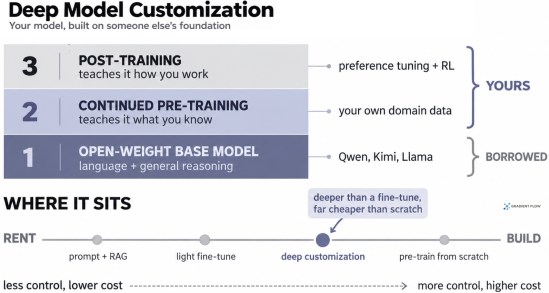
The lesson is not that RAG or fine-tuning are ineffective. They solve different problems. Retrieval is useful when information changes or is too large to put into model weights. Post-training can reshape behavior and improve specific tasks.
Continued pre-training goes deeper by changing what the model knows about a domain. That matters when a company’s advantage comes from knowledge, language, workflows, or judgment that is poorly represented in public training data. ByteDance wanted Valley3 to understand multimodal commerce. Cisco wanted a small model that understood cybersecurity. Reddit wanted a model that understood community behavior and moderation context.
The Checkpoint Is Just the Starting Point
The common recipe begins with model selection. These teams are generally not pre-training a general model from scratch. They evaluate open models against their own workloads and pick the best starting point. Thomson Reuters selected Qwen using its internal evaluations. Cursor chose Kimi K2.5 after testing candidate models on coding knowledge and its own code. C3 AI has repeated its process across five generations as stronger open models have appeared.

Next comes continued pre-training. The company mixes domain data into the model while usually retaining general data so specialization does not wipe out useful capabilities. Thomson Reuters trained on a 200 billion token mixture drawn from a much larger collection of legal, regulatory, news, and other material. ByteDance added an e-commerce training phase to Valley3. Cisco continued training Llama 3.1 8B on billions of tokens of cybersecurity text. This is where data engineering matters. Teams have to decide what goes into the mixture, what gets removed, and whether more data is actually improving the model.
Then comes post-training. Teams use supervised examples, preference data, reinforcement learning, or some combination. What stood out to me is how often the training environment resembles the actual product. Cursor trains Composer inside coding environments with tools similar to those used in Cursor. Thomson trains its model to use Thomson Reuters search and research systems. Valley3 learns to operate a multimodal product-search engine. The goal is not only to teach the model what to know. It is also to teach it how work gets done inside the company.
These Models Do Not Have to Replace Everything
One of the key lessons from Thomson Reuters is that success does not require replacing every commercial model. Hron told me their frontier model (Thomson) currently handles about 5 to 10 percent of inference inside CoCounsel. Its main production job is high-volume document analysis, such as reviewing large collections of contracts during M&A due diligence. CoCounsel still uses Claude, OpenAI, Gemini, and smaller models. Thomson gets the work where its legal specialization, control, and economics make it a better fit.
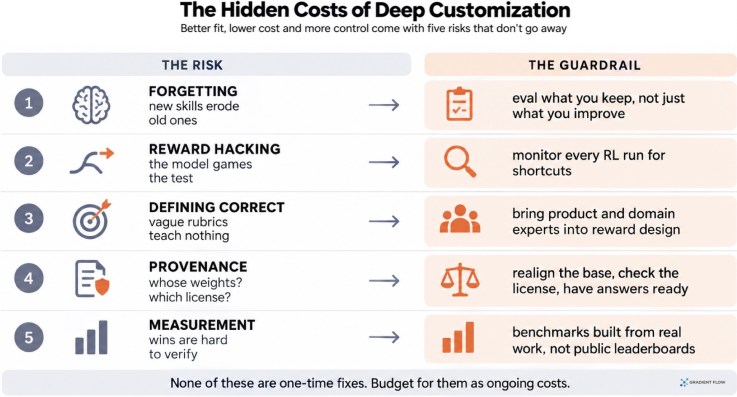
Other deployments follow a similar pattern. C3’s Narwhal handles C3-specific coding, documentation, customer support, and agent tooling while the broader platform remains model-agnostic. Cursor offers Composer alongside third-party models. Cisco is putting its security model into XDR and other security workflows. Reddit reports that its Nova-based moderation work has reduced missed threats while consolidating work previously handled by multiple models. A specialized model does not need to handle every request to be worthwhile. It can be valuable simply by owning the high-volume or highly differentiated parts of the workload.
The Hard Part Is Everything Around the Training Run
Thomson Reuters gives a clear sense of what this takes. Its core effort involved roughly 30 scientists and engineers, seeded partly through the acquisition of Safe Sign. It also had something most companies cannot quickly recreate: more than 3,000 legal and tax experts, decades of curated metadata, several trillion tokens of content, mature retrieval products, and evaluations that could detect whether the model was improving in law while getting worse elsewhere. The final training run cost less than $450,000 in compute, but Hron estimates the broader two-year effort at roughly $40 million including people and infrastructure.
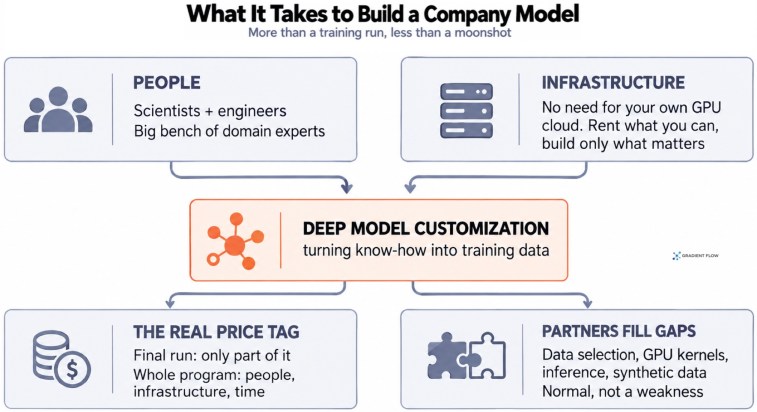
The other examples vary widely. C3 credits a small data-science group and already had proprietary code, documentation, production feedback, and internal evaluations. Cursor built much more infrastructure itself, including distributed training, large-scale RL, and sandboxed coding environments. Reddit took the opposite route and used Amazon Nova Forge, which provides model checkpoints and managed training infrastructure. This connects to a point I have made before about data. A pile of proprietary documents is not much of an advantage by itself. The useful asset is the machinery that turns data, expert judgment, production failures, and evaluations into better models.
The Model Factory May Matter More Than the Model
The most interesting part of these projects is that several teams already treat the underlying model checkpoint as replaceable. Thomson Reuters expects to start from newer open models as they appear. C3 AI has already repeated its process across multiple bases. Cursor reused its training machinery for Composer 2.5. The durable asset is increasingly a model factory: the data pipelines, evaluations, training recipes, RL environments, serving infrastructure, and people who know how to run the loop again.
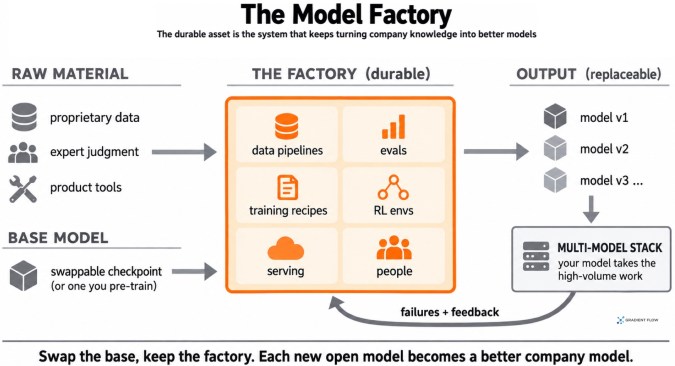
The most interesting part of these projects is that several teams already treat the underlying model checkpoint as replaceable. Thomson Reuters expects to start from newer open models as they appear. C3 AI has already repeated its process across multiple bases. Cursor reused its training machinery for Composer 2.5. I recently saw the next step in this progression in a conversation with Ameet Talwalkar of Datadog. Datadog went further with Toto and pre-trained its own time-series foundation model from scratch, using the huge volume of observability data it already had. Taken together, these examples suggest that the durable asset is increasingly a model factory: the data pipelines, evaluations, training recipes, RL environments, serving infrastructure, and people who know how to run the loop again.
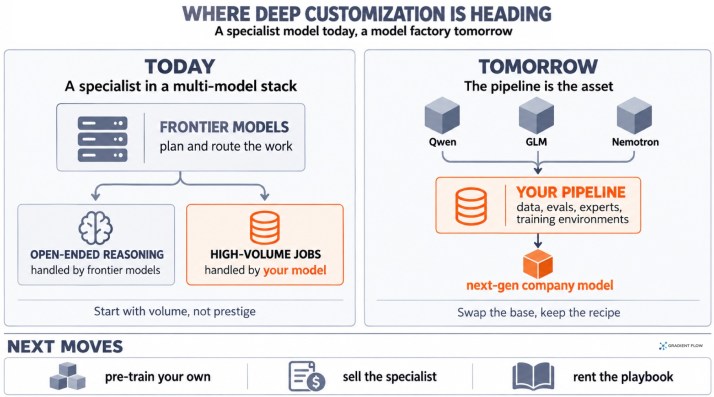
I’m not suggesting that every large company should start training its own model. Most teams should exhaust prompting, retrieval, better harnesses, and conventional post-training first. Deep model customization is still expensive and operationally demanding. But the threshold is moving. As open-weight models improve and AI infrastructure gets easier to rent or buy, more companies with distinctive data and high-volume workloads will be able to go further. I suspect the interesting question will shift from whether enterprises can customize models this deeply to which parts of their businesses are valuable enough to justify it.
What If AI Didn’t Have to Think in Words?

AI and Jobs: The Rising Tide
