Earlier this fall, I wrote about why the data stack is becoming less forgiving as AI agents start making decisions. Stale records, inconsistent definitions, and incorrect permissions can lead to operational failures rather than just bad reports. Consider an agent trying to resolve a billing dispute. It might need subscription information from Salesforce, payment history from an ERP system, and account activity from a database. Today, developers often have to figure out which sources to query and how to combine the results themselves.
Existing data technologies solve parts of the problem. Warehouses and lakehouses support analytics, while newer architectures such as Databricks LTAP are bringing transactional and analytical processing closer together. But enterprise information will continue to live across databases, ERP systems, SaaS applications, and other services. MCP makes it easier to connect agents to these systems, but connectivity alone doesn’t establish what the data means, which source to trust, or which business rules apply. Much of that work still falls on developers.
A Shared Data Layer for Agents
I think a new category of infrastructure is emerging to address these limitations. I’ve started thinking of it as an agent data runtime, a shared layer between AI agents and enterprise data systems. Its purpose is to give agents the right data, at the right time, with the context and permissions needed to use it correctly. Here, runtime refers to the infrastructure that retrieves and prepares information as agents request it, not the environment where agents themselves execute. That shifts much of the work of data retrieval out of individual agents.
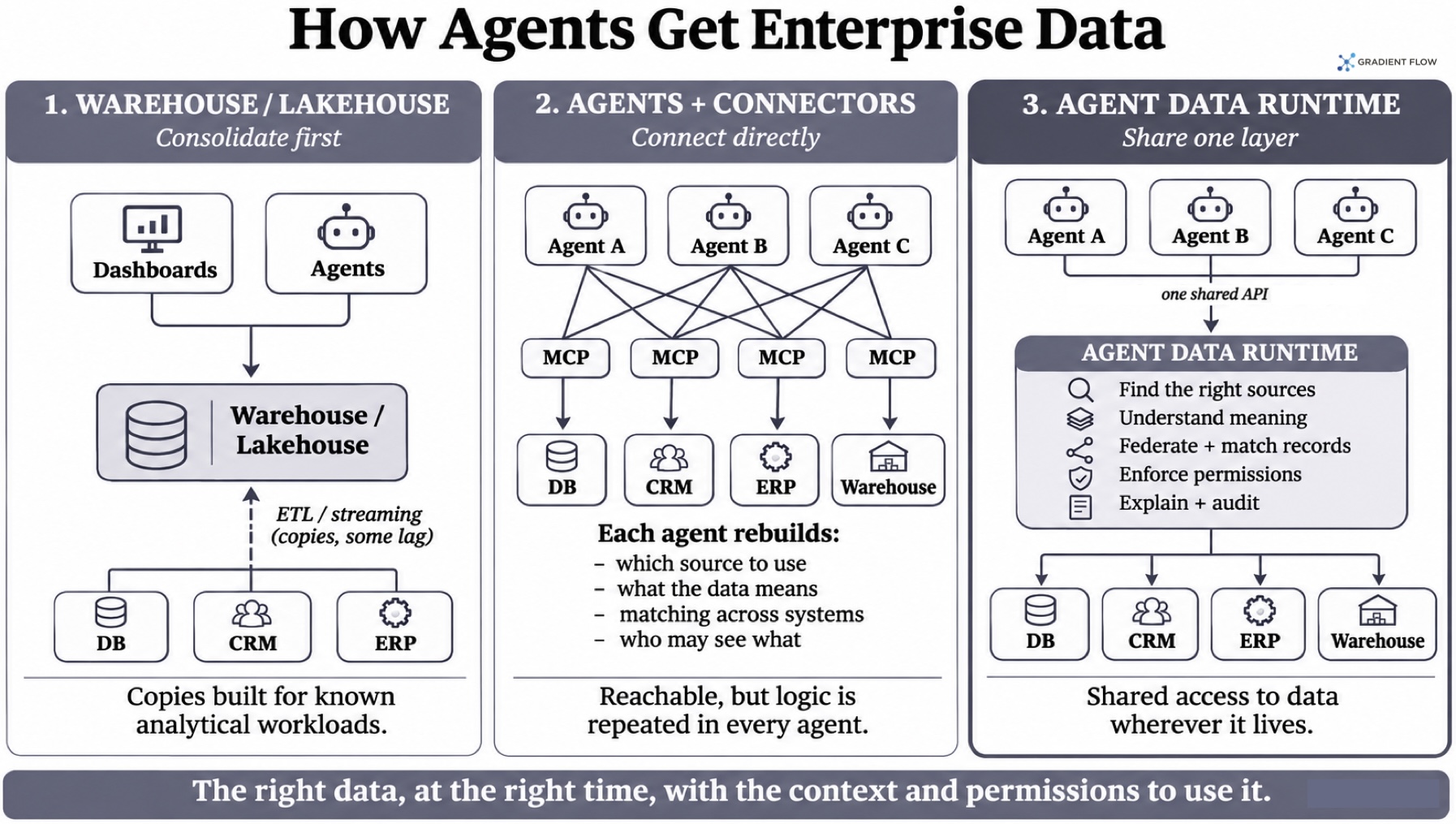
Why is this becoming practical now? Data federation, which means querying and combining information across different systems, has been around for decades. Existing engines already do this, but mapping business concepts across sources and maintaining those mappings can be labor-intensive. AI can help build and update that understanding, then select sources and generate queries as requests arrive. Many operational requests also involve targeted lookups rather than large analytical scans, which can make live federation practical for these workloads.
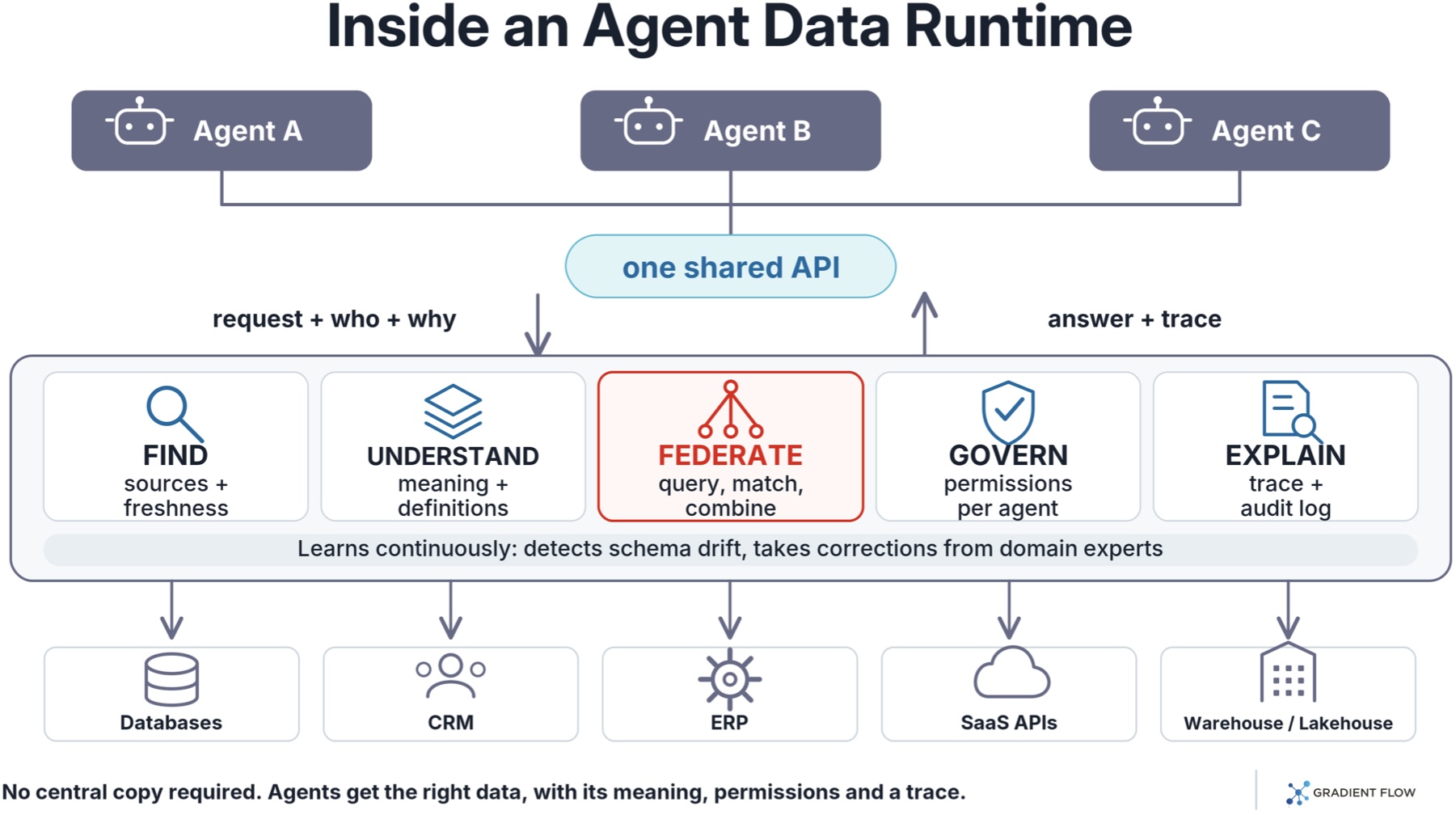
An agent data runtime needs to bring together several capabilities:
- Access to structured enterprise data: Works across operational databases, warehouses, lakehouses, ERP systems, CRM applications, and structured SaaS APIs. It treats existing systems as sources of information rather than requiring everything to move into a central repository.
- The right data at the right time: Retrieves information from appropriate sources with the freshness required by the task. Some requests need current records from operational systems. Others can use cached results, continuously updated views, or historical data.
- Federation across systems: Finds the sources an agent needs, generates queries or API calls, and combines results without first consolidating everything. This may require matching records that use different identifiers across systems.
- Automatic semantic understanding: Builds an initial understanding of business entities, relationships, and definitions from connected systems. A schema might identify a customer ID, but business context determines which accounts count as active customers and how they relate to subscriptions or payments.
- Continuous adaptation: Detects changes in underlying data structures and keeps its understanding up to date. Domain experts can correct inferred definitions and contribute business knowledge that isn’t documented in the systems themselves.
- Agent-aware governance: Enforces permissions based on the agent’s identity, the user or organization it represents, and the task being performed. These controls must work across systems with different access policies.
- Explainability and auditability: Records where information came from, which queries were executed, and which business definitions were applied. These details help developers investigate incorrect answers and verify how information was retrieved.
- Production-ready access: Provides consistent interfaces while managing latency, query load, data consistency, and partial failures. When a source times out or results cannot be reliably combined, the system should make that clear rather than return an incomplete answer with false confidence.
An agent data runtime doesn’t replace databases, warehouses, lakehouses, or integration tools. It brings together capabilities that developers currently have to assemble themselves. For companies building multiple agents, that could mean fewer custom integrations to maintain, along with shared business definitions and consistent rules for accessing data.
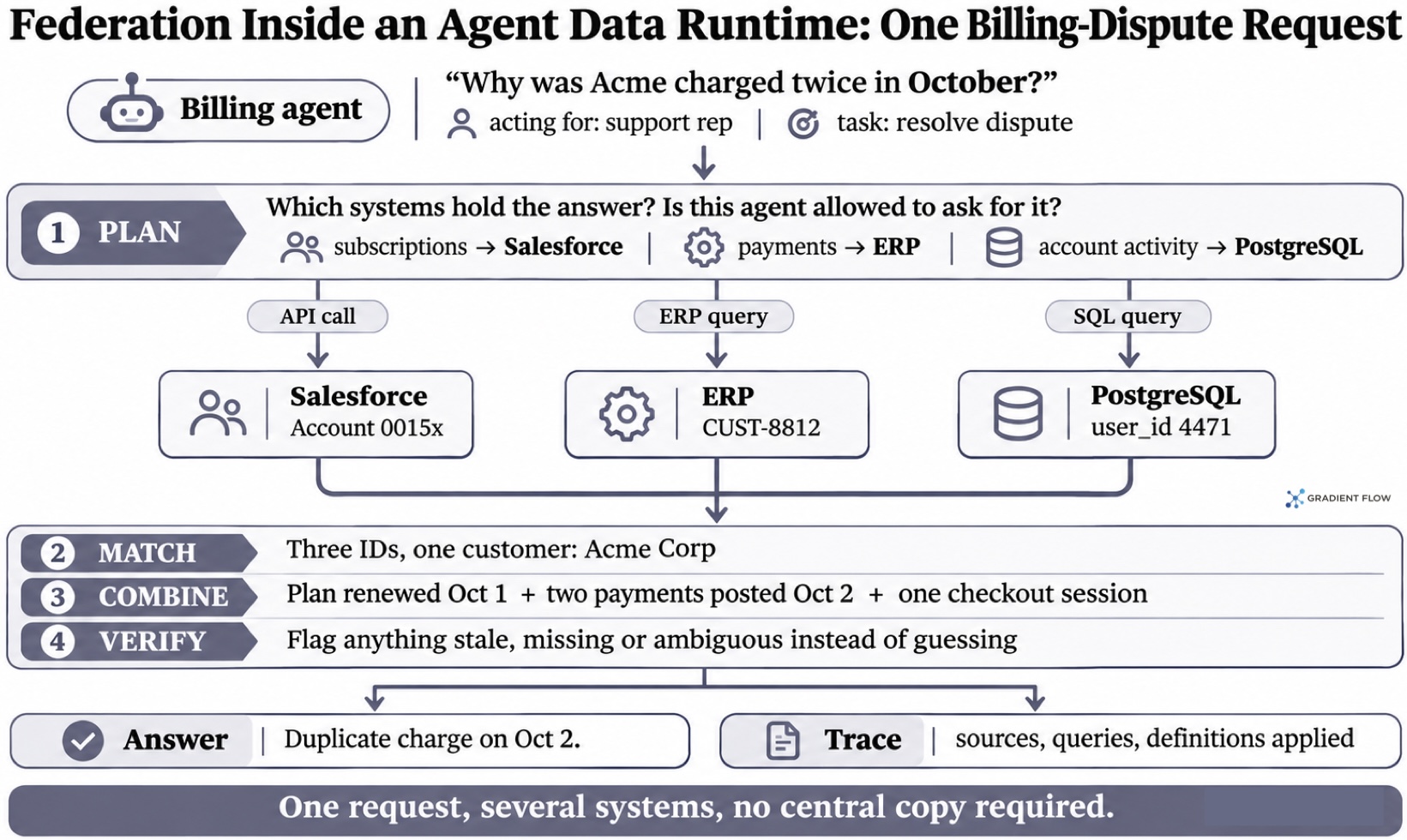
What This Looks Like in Practice
Snow Leopard is an early example of this approach. Developers connect their databases, and Snow Leopard automatically builds an initial understanding of the underlying schemas, relationships, and business meaning. Snow Leopard offers an example in which an agent needs account information from PostgreSQL, usage records from BigQuery, and operational data from Supabase. For these requests, Snow Leopard says it generates database-specific queries and combines the results before returning them to the agent. Snow Leopard Cloud launched in beta in September and now supports several SQL-based systems, including PostgreSQL, MySQL, and BigQuery.
What I find particularly interesting is how Snow Leopard approaches the semantic layer. As Snow Leopard’s founder, Deepti Srivastava, explained in our conversation, the system examines the data itself rather than relying only on schemas and metadata. People can correct business definitions through a feedback mechanism, and developers can inspect the queries used to retrieve results. Snow Leopard’s roadmap extends beyond databases to systems such as Salesforce and structured SaaS APIs. That broader coverage, together with stronger agent-aware governance and production reliability, will be important as the architecture matures.
From Answers to Actions
An agent investigating a billing dispute might go beyond identifying a duplicate charge and issue a refund. Reliable data becomes even more important when agents can act on what they find. Deciding whether those actions are authorized remains a separate responsibility.
Warehouses, lakehouses, and transactional databases aren’t going away, nor should they. They will continue to support workloads that benefit from prepared, consolidated, or historical data. But businesses will also depend on independent systems, each with its own structures and rules. An agent data runtime offers a way to work across them without rebuilding the same retrieval logic for every application.
There are still hard problems to solve, particularly around accuracy, governance, and reliability. But I think the direction is becoming clearer. As agents become more capable, companies will need infrastructure that can keep track of changing systems and supply the information and business context agents need. The goal isn’t simply faster access to data. It’s getting the right data at the right time, so agents can make decisions that organizations can trust.