

The start of a second Trump administration is prompting speculation about the future of technology policy in the United States. This analysis explores potential shifts across various sectors, from artificial intelligence and cryptocurrency to government efficiency and national security. The predictions outlined here are based on a combination of past statements made by individuals associated with the Trump administration, as well as a careful reading of expert analysis and reporting on potential policy directions. This analysis does not aim to be a definitive forecast—as evidenced by the omission of topics like Section 230 and content moderation—but rather seeks to illuminate potential policy shifts based on the available information.

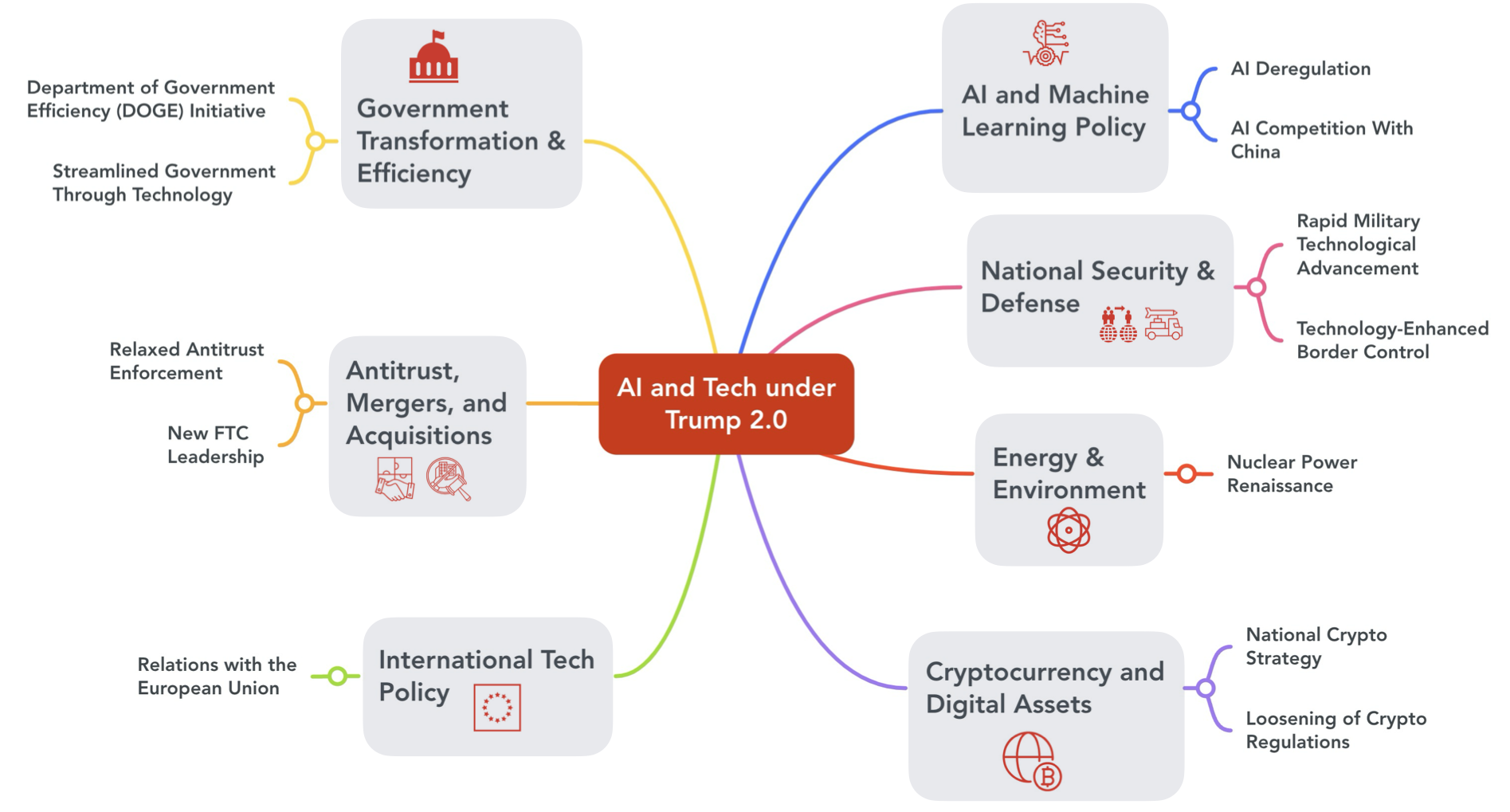
AI and Machine Learning Policy
AI Deregulation
A Trump 2.0 presidency is fueling expectations of a significant deregulation of the artificial intelligence landscape, a move that could dramatically reshape the sector. This anticipated deregulation, kicked off with the rollback of Biden-era rules designed to mitigate AI risks and increase federal oversight, will likely see a loosening or outright scrapping of guidelines on safe AI development, data usage, and ethical considerations. Crucially, this also extends to a loosening of copyright laws, which Silicon Valley sees as critical for developing the next generation of AI technologies. This shift, while potentially accelerating AI innovation by removing compliance hurdles for tech giants eager to train models on vast datasets, also raises concerns. The abolition of mandated AI impact assessments, for example, would free companies from reporting on the societal implications of their large-scale deployments. AI companies will still need to grapple with a patchwork of regulations emanating at the state level, similar to the emergence of state-level privacy laws, and historically, organizations have adopted the strictest regional laws.
AI Competition With China
The “AI arms race” with China is set to intensify, shaping the future of US artificial intelligence policy. A continued emphasis on outpacing China in AI research and development is expected, with a focus on restricting certain AI exports and collaborations with Chinese entities to maintain a strategic advantage. This geopolitical framing of AI could lead to domestic initiatives prioritizing national security applications, potentially at the expense of workforce development and ethical considerations. Policies such as blocking the sale of advanced AI chips or limiting cloud-computing access for Chinese companies are likely to be maintained. The result is predicted to be heightened tensions around AI technology sharing, with strict export controls and increased spending on defense-oriented AI research and development.
Government Transformation & Efficiency
Department of Government Efficiency (DOGE) Initiative
A radical restructuring of the US federal government is envisioned, spearheaded by a temporary advisory commission, the “Doge team,” with a sunset date of July 4, 2026. This initiative aims to drastically reduce bureaucracy and enhance efficiency through technology-driven reforms. The plan includes a reduction of cabinet agencies, leveraging Chevron Deference to challenge regulations, restoring presidential impoundment powers, and installing reform-minded officials. This could fundamentally alter how regulations are created and enforced, and how the government interacts with the tech sector. Potential examples include legal challenges to agencies for overstepping their statutory remit, consolidation of 14 cabinet agencies into 4 core functions, and the use of AI to identify and eliminate redundant government programs. The prediction is that DOGE will face significant political resistance and implementation hurdles.

Streamlined Government Through Technology
A renewed push to modernize government operations through technology is gaining momentum, encompassing a broad range of initiatives from AI and automation to data analytics and cloud adoption. This drive, reminiscent of past efforts such as President Obama’s major digital transformation initiatives, aims to streamline day-to-day functions, reduce physical office footprints, and overhaul procurement processes. The significance lies in the potential to improve efficiency and transparency, impacting how the government interacts with the tech sector and manages data. Potential examples include using AI-based systems for budgeting and logistics, consolidating government data silos onto secure cloud platforms, and reducing paperwork. While the prediction is for a modernization of government operations through technology, potential implementation hurdles, privacy concerns, and cybersecurity challenges remain significant, underscoring the complexities of such large-scale transformations.
National Security & Defense
Rapid Military Technological Advancement
A drive for rapid military technological advancement is set to reshape the Pentagon, with a focus on adopting next-generation technologies such as drones, AI, hypersonics, and sensor fusion to maintain strategic dominance. This initiative aims to bridge the military-tech divide, integrate commercial technology, and draw lessons from recent conflicts. This initiative has the potential to modernize the military and create new opportunities for AI and robotics companies. Examples include networked drones, hypersonic missiles, real-time sensor arrays, and AI-driven decision support, as well as repurposing off-the-shelf solutions for military applications.
Technology-Enhanced Border Control
A significant investment in technology-enhanced border control is anticipated, with the deployment of sophisticated surveillance and AI-driven systems to secure U.S. borders. This includes sensor networks, sensor fusion and AI, and tagging and tracking technologies. The initiative aims to enhance border security through technology, creating new opportunities for AI and surveillance companies, but also raising concerns about privacy and civil liberties. Potential examples include mesh-networked towers, cameras, and UAVs for continuous monitoring of border zones, and AI systems to detect and track individuals crossing the border. The prediction is for enhanced border security through technology, but this will likely raise potential privacy and civil liberties concerns, as well as political controversy.
Energy & Environment
Nuclear Power Renaissance
A nuclear power renaissance is on the horizon, driven by the dual goals of achieving U.S. energy independence and reducing emissions. The long-term vision includes an expanded nuclear infrastructure fueling next-generation manufacturing, AI data centers, and large-scale electric vehicle fleets. This initiative envisions a sweeping revival of nuclear power, including the construction of new reactors, and the promotion of innovative reactor designs. This resurgence is further bolstered by the support of many tech leaders, who see nuclear power as a crucial component of a sustainable energy future.
Cryptocurrency and Digital Assets
National Crypto Strategy
A new U.S. crypto strategy is taking shape, with a push to establish the U.S. as a global leader in the cryptocurrency space. Proposed actions include creating a national Bitcoin stockpile, forming a high-level advisory council on cryptocurrency, and offering a more favorable regulatory landscape for crypto innovation. Potential examples include a White House-endorsed advisory council guiding policy and drafting legislation that legitimizes certain cryptocurrencies for federal use. The prediction is for an early boom in crypto markets driven by favorable policies, but also a higher chance of volatility and backlash if consumer protections and fraud prevention measures are insufficient. The long-term outlook suggests that minimal oversight could heighten fraud and volatility, potentially prompting a future regulatory backlash.
Loosening of Crypto Regulations
A significant loosening of crypto regulations is anticipated under a Trump 2.0 administration, with a widespread expectation of a rollback or weakening of regulatory frameworks imposed by the prior administration or federal agencies like the SEC. This includes easier compliance requirements for crypto exchanges and startups, potentially spurring the development of decentralized finance (DeFi) platforms, NFT markets, and other blockchain innovations. However, this environment could also harbor scams and expose consumers to unregulated, high-risk financial instruments. Examples include reducing Know-Your-Customer (KYC) mandates for certain crypto transactions, making it simpler for start-ups to operate without stringent investor checks. The prediction is for an influx of entrepreneurs seeking a “crypto-friendly” jurisdiction, though the risk of high-profile fraud cases or market crises may pressure lawmakers to reintroduce stricter rules down the line. The short-term outlook suggests a crypto boom with new tokens and platforms, but with a heightened risk of scams and market bubbles, potentially leading to abrupt clampdowns later on.
Antitrust, Mergers, and Acquisitions
Relaxed Antitrust Enforcement
A significant shift in antitrust enforcement is anticipated, with a Trump 2.0 administration expected to adopt a more permissive stance toward large-scale mergers and acquisitions within the tech sector. This contrasts sharply with the more aggressive antitrust posture under the Biden administration. The significance lies in the potential for greater consolidation, which could lead to fewer market competitors and stifle smaller innovators. For AI practitioners, this might mean fewer independent startups and more development housed under tech giants. This potentially means that major players like Nvidia, Google, Amazon, Microsoft, and Meta are able to acquire smaller AI companies with little pushback from the Federal Trade Commission (FTC). The prediction is for an uptick in high-profile acquisitions, leading to both higher valuations for startups and mounting concerns over monopolistic power. Over time, reduced market competition could spur calls for antitrust action once consumer choice or innovation appears stifled.
New FTC Leadership
The regulatory landscape for the tech sector is poised for a potential shift with new leadership at the FTC. While many anticipate a more lenient approach towards large-scale tech deals, some foresee that certain administration figures might selectively pursue high-profile cases against big tech companies. The significance lies in the FTC’s power to determine the regulatory environment for tech consolidation. A more lenient FTC might “pick battles” less frequently, while a hawkish FTC might still target specific companies for antitrust or consumer protection reasons. The prediction is that overall policy will likely tilt towards enabling big tech expansion, though sporadic enforcement could occur if politically advantageous, creating pockets of regulatory uncertainty.
International Tech Policy
Relations with the European Union (EU)
Transatlantic relations in the digital sphere could face turbulence under a potential Trump 2.0 administration, with suggestions that its approach might clash with the European Union’s stringent regulations on data privacy, antitrust, and AI oversight. The significance lies in the potential conflict between the EU’s digital regulations, such as GDPR and the Digital Services Act, and a more deregulated U.S. environment, complicating operations for tech companies spanning both regions. The EU also faces a complex challenge in regulating Elon Musk due to his close ties to the incoming Trump administration, as any actions against Musk’s companies could have broader implications for the US-EU relationship. The prediction is for heightened friction in transatlantic digital commerce and social media, with possible retaliatory measures from the EU if they perceive U.S. deregulation or AI policy as undermining consumer protections. This could lead to ongoing legal and diplomatic disputes over data transfers and content moderation, with some U.S. firms potentially separating their EU user data to comply with GDPR, further exacerbating transatlantic tensions. The predicted transatlantic friction, coupled with U.S. tech companies’ global lobbying efforts on AI regulation in numerous regions, underscores the significant influence these firms wield in shaping the future of international digital governance, not just in Europe.
If you enjoyed this post, please consider supporting our work by leaving a small tip here and inviting your friends and colleagues to subscribe to our newsletter: