

Strengthening AI Foundations through Supply Chain Security
Software supply chain security is the safeguarding of every stage in the software development lifecycle, from initial source code to the final deployed product. This approach aims to guarantee the integrity and authenticity of all software artifacts by preventing unauthorized modifications and ensuring a verifiable chain of custody. This is especially critical in AI, where the complex web of libraries, frameworks, and dependencies creates multiple points of potential vulnerability. A single compromised component can have cascading effects throughout the entire system, jeopardizing the integrity and security of the final AI application.
When applied to AI systems, software supply chain security encompasses additional critical elements. These include protecting training data and models, tracking dataset provenance, securing model weights and architectures, and safeguarding AI frameworks and infrastructure. The following section will delve deeper into why these measures are urgently needed in the AI landscape.


The Urgency of Supply Chain Security in AI
The threat to AI supply chain security is not a distant concern, but a pressing reality with potentially devastating consequences. As AI systems become increasingly integrated into critical sectors like healthcare, finance, and infrastructure, the impact of security breaches could be catastrophic. Ensuring the integrity and security of these systems is no longer optional, but a critical imperative.
While AI development inherits the traditional software supply chain risks associated with frameworks, libraries, and other components, the complexity and scale of AI systems amplify these vulnerabilities. The reliance on vast datasets and intricate models introduces new attack vectors and magnifies the potential impact of a successful breach.
Therefore, securing the AI supply chain demands a broader approach than traditional software security measures. It necessitates a holistic strategy encompassing the entire AI lifecycle:
- Data Integrity. Protecting training data and models from poisoning attacks and other forms of manipulation.
- Provenance Tracking. Maintaining a clear and auditable record of the origin and usage of all datasets used in training.
- Model Security. Implementing robust protections for sensitive model weights and architectures to prevent unauthorized access or modification.
- Infrastructure Hardening. Securing the underlying AI frameworks and infrastructure against compromise.

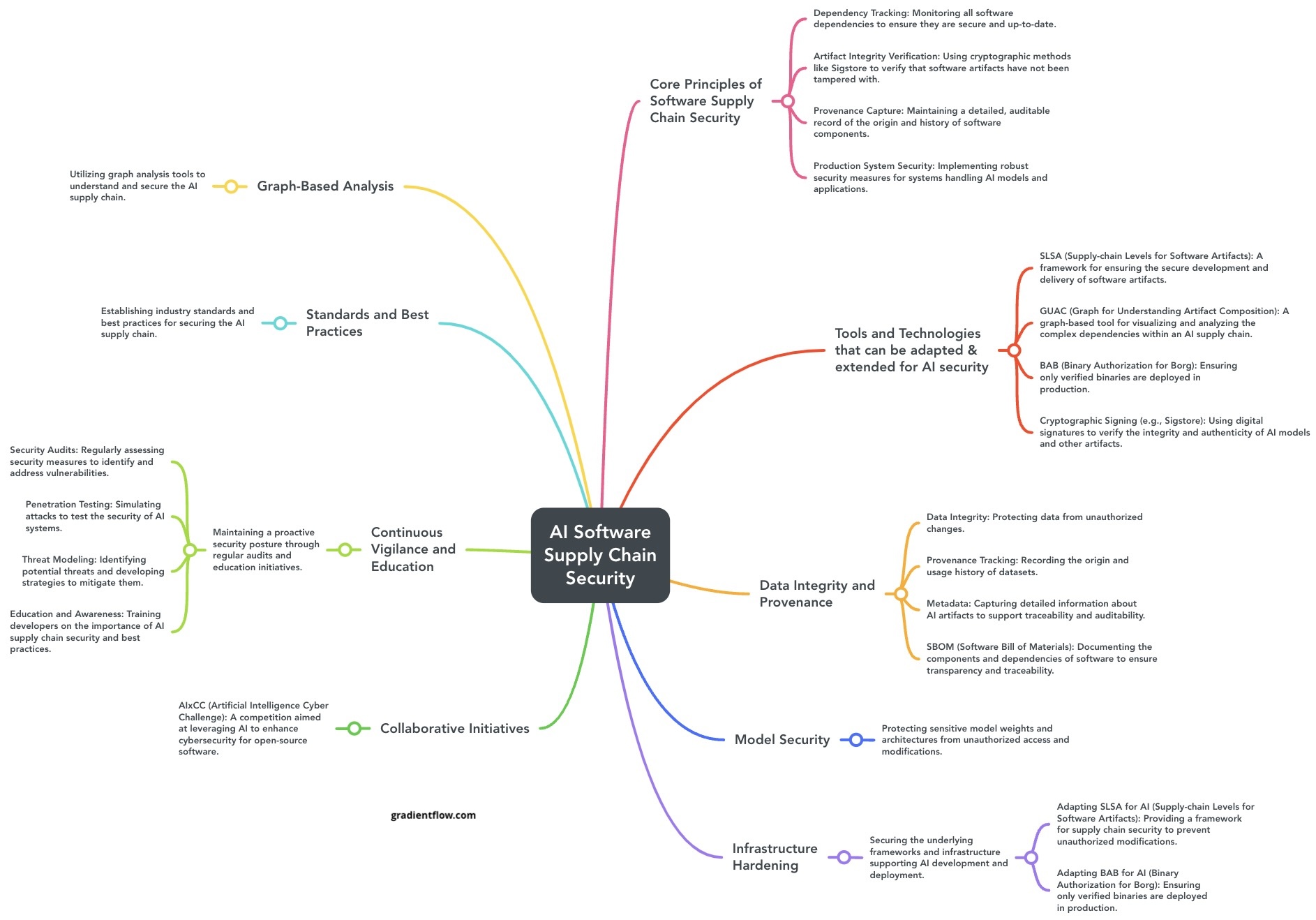
Analysis
The challenges posed by AI supply chain security are significant, but not insurmountable. A multi-faceted approach, combining established practices with AI-specific solutions, is crucial to mitigating risks and building a more secure foundation for the future of AI. Here’s how:
- Leveraging Existing Foundations: Implement core software supply chain security principles within AI development. This includes rigorous dependency tracking, artifact integrity verification, comprehensive provenance capture for all AI artifacts, and robust security for production systems handling AI models.
- Adapting and Extending. Modify existing security tools and frameworks to meet the unique demands of AI. This involves adapting solutions like BAB and SLSA for AI, utilizing cryptographic signing (e.g., Sigstore) for model integrity, and building comprehensive data and model cataloging systems.
- Utilizing Graph-Based Analysis. Utilize tools like GUAC (Graph for Understanding Artifact Composition) to create a comprehensive, queryable graph of your AI supply chain, enabling you to identify and mitigate risks associated with dependencies and vulnerabilities.
- Prioritizing Metadata and Lineage. Emphasize the capture, organization, and accessibility of metadata detailing the lineage of all AI artifacts. This metadata should be easily queryable, support access controls, and be shared in interoperable formats (SBOMs, provenance documents, model cards) to ensure a trustworthy and auditable record.
- Addressing AI-Specific Challenges. Recognize and address the unique security challenges inherent to AI development. This includes adapting traditional software development practices (version control, code review, build processes) for AI, developing strategies for provenance tracking across large datasets and training processes, and balancing security needs with efficiency and latency concerns.
- Establishing Industry Standards. Foster collaboration within the AI community to define clear standards and best practices for AI supply chain security. This includes standardizing requirements for model and data provenance information (format, storage, sharing, verification), exploring dataset signing for integrity, establishing secure training practices for untrusted data, and integrating provenance verification within model hubs.
- Embracing Continuous Vigilance. Maintain a proactive security posture through regular security audits, penetration testing, and threat modeling tailored for AI systems. Staying informed about emerging threats and vulnerabilities in the rapidly evolving AI landscape is crucial.
- Empowering Through Education. Prioritize education and awareness initiatives to equip AI developers and teams with the knowledge and skills to address AI supply chain security risks. This includes training on potential attack vectors, the importance of provenance and metadata, and best practices for securing AI artifacts throughout their lifecycle.
One weak link in the AI supply chain can compromise the entire system, jeopardizing its integrity and security
The urgency of securing the AI supply chain is evident in initiatives like the Artificial Intelligence Cyber Challenge (AIxCC), a $29.5 million competition spearheaded by DARPA and ARPA-H. This collaborative effort, engaging top AI companies, cybersecurity experts, and the open-source community, aims to leverage AI itself to enhance cybersecurity for critical open-source software. AIxCC exemplifies the innovative, collaborative approaches needed to address the complex challenges of AI supply chain security. By fostering such cross-sector partnerships and investing in AI-driven security solutions, we can build a more resilient and trustworthy foundation for the future of AI.
Recommended Reading
- AI Incident Response: Preparing for the Inevitable
- Securing the AI Software Supply Chain (Google Report)
- AIxCC: Artificial Intelligence Cyber Challenge (DARPA and ARPA-H)
- Hackers race to win millions in contest to thwart cyberattacks with AI
- Graph for Understanding Artifact Composition (GUAC): GUAC aggregates software security metadata into a high fidelity graph database.
If you enjoyed this post please support our work by encouraging your friends and colleagues to subscribe to our newsletter: