Author: Ben Lorica
-
Why do our AI models stop learning the second we deploy them?
Continual Learning Is Arriving in Pieces A while back I wrote about how startups are using reinforcement learning to make agents more reliable. A deeper problem behind that whole trend keeps resurfacing: a model can improve…

-
Why Data Centers Became the Face of the AI Backlash
AI is no longer being judged only as software. Once the buildout arrives as a massive industrial facility, new transmission lines, continuous power demand, and possible pressure on utility rates, the argument changes. Communities are being…

-
What Comes After Language Models
I keep seeing scientific discovery framed as a sufficiently ambitious prediction or data-compression problem. A recent position paper by Tom Zahavy challenges that view by separating reasoning into three capabilities. Induction finds general patterns in examples.…

-
Passing Your Evals Doesn’t Mean You’re Safe
Evals are part of every serious conversation about putting AI into production. Teams define benchmarks, set thresholds, and increasingly run red teams to see how the system holds up against someone actively trying to break it.…

-
What Workday, OpenAI, and a German court have in common
Passing Your Evals Doesn’t Mean You’re Safe Evals are part of every serious conversation about putting AI into production. Teams define benchmarks, set thresholds, and increasingly run red teams to see how the system holds up…

-
If the Labs Wobble, the Clouds Feel It First
I have written separately about the shaky economics behind the data center boom and the growing pressure on the frontier labs. This post connects the two. Microsoft reported $24.1 billion of revenue from its OpenAI relationship,…

-
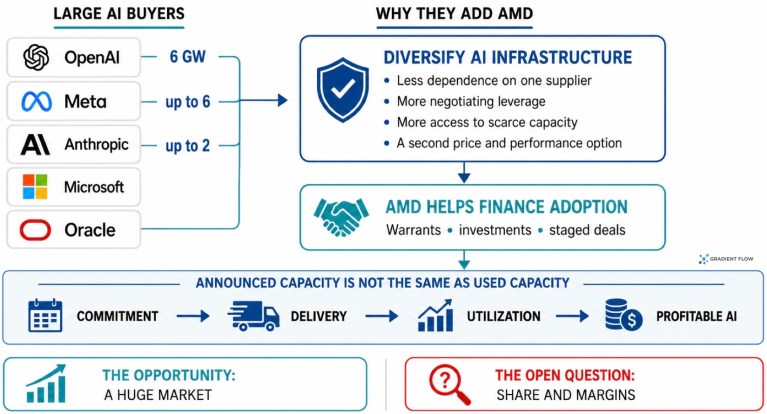
Inside AMD’s AI Bet
Table of Contents What AMD Actually Sells Now The Software Story, Which Is the Whole Story The Open-Standards Bet Who’s Buying, and How the Money Actually Moves Where This Could Still Come Apart What It Means…
-
Specialized AI Is Getting Easier to Build
Last week I argued that open models will absorb most of the money and compute the world spends on AI. A week later, open weights are even more central to the conversation. Recent releases have made…

-
The Big AI Labs Are Suddenly Competing with Your Own Data
Specialized AI Is Getting Easier to Build Last week I argued that open models will absorb most of the money and compute the world spends on AI. A week later, open weights are even more central…

-
Multiple Dials, Not One: Reading an Open Model Release
The most useful thing I’ve learned watching this latest round of open model releases is that “open” has stopped predicting anything. It used to be a reliable shorthand for cheap and second-tier. Now the top-ranked open…
