

Teaching Machines to Value Companies Like a Wall Street Legend
In the rapidly evolving landscape of artificial intelligence, a fascinating new frontier is emerging: AI assistants that aim to capture and replicate the expertise of world-class professionals. One notable example is the Damodaran Bot (DBOT), developed by researchers Vasant Dhar and Joao Sedoc at New York University. This AI system attempts to emulate the valuation methodology and thinking process of Aswath Damodaran, the renowned NYU professor known as Wall Street’s “Dean of Valuation.” By training on Damodaran’s extensive public works – including blog posts, webcasts, valuations, and teaching materials – DBOT represents an ambitious effort to systematize expert knowledge in long-term value investing.
The development of expert-based AI assistants like DBOT raises intriguing questions about the future relationship between human expertise and artificial intelligence. While these systems can process vast amounts of domain knowledge and replicate certain analytical processes, they currently struggle to match the nuanced judgment, adaptability, and creative thinking that characterize true expert reasoning. In DBOT’s case, early attempts to have the system independently evaluate companies based on Damodaran’s methodology produced outputs that, while coherent, lacked the professor’s characteristic depth of insight and ability to ask penetrating questions that frame complex valuation problems.
This emerging field of expert-based AI assistants highlights both the tremendous potential and current limitations of artificial intelligence in professional domains. As these systems evolve, they may increasingly serve as powerful tools that augment human expertise rather than replace it entirely. The key challenge lies in effectively capturing not just the explicit knowledge of experts, but also their tacit understanding, intuition, and ability to adapt principles to novel contexts – capabilities that remain distinctively human even as AI grows more sophisticated.
Inside the Damodaran Bot: Features and Limitations
DBOT represents an ambitious attempt to systematize expert knowledge in valuation. Currently at version 1.0, the system is undergoing evaluation by comparing its analyses against valuations performed by students from Damodaran’s class and Damodaran himself. While the bot can generate coherent valuation reports that demonstrate awareness of industry contexts and market dynamics, it faces several key limitations in matching Damodaran’s depth of analysis.
The bot’s architecture combines automated data gathering from multiple sources (financial statements, industry data, market comparables, regulatory information) with specialized agents for different analytical tasks. It employs large language models to process Damodaran’s extensive public works, including blog posts, webcasts, and teaching materials. Early testing suggests the system can produce valuations within ±50% of market prices, though outputs can vary between runs even with identical inputs.
Current limitations include the bot’s inability to match Damodaran’s depth of analytic thinking, particularly in asking penetrating questions that frame complex valuation problems. The system also lacks true curiosity and capability for reflection – key traits that Vasant Dhar identifies as essential for superforecaster-level analysis. These limitations highlight the challenge of capturing not just explicit knowledge but also the tacit understanding and intuition that characterize expert reasoning.

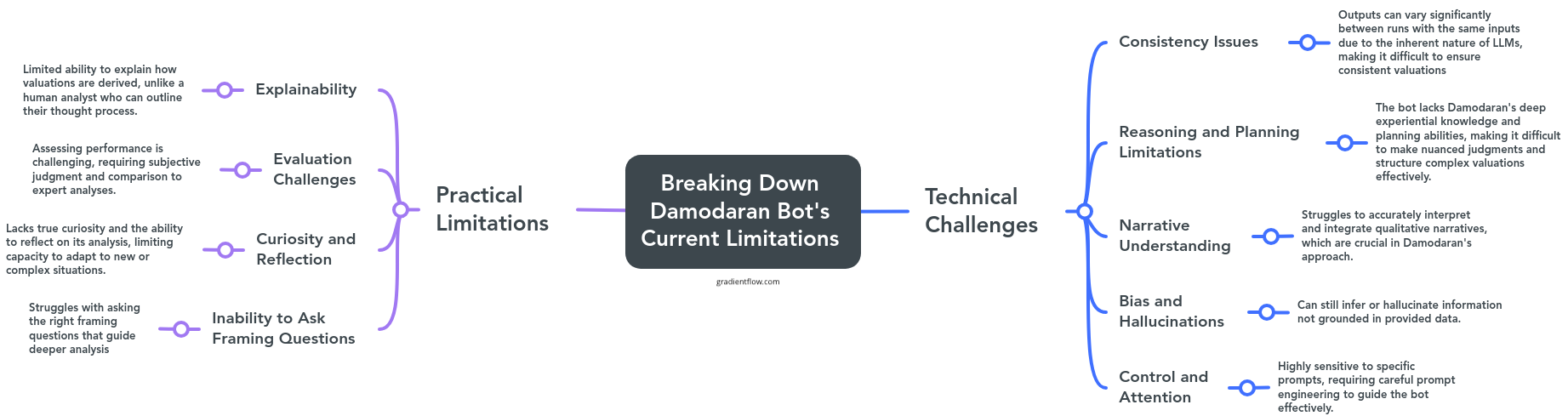
DBOT’s Technical Components and Design
The Damodaran Bot employs a multi-agent architecture that combines several AI technologies to emulate expert valuation analysis. At its core, the system uses specialized agents for different aspects of the valuation process, including data gathering, narrative analysis, and financial modeling. These agents work together through a coordinated planning system that structures the analysis approach.
Key technical components include:
- Large Language Models (LLMs) for processing Damodaran’s extensive public works and generating coherent analysis
- Retrieval-Augmented Generation (RAG) techniques to ground outputs in specific financial datasets and reduce hallucination
- Planning mechanisms to guide structured analysis similar to human expert reasoning
- Data gathering systems that automatically collect financial statements, market data, industry reports and regulatory information
- Financial modeling tools for tasks like discounted cash flow analysis and sensitivity testing
DBOT: Future Directions
The development team has outlined several key areas for DBOT’s evolution, focusing on both near-term improvements and longer-term capabilities. In the immediate future, efforts are concentrated on enhancing the bot’s planning mechanisms and reasoning capabilities to better structure complex valuation tasks. A critical focus is improving output consistency and developing more robust control mechanisms to reduce variance between runs, even with identical inputs.
AI assistants can process vast amounts of domain knowledge but struggle to match the nuanced judgment of true experts
Looking further ahead, the roadmap includes several ambitious technical enhancements. The team plans to implement specialized fine-tuning approaches for specific use cases, develop better meta-level analysis capabilities, and create more sophisticated agent interactions. A particular emphasis is being placed on incorporating tacit knowledge and experiential learning – key aspects of expert judgment that current AI systems struggle to replicate. The development of backtesting functionality is also planned to evaluate historical predictive accuracy while carefully managing potential knowledge leakage issues.
The long-term vision includes building enhanced curiosity and question-asking capabilities, areas where DBOT currently falls short compared to human experts. This aligns with research showing that superforecasters excel at asking penetrating questions and maintaining high levels of curiosity. Additional planned improvements include developing better explainability frameworks to help users understand how valuations are derived, and creating more intuitive interfaces for analysts to interact with the system. These enhancements aim to make DBOT a more effective tool for augmenting human expertise rather than replacing it entirely.
Building Better Expert-Based AI Assistants
The development of the Damodaran Bot offers valuable insights for teams building AI systems that aim to capture expert knowledge. While current AI technologies can effectively process and synthesize explicit knowledge from extensive documentation, they face significant challenges in replicating the nuanced thinking and tacit knowledge that characterize true expert reasoning.
Key technical considerations include the importance of multi-agent architectures, sophisticated planning mechanisms, and attention control systems. However, the deeper challenge lies in capturing what makes experts unique – their ability to ask penetrating questions, draw novel analogies, and adapt principles to new contexts. The research highlights that successful expert-based AI systems must go beyond mere knowledge representation to develop capabilities for curiosity-driven exploration and meta-level analysis.
Current AI lacks true curiosity and capability for reflection – key traits essential for superforecaster-level analysis
For practitioners building such systems, the findings suggest focusing on three critical areas: (1) developing better mechanisms to capture tacit knowledge and experiential learning, (2) implementing more sophisticated planning and reasoning capabilities that can match experts’ ability to frame complex problems, and (3) creating architectures that can balance rule-based analysis with principle-based thinking. While current AI systems can serve as powerful tools to augment human expertise, truly replicating expert-level reasoning remains an ambitious goal that will require significant advances in areas like curiosity, reflection, and adaptive thinking. The path forward will require closer collaboration between domain experts and AI developers to better understand and systematize the full spectrum of expert knowledge and reasoning.
References:
- Aswath Damodaran: Beat your Bot – Building your Moat against AI
- Vasant Dhar: The Damodaran Bot
- Aswath Damodaran’s FT article: Strategies to beat the AI bots
- Vasant Dhar on The Data Exchange podcast: Inside AI Valuation Bots
- Superforecasting: The Art and Science of Prediction
If you enjoyed this post please support our work by encouraging your friends and colleagues to subscribe to our newsletter: