

As AI teams work to develop effective enterprise solutions, understanding real-world deployment experiences can be invaluable. This Q&A draws key insights from a recent research paper, “Generative AI Uses and Risks for Knowledge Workers in a Science Organization,” which studied the adoption of generative AI at Argonne National Laboratory. The study combined quantitative and qualitative methods, including analyzing usage statistics of Argonne’s internal AI assistant (Argo), conducting interviews with 22 employees, and surveying 66 staff members across both scientific and operational roles. Researchers tracked adoption patterns over eight months, capturing the perspectives of early adopters from various departments. The findings offer practical guidance for teams building AI applications in professional contexts, highlighting how different user groups approach AI tools, what barriers they face, and what organizational concerns must be addressed for successful implementation. Whether you’re developing an AI copilot for enterprise use or building workflow automation systems, these insights can help you design solutions that address the real needs of knowledge workers.
Table of Contents
- Generative AI Adoption: A Snapshot of Science Organizations
- Two Key Modes: Copilots and Workflow Agents in Scientific AI
- Streamlining Science: How Generative AI is Used Today
- The Future of AI in Science: Envisioning Advanced Applications
- Divergent Applications: Comparing AI Use in Science and Operations
- Key Concerns: Addressing Risks of Generative AI in Science
- Data Privacy and Security
- Job Impacts: How Generative AI is Reshaping the Scientific Workforce
- Recommendations for Implementing Generative AI
- Strategies for Safe and Effective Implementation
- Building Better AI: Lessons from Real-World Deployments
Generative AI Adoption: A Snapshot of Science Organizations
Based on research at Argonne National Laboratory, generative AI adoption is in its early stages but shows a steady upward trend. While less than 10% of employees were using the organization’s internal AI assistant (Argo, a private instance of GPT-3.5 Turbo) during the study period, usage increased approximately 19.2% monthly. Most employees are experimenting – familiar with generative AI, but few (less than 30%) consider it essential to their workflows. Many are testing both internal tools like Argo and commercial options like ChatGPT.
Two Key Modes: Copilots and Workflow Agents in Scientific AI
The research distinguishes two main modalities:
- Copilot: Works alongside users in a conversational manner, providing real-time responses to questions and assisting with tasks like writing, coding, and information retrieval. This is similar to how people typically use ChatGPT.
- Workflow Agent: Operates more autonomously, handling complex processes with minimal supervision. For example, automatically extracting data from scientific instruments, processing it, generating visualizations, and preparing a preliminary report – all with limited human intervention. These represent more advanced applications.
Both Science and Operations teams use both modalities, though current applications primarily focus on copilot-style interactions.
Streamlining Science: How Generative AI is Used Today
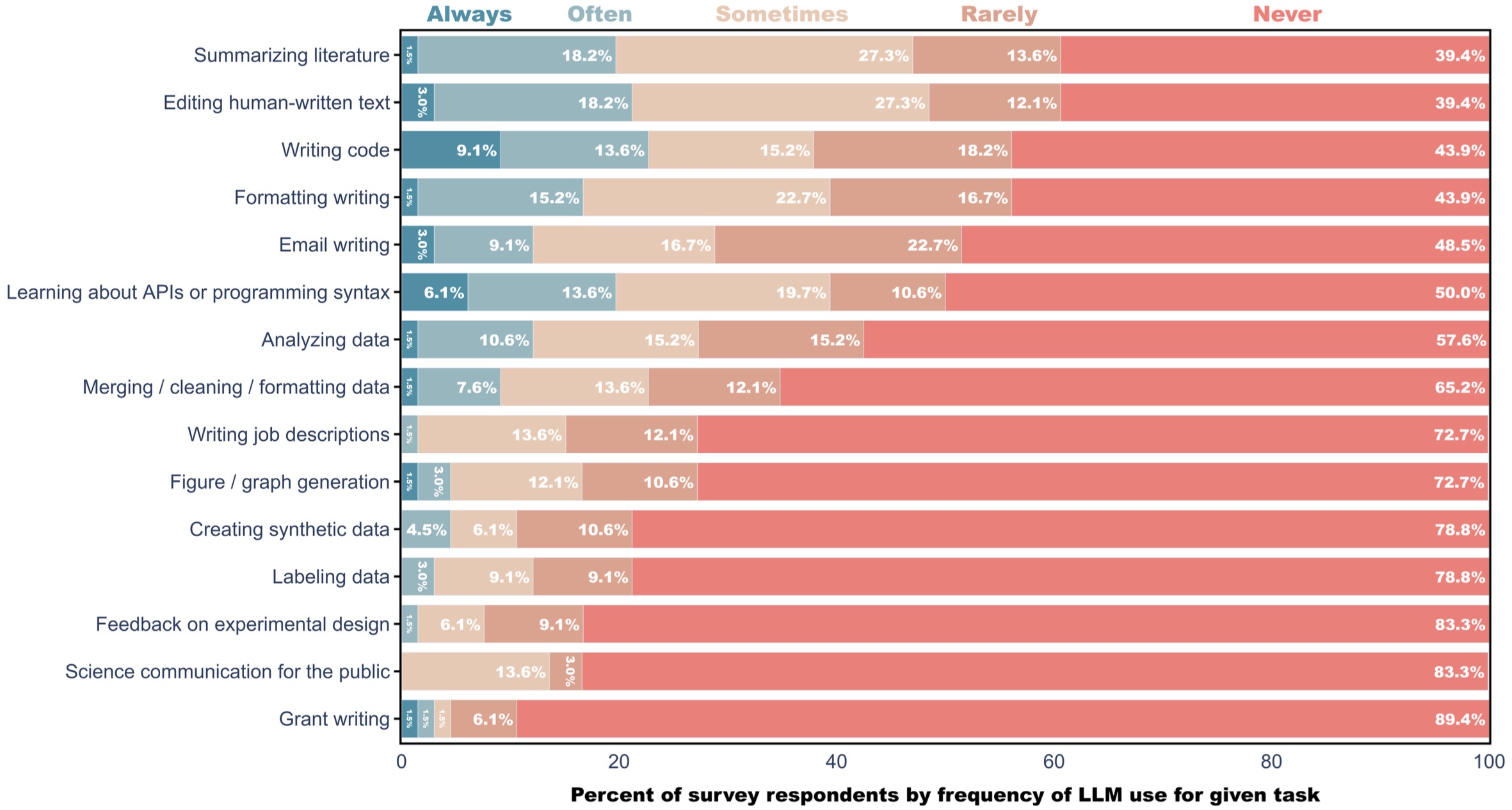
Current applications primarily focus on generating or refining structured text and code that can be easily verified:
- Email writing with adjusted tone
- Report drafting following standardized formats
- Academic paper introductions and grant proposals
- Code development (especially repetitive or template-based scripts)
- Language translation and writing assistance
These applications are valued for reducing emotional labor and time spent on routine writing tasks.
The Future of AI in Science: Envisioning Advanced Applications
Participants envisioned more advanced applications in two categories:
- Advanced Copilot – Extracting Insights: Using LLMs to analyze large, unstructured text data, such as:
- Interactive analysis of scientific literature
- Mining public data sources for trends
- Summarizing meeting transcripts and team surveys
- Retrieving information from organizational policies
- Finding connections across siloed datasets
- Workflow Agent: Automating or semi-automating complex tasks:
- Science: Automating data analysis pipelines, operating scientific instruments, and eventually developing an “AI scientist” capable of generating and testing hypotheses
- Operations: Automating instrument safety checks, project management tasks (prioritization, Gantt chart creation), and database interactions

Divergent Applications: Comparing AI Use in Science and Operations
Both teams show similar usage patterns, but with domain-specific applications. Science teams use generative AI for academic writing, code development, and scientific data analysis. Operations teams apply it to communication tasks, project management, and automating administrative processes. Scientists often focus on technical tasks like writing code for experiments and summarizing complex research, while Operations staff focus on automating administrative processes, creating safety reports, or organizing project plans. Both groups see potential in using AI for time-consuming or repetitive tasks.
Key Concerns: Addressing Risks of Generative AI in Science
Five primary concerns emerged:
- Reliability/Hallucinations: The tendency of generative AI to produce incorrect information with high confidence – particularly problematic where accuracy is crucial.
- Overreliance: Concerns that users might trust AI outputs without sufficient verification.
- Privacy and Security: Risks of sharing sensitive, classified, or unpublished data with commercial AI models.
- Academic Integrity: Uncertainty about appropriate use of AI in scientific publications, citation practices, and potential for AI-generated research fraud.
- Job Impacts: Questions about how generative AI might affect hiring, required skill sets, and certain roles.
Reliability concerns were mentioned most frequently.
Data Privacy and Security
Many organizations are deploying private instances of LLMs (like Argonne’s Argo) that:
- Do not store user queries or model responses
- Don’t share data with third-party services
- Operate behind organizational firewalls
- Require secure authentication
Organizations need clear guidelines about data sharing and to ensure internal AI tools remain competitive.
Job Impacts: How Generative AI is Reshaping the Scientific Workforce
The study found mixed opinions. Participants in specialized scientific roles generally viewed AI as an enhancing tool, not a replacement. However, there was more concern about roles involving routine information processing or communication. Managers indicated that generative AI would likely change required skills rather than reduce overall headcount, with greater emphasis on AI literacy, critical evaluation of AI outputs, and human skills.

Recommendations for Implementing Generative AI
The researchers recommend:
- Focus on privacy and security: Protect sensitive data, including deploying secure internal AI tools.
- Develop clear policies: For publication practices, citation methods, and appropriate data sharing.
- Design specialized copilots: With organization-specific knowledge for email tone, report structures, and internal documentation.
- Support workflow agent development: Provide templates and scaffolding for employees to customize.
- Be transparent: About how AI will affect future hiring and valued skills.
- Create knowledge-sharing mechanisms: For employees to share effective prompts and customized agents.
- Consider a single organizational copilot: Due to the overlap of needs between Science and Operations.
Strategies for Safe and Effective Implementation
Teams should:
- Identify workflows or writing tasks where AI offers clear efficiency gains with minimal risk
- Provide staff with a vetted, internal AI option, and outline data handling policies
- Provide regular training on AI’s limitations, including how to spot inaccuracies or bias
- Maintain human oversight in critical tasks
- Focus on tasks where LLMs provide the most value (e.g., summarization, formatting) while leaving critical analysis to humans
- Emphasize verification and critical evaluation of LLM outputs
- Design systems that augment human capabilities, not replace them
Building Better AI: Lessons from Real-World Deployments
Technical teams should:
- Design for domain-specific needs: Create interfaces that understand the specialized vocabulary and workflows
- Build reliable citation mechanisms: Implement systems that track and cite sources
- Develop customizable workflow agents: Create frameworks that allow non-technical users to build and modify autonomous AI processes
- Implement robust privacy controls: Design systems that clearly indicate what data is being stored or shared, with appropriate security measures
- Focus on structured data extraction: Address the demand for tools that can intelligently query unstructured text data
- Create integration pathways: Develop APIs and connectors to scientific instruments and specialized databases
- Build evaluation metrics: Implement ways for users to understand the confidence and reliability of AI outputs
- Address organizational level concerns: Consider how to craft a generalized basic workflow agent or template agent that can be adapted by employees in multiple roles and with a range of technical skills
Support our work by subscribing to our newsletter📩
Related Content
- [Source paper] Generative AI Uses and Risks for Knowledge Workers in a Science Organization
- The State of Generative AI in America: First National Study Reveals Adoption Patterns and Productivity Gains
- What AI Teams Need to Know for 2025
- The Real Story of AI in Code
- Rethinking Analyst Roles in the Age of Generative AI
- The Highs and Lows of Generative AI