

Over the past few weeks, I have had a lot of conversations with people who are genuinely worried about what AI means for their careers. Not just developers, but marketers, analysts, lawyers, and others who are starting to wonder how much of their job will exist in 2-3 years. The anxiety is real and not entirely misplaced. Psychiatrists studying AI-driven job loss are warning about something beyond the usual economic disruption: they argue that serial job loss and chronic occupational uncertainty threaten the psychological foundations of adult life in ways that income replacement alone cannot fix. That got me to sit down with Evangelos Simoudis for an unplanned podcast on exactly this topic. What came out of that conversation, and from the research I have been reading, is a practical list of things knowledge workers can do right now to stay valuable.
1. Build a working rhythm with AI, not just a habit of using it. The most productive people in AI adoption studies are not the heaviest users. They have a disciplined loop: direct the AI, check what it produces, refine, repeat. Fully handing off complex tasks produces mixed results. Keeping judgment in your own hands consistently does better. Learn to prompt well, spot-check outputs, and iterate fast. That loop is the skill.
2. Treat verification as a primary skill, not a secondary check. Research finds that whether AI makes you more or less valuable comes down largely to how well you catch what it gets wrong. Workers who verify reliably produce better results. Workers who struggle tend to hand off too much, and quality drops even when the AI is performing fine. Small differences in verification ability lead to big differences in outcomes. If you cannot tell when AI is wrong, your employer will notice before you do.
3. Know when not to hand a task to AI. The best workflow is not always more delegation. Workers tend to over-rely on AI on harder tasks, which is exactly when AI is least accurate and mistakes are hardest to catch. Knowing when to use AI, when to verify carefully, and when to just do the work yourself is a genuinely valuable skill. Being fast with AI tools is not the same as being reliable, and employers are starting to tell the difference.

4. Spend more time defining problems than executing solutions. Workers whose main job is carrying out known procedures face the highest automation risk. The defensible position is upstream: deciding which problems matter, what constraints matter, and how success should be measured. If your job is mostly applying known steps to familiar problems, AI is coming for that work first. The durable skill is not just execution. It is setting direction.
5. Develop precision in articulating intent. Knowing what problem to solve is only half the job. You also have to describe it clearly enough that an AI cannot misread it: naming constraints, edge cases, and what a good result actually looks like before the work starts. This is already being called spec-driven development in software, but the skill is not technical. It looks the same whether you are a lawyer briefing an AI on what a clause must and must not allow, a marketer specifying tone guardrails before a campaign runs, or an analyst defining what the model should not infer. Vague intent produces vague output, and the gap shows up immediately in what comes back.
6. Develop systems thinking across the full business process. As AI handles more individual tasks, the premium shifts toward people who understand how an entire process fits together. Someone who only knows their corner of a workflow is more exposed than someone who understands the end-to-end process and can spot where AI belongs in it. In most organizations still figuring out AI adoption, this kind of thinking is rare enough to be a real differentiator.
7. Reframe AI as a colleague you manage, not a tool you operate. Software developers seeing the largest gains stopped treating AI as sophisticated autocomplete and started treating it as a team member: someone work gets delegated to, whose output gets reviewed, and whose limitations get planned around. This changes how you scope tasks and how you hold yourself accountable for results, because you are now the manager of the output. Similar workflows are likely to spread well beyond software into accounting, legal analysis, and other knowledge-work domains.

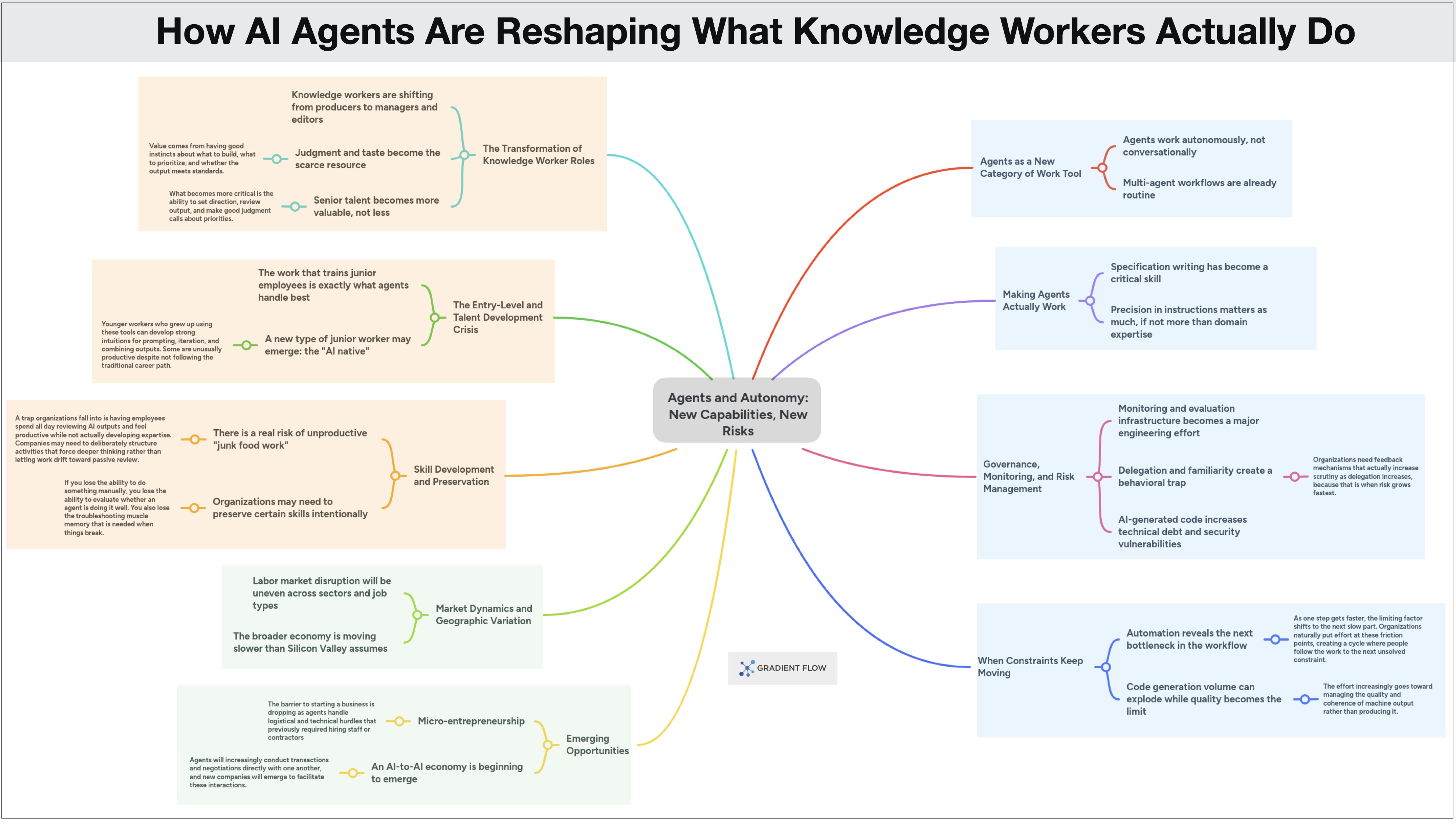
8. Invest in domain expertise that cannot be written down. Generic, codifiable skills are easier for AI to absorb and easier for employers to replace. The durable investment is deep knowledge of a specific process, environment, or problem set, the kind that comes from years of experience rather than reading a manual. Knowing which edge cases matter, which heuristics hold up, and which approaches work even though no textbook recommends them, that kind of tacit knowledge is hard for AI to replicate and hard for employers to substitute away. It compounds over time. Codified skills do not.
9. Make your actual contribution visible and verifiable. AI is flattening the visible difference between strong and average workers, and employers are responding by leaning harder on track records. Make your judgment visible: document the reasoning behind key decisions, write up problems you diagnosed that others missed, build a record of outcomes tied directly to your work. Polish is easy to fake now. Evidence of judgment is not.

10. Pay attention to how your work product is being used. Unlike published content, the expertise of most knowledge workers is not protected by copyright. There is a real and growing risk that employers are feeding internal work product into model training pipelines without clear frameworks for worker ownership. You do not need deep technical knowledge to track this, just awareness and a habit of following how your company’s policies around AI training data are evolving. It matters most for senior people whose accumulated know-how is quietly becoming part of someone else’s training data.
11. Prepare financially and structurally for a less stable career. Senior tech workers with 15-plus years of experience are already shifting toward financial resilience: larger cash reserves, lower fixed costs, and an expectation of more frequent job changes. It is also worth asking whether your skills could support splitting time across more than one employer. AI-driven productivity gains may reduce the total hours any one company needs from a given worker, even one who has adapted well. Treating your career as a portfolio of engagements is a reasonable hedge against that shift.
As AI masters execution, the ultimate human skill moves upstream: defining the right problems and setting the constraints.
What This List Cannot Fix
This list is built for a specific scenario: that AI reshapes knowledge work substantially but does not eliminate the need for skilled people, or that we land somewhere in an uneven, messy middle. I will be honest, though. I lean toward the more disruptive end of that spectrum. The pace at which AI is compressing routine cognitive work, combined with how unprepared most institutions are for what comes next, makes me skeptical that individual adaptation alone will be enough for most workers. The list above is still worth working through. But it is worth being clear about what kind of response it represents.

Behavioral scientists use two terms that are useful here. The i-frame focuses on what individuals can do to navigate a problem within the existing system. The s-frame asks whether the system itself needs to change. This list is entirely i-frame: upskill, reposition, save more, adapt. Those are real and worthwhile moves. But if AI displaces knowledge workers at a scale that individual adaptation cannot absorb, what is actually needed are s-frame responses: updated labor protections and tax codes, serious retraining infrastructure, legal frameworks around worker ownership of AI training data, and political leadership willing to treat this as a first-order problem. None of that exists in coherent form right now. The affected population is large, the anxiety is real, and the political opening is sitting there unclaimed. AI’s impact on employment could easily become a defining issue in the 2028 presidential race. It will depend on whether a skilled political figure decides to make it one.
