

Following the release of DeepSeek-V3 and DeepSeek-r1, a torrent of articles has flooded the media, igniting debates over the intensifying U.S.-China AI competition and heralding the rise of open, cost-effective foundation models that challenge established leaders like OpenAI, Google, and Anthropic. While Alibaba Qwen had already proven that China could deliver competitive open models, DeepSeek’s breakthrough has captured the attention of Western companies, signaling a new era in AI development. Below is a curated list of practical lessons and actionable strategies designed for AI application teams, distilled from this pivotal moment in the AI landscape.

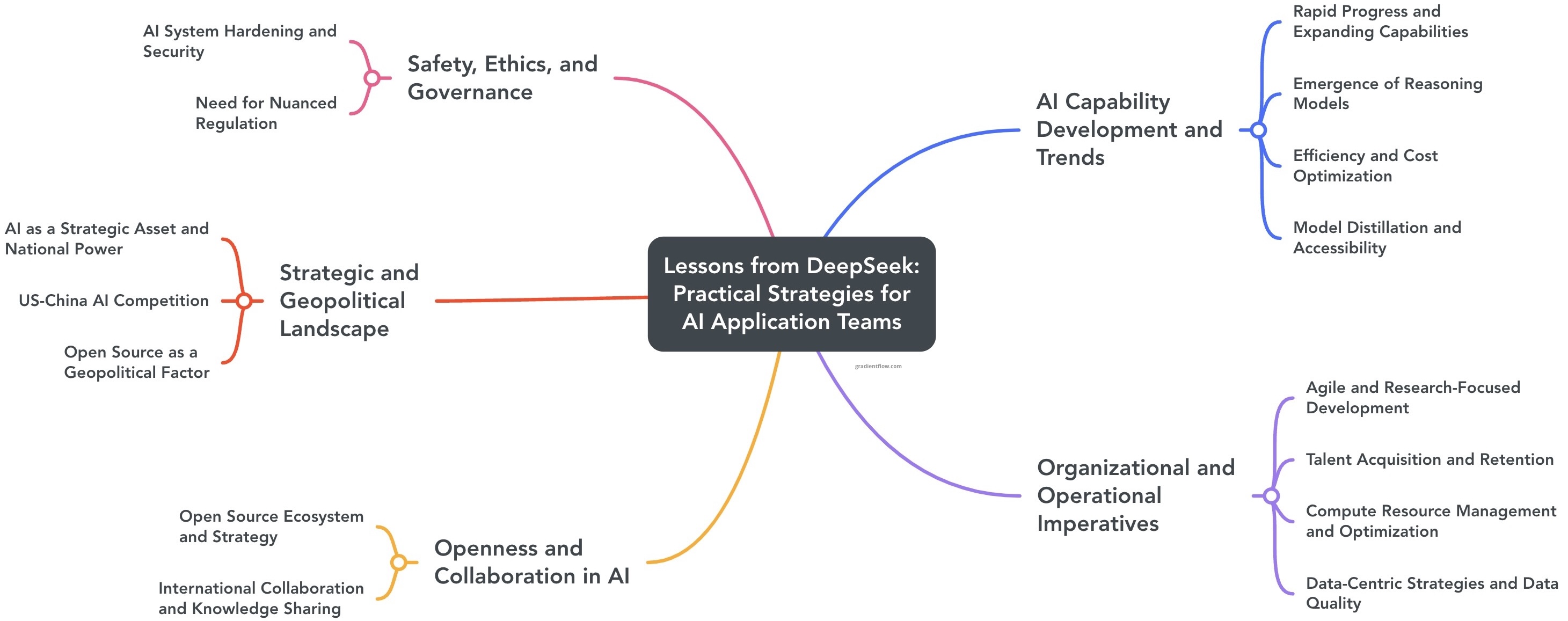
1. Key Capability Trends and Opportunities
Faster, Smarter, More Accessible AI
What’s Happening:
- Rapid Performance Gains & Cost Reduction: Training costs for advanced models are beginning to fall. This enables faster iteration and higher performance without the need for massive budgets.
- Emergence of Reasoning Abilities: New models like DeepSeek’s r1, alongside others from OpenAI and Google, are beginning to demonstrate step-by-step reasoning, self-correction, and multi-step decision-making. These advances open up application areas that require logical inference and strategic planning.
- Shrinking Global Capability Gaps: The competitive landscape is becoming more global. Teams from China are closing the performance gap, offering diverse approaches and fostering healthy competition.
Actionable Advice for Your Team:
- Adopt Agile Development Practices: Build modular architectures and implement agile sprints and CI/CD pipelines. This ensures you can quickly integrate emerging capabilities and adapt to rapid changes.
- Prioritize Continuous Learning: Set aside dedicated time for your team to explore new models, techniques, and research trends. Encourage participation in AI communities and knowledge-sharing sessions.
2. Optimizing Efficiency and Resources
Doing More with Less
What’s Happening:
- Model Optimization Techniques: Techniques such as model compression, quantization, and distillation are transitioning from research topics to essential tools for deployment. They allow you to run sophisticated models on less powerful hardware.
- Strategic Compute Management: Efficient resource use is crucial. Beyond traditional GPUs, distributed training, hardware–software co-optimization, and alternative hardware (like TPUs or specialized accelerators) are key to cutting costs.
Actionable Advice for Your Team:
- Integrate Optimization Early: From the design phase, incorporate model optimization techniques. Evaluate serverless or cloud-based architectures that offer cost-effective scalability.
- Benchmark Diverse Hardware Options: Run comparative tests on CPUs, GPUs, TPUs, and other accelerators to determine the best cost-performance mix for your workloads.
3. Data as a Strategic Asset
Fueling Model Performance
What’s Happening:
- Quality Over Quantity: High-quality, well-curated data remains the foundation of successful AI applications. Clean, representative datasets can outperform larger, lower-quality ones.
- Data-Centric Strategies: Rigorous data cleaning, validation, and augmentation practices are becoming as critical as model architecture. There’s also a growing trend toward leveraging open data and forming strategic partnerships.
Actionable Advice for Your Team:
- Invest in Data Excellence: Establish automated data quality checks and clear governance policies. Allocate resources specifically for data preparation and enhancement.
- Pursue Data Partnerships: Look for opportunities to access diverse datasets through collaborations with government agencies, industry consortia, or open data initiatives.
4. Talent and Agile Teams
The Human Element of AI Innovation
What’s Happening:
- Attracting Top Talent: In today’s competitive landscape, it’s not enough to offer high salaries. Top AI talent is drawn to environments that offer autonomy, growth, and impactful work.
- Agile, Research-Focused Environments: Emulating the best aspects of academic research labs—such as flat hierarchies and rapid iteration—can drive innovation and empower teams to experiment freely.
Actionable Advice for Your Team:
- Invest in Your People: Create a culture that rewards innovation and continuous learning. Provide opportunities for professional development and ensure your compensation and benefits are competitive.
- Empower Through Organizational Agility: Implement flatter organizational structures and encourage cross-functional collaboration. Give teams the autonomy to experiment, make decisions, and learn from both successes and failures.
5. Leveraging Open Source for Innovation and Global Collaboration
Harnessing Transparency to Democratize AI
What’s Happening:
- Driving Innovation Through Openness: Open source AI is accelerating technical innovation through transparency and collective learning. DeepSeek’s commitment to open source serves as a model for how sharing tools and code can lead to faster development cycles and cost reductions.
- Geopolitical and Collaborative Benefits: Open source initiatives not only challenge proprietary models but also foster international partnerships—especially in emerging economies. This democratization of technology can help balance competitive pressures on a global scale.
- Balancing Benefits with Risks: While open source offers substantial benefits, it also brings risks such as potential misuse and intellectual property challenges. Effective engagement with the open source ecosystem requires robust security safeguards and clear policies.
Actionable Advice for Your Team:
- Integrate Open Models & Tools in Your Workflow: Leverage open source tools and platforms to reduce development costs and accelerate innovation. Contribute back to the community to build credibility and influence standards.
- Develop Open Source Policies: Establish internal guidelines to manage intellectual property risks while capitalizing on the benefits of transparency and collaboration. Consider forming partnerships with other organizations to co-develop and share resources.
- Stay Informed on Global Trends: Recognize that open source is not just a technical strategy—it’s a geopolitical tool. Monitor international initiatives and regulatory developments to ensure your strategies remain aligned with global best practices.
6. Navigating the Geopolitical and Ethical Landscape
Responsibility in a Global AI World
What’s Happening:
- Geopolitical Dynamics: The intensifying US-China competition and the global race for AI leadership have implications for technology transfer, international collaboration, and market access.
- Ethical and Regulatory Considerations: With growing AI capabilities comes an increased focus on security, ethics, and responsible innovation. Whether through open source or proprietary models, safeguarding technology against misuse is critical.
Actionable Advice for Your Team:
- Maintain Global Awareness: Factor in geopolitical risks when planning international collaborations. Stay informed about regulatory developments in key markets.
- Commit to Responsible Innovation: Develop internal ethical guidelines and robust security protocols. Balance the drive for innovation with the need for risk mitigation, ensuring that your AI deployments are both powerful and trustworthy.
Conclusion
DeepSeek’s recent model releases will catalyze a new wave of AI innovation. By prioritizing agile development, efficiency, high-quality data, empowered talent, and responsible practices, your team can not only keep pace with these rapid changes but also lead the way in building scalable, competitive AI applications. Now is the time to act—embrace these lessons and position your team at the forefront of the AI revolution.
If you enjoyed this post, consider supporting our work by leaving a small tip💰 here and inviting your friends and colleagues to subscribe to our newsletter📩