

Table of Contents
Understanding MCP Basics
What is the Model Context Protocol (MCP)?
The Model Context Protocol is an open standard designed to provide a standardized way for AI models (particularly large language models) to access context from various data sources and tools. Its creator, Anthropic, describes MCP as a “USB-C for AI applications” – a universal connector that enables AI systems to access external tools, databases, and resources through a consistent interface, regardless of which specific LLM or framework is being used. MCP creates a portable, consistent layer for context management that works across different models and implementations. Just as HTTP standardized web communications, MCP is standardizing how LLMs and foundation models interact with organizational knowledge.
What fundamental problems does MCP aim to solve?
MCP addresses several critical challenges in AI development:
- Context Fragmentation. Different AI frameworks (e.g., AutoGPT, BabyAGI, LangChain) use incompatible methods for handling contextual data, forcing developers to implement custom integrations for each platform.
- The “M×N” Integration Problem. With M AI applications needing to connect to N tools/data sources, developers potentially need to build M×N custom integrations – an unsustainable situation with duplicated effort.
- Dynamic Context Access. LLMs struggle to retrieve real-time information from external systems (calendars, databases, APIs), leading to hallucinations or stale responses.
- Limited Context Windows. LLMs have fixed token limits and can lose track in complex interactions or when handling large amounts of information.
- Interoperability Gaps. There’s no standardized way for AI tools from different vendors or frameworks to exchange context securely.


Why are these context management problems significant for AI applications?
These challenges substantially impact AI reliability, development efficiency, and practical utility:
- Reduced Reliability. Without access to accurate, up-to-date data, AI assistants provide incorrect or stale responses, undermining user trust. Studies show significant accuracy drops in workflows requiring real-time data.
- Development Inefficiency. Fragmentation forces developers to rewrite context handling for each model/framework, requiring substantial development time when switching AI frameworks.
- Limited Practical Capabilities. Complex AI workflows (travel planning, medical diagnostics, coding assistance) require coordinating multiple tools and data sources, which is nearly impossible without standardized context management.
- Poor User Experience. AI assistants seem “forgetful,” losing context when switching tasks or applications, forcing users to repeat information.
- Security Vulnerabilities. Ad-hoc context piping increases exposure of sensitive data, as custom integrations often implement inconsistent security practices.
- Ecosystem Lock-in. Developers get trapped in specific frameworks or vendor ecosystems, limiting flexibility and increasing dependency risks.
Can you provide a concrete example of how context fragmentation affects AI applications?
Consider an AI assistant that helps plan travel. It needs to:
- Check your calendar for availability (requires calendar API access)
- Understand your preferences (needs access to your profile/history)
- Search for flights (needs travel API integration)
- Book hotels (requires another API)
- Add the bookings to your calendar (back to calendar API)
Without MCP, developers must create custom integrations for each data source with each AI model/framework they want to use. If they switch from GPT to Claude, or from a custom solution to LangChain, they must reimplement all these integrations. This fragmentation makes building sophisticated, reliable AI assistants prohibitively complex and maintenance-heavy.
Current Approaches and Their Limitations
What methods do developers currently use to provide context to LLMs, and why are they insufficient?
None of the alternative approaches listed below provide a universal, portable, standardized protocol for context and tool interaction, which is the gap MCP fills.


Why can’t developers simply use existing API standards like REST or GraphQL for AI tools?
While traditional API standards work well for programmatic access, they weren’t designed with AI-specific needs in mind. They lack built-in concepts for:
- Natural language interaction patterns
- Dynamic capability discovery (letting the AI learn what tools are available)
- Iterative, conversational workflows that characterize LLM usage
- Context management across multiple exchanges
MCP is specifically designed to bridge the gap between structured APIs and the more fluid, natural language-oriented way that LLMs operate, making it more suitable for AI-native applications.
How MCP Works
How does MCP work architecturally? What are the key components?
MCP uses a client-server architecture inspired by protocols like the Language Server Protocol (LSP):
- MCP Host: The main AI application (e.g., Claude Desktop, an AI-powered IDE like Cursor)
- MCP Client: A component within the Host that manages communication with MCP Servers
- MCP Server: A separate process or service that exposes specific external capabilities (tools, data, etc.)
Communication happens via standardized JSON-RPC 2.0 messages, typically over STDIO (for local servers running as subprocesses) or HTTP/SSE (for remote/networked servers). This architecture decouples the AI application from the specific implementations of tools and data sources.
What types of capabilities can an MCP Server provide? Are there practical examples showing how MCP improves AI applications?
Several real-world implementations demonstrate how MCP enhances AI applications:
- AI-powered code editors. Development tools like Cursor, Replit, Sourcegraph, and Codeium use MCP to provide AI assistants with seamless access to relevant code context, repository structure, and documentation. This enables more accurate code suggestions, bug fixes, and contextual help without requiring custom integrations for each codebase format.
- Customer support systems. Support chatbots leverage MCP to retrieve up-to-date company policies, product information, and customer data from various sources. For example, an MCP server might connect to both a knowledge base and CRM system, allowing the AI to provide personalized assistance while maintaining consistent responses based on current information.
- Medical diagnostic systems. MCP has been applied in specialized healthcare applications, such as intracranial hemorrhage detection, where AI assistants can securely integrate with multiple patient data sources, medical image repositories, and clinical guidelines to provide comprehensive analysis.
- Data analysis workflows. Business intelligence applications use MCP to create seamless data exploration experiences where users can ask natural language questions, and the AI can dynamically query databases, generate visualizations, and explain insights—all while maintaining context across multiple analytical steps.
- Enterprise integrations. Companies like Block (formerly Square) are implementing MCP to connect AI assistants with internal tools and databases, reducing development overhead and enabling more sophisticated automation of complex business processes that span multiple systems.
How does an AI application discover what an MCP server can do?
MCP supports dynamic discovery through standard endpoints. When an MCP client connects to a server, it can query endpoints like tools/list, resources/list, and prompts/list. The server responds with machine-readable descriptions of its available capabilities, including names, descriptions, schemas, and required permissions. This allows AI applications to adapt at runtime to whatever capabilities are available, without needing pre-configuration for every possible server.
MCP in the AI Ecosystem
How does MCP compare to other protocols like Google’s Agent2Agent (A2A)?
Based on their respective design goals and documentation, MCP and A2A address different, complementary aspects of AI interoperability:
- MCP. Focuses on how a single AI agent connects to its external tools and data sources (agent-to-tool communication). It’s like defining how plugins or extensions work in a browser.
- A2A. Focuses on standardizing communication between different AI agents (agent-to-agent communication), enabling agents to collaborate or delegate tasks. It’s like defining how microservices or peers communicate.
These protocols can work together in a complete AI ecosystem – MCP handling how agents access tools and data, and A2A handling how agents coordinate with each other. Major players like Google and Microsoft appear to view them as complementary standards.
How does MCP fit into the broader AI tooling landscape?
MCP serves as a foundational layer in the AI technology stack:
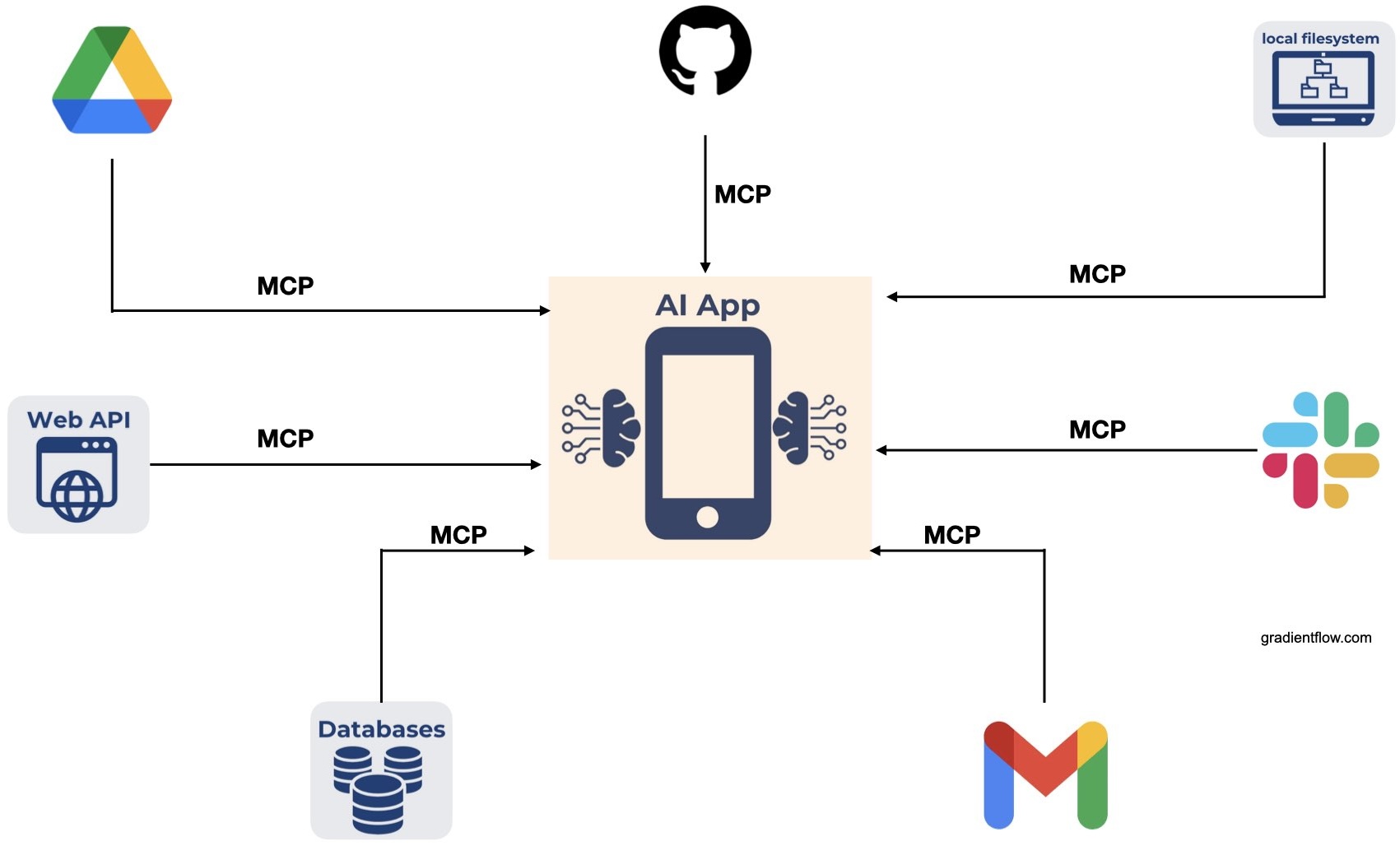
- It complements rather than replaces existing technologies – RAG systems can be exposed through MCP’s resource mechanism, function calling can be implemented via MCP tools, and agent frameworks can use MCP for standardized tool access.
- By providing a standardized interface, MCP enables a more modular, composable approach to building AI applications where components can be easily swapped or upgraded.
- MCP transforms the M×N integration problem into an M+N problem – each AI application and each tool only needs to implement MCP once to be compatible with the entire ecosystem.
Adoption and Real-World Impact
What are some early signs of MCP’s adoption and success?
Despite being relatively new, MCP has shown strong signs of adoption:
- Key Adopters. Companies like Anthropic (native in Claude Desktop), Block (Square), Apollo, and developer tool makers (Replit, Sourcegraph, Codeium, Cursor, Zed, JetBrains) have integrated or experimented with MCP. Major players like Microsoft, OpenAI, Google, and Cloudflare are also engaged.
- Real-world Applications. MCP has been applied in coding assistance, in data analysis including MCP servers that expose databases, and various enterprise integration scenarios.
- Developer Ecosystem. GitHub repositories dedicated to MCP show high engagement (stars, forks), with SDKs available for multiple languages (Python, TypeScript, Java, C#). Active forums and communities discuss MCP implementation and best practices.
- Integration Growth. Thousands of MCP server implementations have been created connecting to various services (Slack, GitHub, Google Drive, Notion, databases, etc.).
How can we measure the vibrancy of the MCP ecosystem?
Several metrics indicate MCP’s ecosystem health:
- Implementation Count. Number of MCP servers available (over 1,000 within months of launch)
- GitHub Metrics. Stars, forks, and active contributors to MCP repositories
- Corporate Adoption. Number and diversity of companies incorporating MCP
- Community Engagement. Activity in forums, educational resources, and hackathons
- Integration Breadth. Variety of systems and data sources connected via MCP
- Reported Efficiency Gains. Teams using MCP report significant improvements in development efficiency and reduced integration times.
Security Considerations
The following security analysis extends general security principles with additional expert classification of potential vulnerabilities and specific mitigation strategies that organizations should consider when implementing MCP.
What security concerns exist with MCP implementation?
MCP’s power to connect AI models with external systems introduces significant security considerations:
- Access Control Concerns. When LLMs can access external systems through MCP tools, particularly those with filesystem access, there’s a risk they could be manipulated to perform unauthorized actions on sensitive files or system configurations.
- Authentication Vulnerabilities. Without proper security measures, attackers could potentially prompt LLMs to use MCP tools to modify authentication settings or access credentials.
- Data Exfiltration Risks. LLMs connected to multiple data sources through MCP might be susceptible to prompts designed to extract and expose sensitive information across systems.
- Content Poisoning. Documents accessed through retrieval-based MCP servers could potentially contain embedded instructions that, when processed by an LLM, lead to unintended tool usage or data access.
- Trust and Verification Issues. The decentralized nature of MCP server distribution creates challenges in verifying the authenticity and security of servers before integration.
Research indicates that relying solely on LLM guardrails is insufficient to prevent these types of security issues, as even sophisticated models can potentially be manipulated through carefully crafted prompts.
How can developers mitigate MCP security risks?
A multi-layered approach is necessary:
- Server Hardening. Implement strict security measures – limit file access to specific directories, validate inputs rigorously, avoid exposing overly powerful tools, implement proper authentication/authorization.
- Client-side Caution. Be selective about which MCP servers you connect to. Verify sources and limit permissions. Avoid running untrusted servers or using unofficial installers without scrutiny.
- Proactive Auditing. Use or develop tools that scan MCP server configurations before deployment to identify potential vulnerabilities.
- Monitoring & Logging. Implement robust monitoring for MCP interactions to detect anomalous behavior.
- Secure Defaults. Follow security best practices like strict file permissions and least privilege principles.
- Formalized Ecosystem. Work toward establishing official package management, server registries, and cryptographic signing for MCP servers.
Getting Involved
What’s on the roadmap for MCP’s future development?
MCP is under active development with several key priorities:
Short-term (next 6 months):
- Creating validation tools and compliance test suites to ensure consistency
- Developing reference client implementations and example applications
- Building a centralized MCP Registry for easier server discovery and installation
Longer-term:
- Supporting complex, multi-agent workflows (“Agent Graphs”)
- Adding multimodal capabilities (images, audio, video)
- Enhancing security features and permission models
- Establishing formal governance structures and standardization
How can developers get involved with MCP?
There are multiple entry points for engaging with MCP:
- Start Using It. Integrate existing MCP servers into your AI applications using official SDKs (Python, TypeScript, Java, C#, etc.).
- Build Your Own Servers. Create MCP servers that expose your tools, APIs, or data sources. Consider open-sourcing them for the community.
- Contribute to Core Development. Help improve the protocol specification, SDKs, documentation, or testing through the official GitHub repositories.
- Join the Community. Participate in forums, working groups, and discussions to help shape MCP’s evolution.
- Create Supporting Tools: Develop tools that enhance the MCP ecosystem – server discovery platforms, security scanners, or testing frameworks.
- Share Knowledge. Write tutorials, create examples, or present at meetups to help others understand and adopt MCP.
Platforms like GitHub, dedicated Slack channels, and community forums offer ways to connect with other MCP developers.
Why should teams building AI applications pay attention to MCP?
MCP offers several strategic advantages for AI application developers:
- Reduced Integration Overhead. Standardizing context access significantly reduces the amount of custom “glue code” teams need to write.
- Future-Proofing. As the AI landscape evolves, MCP helps insulate applications from underlying model changes.
- Improved Reliability. By ensuring consistent access to up-to-date information, MCP helps reduce hallucinations and inaccurate responses.
- Accelerated Development. Teams can focus on core application features rather than reinventing context integration mechanisms.
- Ecosystem Benefits. As more tools become MCP-compatible, each new implementation becomes immediately useful across the entire ecosystem.
By adopting MCP, teams can build more capable, reliable, and maintainable AI applications while leveraging the growing ecosystem of compatible tools and resources.