

I. Global Strategy, Geopolitics & Governance
Emergence of a Global AI Race
The AI Action Summit highlighted the intensifying international competition in AI, with major players like the US, EU, and China strategically positioning themselves to lead in development and deployment.
- Teams should be aware of how this geopolitical contest influences funding flows, partnerships, and market access, and plan strategically to navigate potential trade barriers and localized incentives.
Diverging National AI Strategies: US vs. EU vs. UK
Different regions are solidifying distinct AI approaches: the US is pursuing deregulation and rapid innovation; the EU is emphasizing ethical, inclusive, and sustainable practices; and the UK is focusing on national security and defense applications.
- Tailoring products to meet these diverse priorities is crucial for global market success—prioritize speed and performance for the US, ethical adherence for the EU, and robust security for the UK.
National Security and Technological Sovereignty Concerns
Countries increasingly view AI as a strategic asset, driving efforts to secure supply chains for critical components, boost domestic capabilities, and protect sensitive infrastructures.
- AI teams should implement robust cybersecurity and consider localization strategies to mitigate risks when entering markets with stringent national security requirements.
Evolving AI Governance and Policy
There is a dynamic shift in policy, marked by trends toward lighter regulation, a rebalancing from safety to economic opportunity, and the continued emphasis on transparency, auditability, and multi-stakeholder accountability.
- Practitioners should proactively integrate safety-by-design and auditability measures in their systems, ensuring they remain compliant and trusted as governance frameworks evolve.

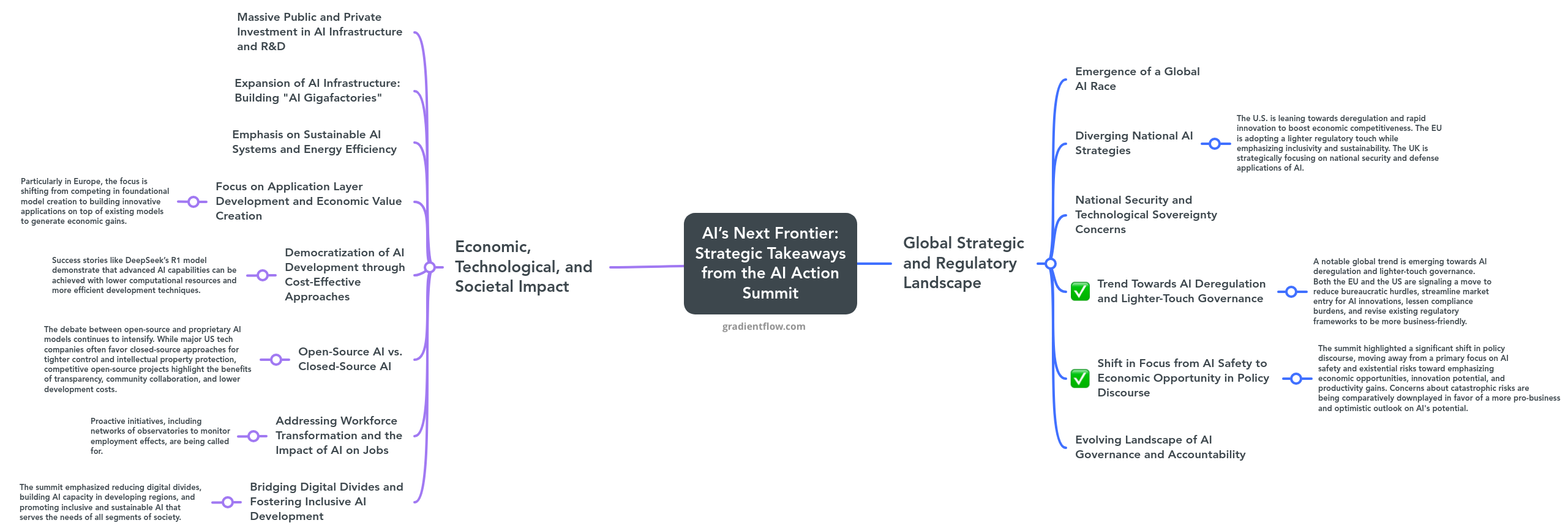
II. Economic, Technological & Societal Impact
Infrastructure and Sustainable Investment
Massive public and private funding is fueling investments in AI infrastructure, including the development of gigafactories and energy-efficient data centers, with a growing focus on sustainability.
- This surge in funding lowers barriers for advanced AI model training and deployment; practitioners should leverage these investments to access scalable compute resources while adhering to emerging environmental standards.
Innovative AI Development and Application
There is a clear trend toward developing practical AI applications that generate tangible economic value by building on existing models and adopting cost-effective, open-source approaches.
- Focusing on specialized tools that demonstrate strong ROI and productivity improvements can help attract investment and drive market adoption, while balancing innovation with responsible development practices.
Inclusive Social Impact and Workforce Transformation
The summit underscored AI’s profound societal implications, from transforming workforces through upskilling to addressing digital divides and promoting inclusive, human-centric AI solutions.
- Teams should design systems that augment human capabilities and invest in initiatives for reskilling and community engagement, ensuring AI’s benefits are broadly shared and socially responsible.
If you enjoyed this post, consider supporting our work by leaving a small tip💰 here and inviting your friends and colleagues to subscribe to our newsletter📩