

Building Trust: Enhancing AI with Private Information Retrieval
As AI co-pilots, virtual assistants, and agents become integral to our daily routines, I’ve been reflecting on how these tools handle our most sensitive queries and requests. Whether it’s confidential medical consultations, private legal advice, or personalized mental health support, how can we trust that our interactions remain truly confidential in an age where digital privacy feels increasingly fragile? This curiosity led me to explore Private Information Retrieval (PIR) and its potential to empower AI applications to provide personalized assistance without compromising user privacy.
PIR is a privacy-enhancing technology that allows users to access specific data from a database or server without revealing to the server which item they are retrieving. Its primary goal is to protect the privacy of the user’s query and access patterns, ensuring that the user’s specific interests remain confidential—even to the entity hosting the data. Importantly, PIR does not encrypt the database—which is still available to the provider—but only protects the privacy of the user’s query.
PIR enables users to securely retrieve sensitive information—such as medical records or financial data—without disclosing their specific queries, fostering a sense of trust and security. By safeguarding user privacy, PIR encourages more open engagement with digital services, as individuals can be confident that their personal interests and data remain confidential. Incorporating PIR allows development teams to create solutions that not only comply with stringent data protection regulations but also enhance user satisfaction and confidence. Furthermore, PIR can serve as a significant competitive advantage, distinguishing services in a marketplace where privacy concerns will continue to grow.

While PIR offers significant privacy benefits, its implementation in AI applications presents a set of challenges that developers must carefully navigate. A primary limitation is the computational overhead; PIR protocols typically require more processing power than traditional data retrieval methods, potentially affecting system efficiency. Moreover, the increased communication between user and server can lead to higher latency and greater bandwidth consumption, which may impact user experience. The security of PIR also hinges on robust cryptographic foundations, and any vulnerabilities in these underlying assumptions could compromise the privacy guarantees that it aims to provide. For teams looking to incorporate PIR into their solutions, it is crucial to understand and mitigate these challenges. Balancing the trade-offs between privacy, performance, and usability is essential to successfully leveraging PIR in real-world applications.
Adding to these challenges, recent studies have highlighted that Retrieval-Augmented Generation (RAG) systems are vulnerable to privacy leaks, emphasizing the importance of implementing solutions like PIR.
PIR in the Real World
Duality is a startup specializing in privacy-enhancing technologies that enable secure data collaboration through homomorphic encryption. In speaking with Duality, I learned that PIR has transitioned from a theoretical idea to a practical, high-performance solution in their offerings. Duality has been pushing the boundaries of what’s possible with Fully Homomorphic Encryption (FHE), enabling confidential queries that allow organizations to run encrypted queries without revealing the predicates. This means that even the data vendor handling the query doesn’t know what’s being searched for, a game-changer for industries like finance and healthcare that are constantly dealing with sensitive information.

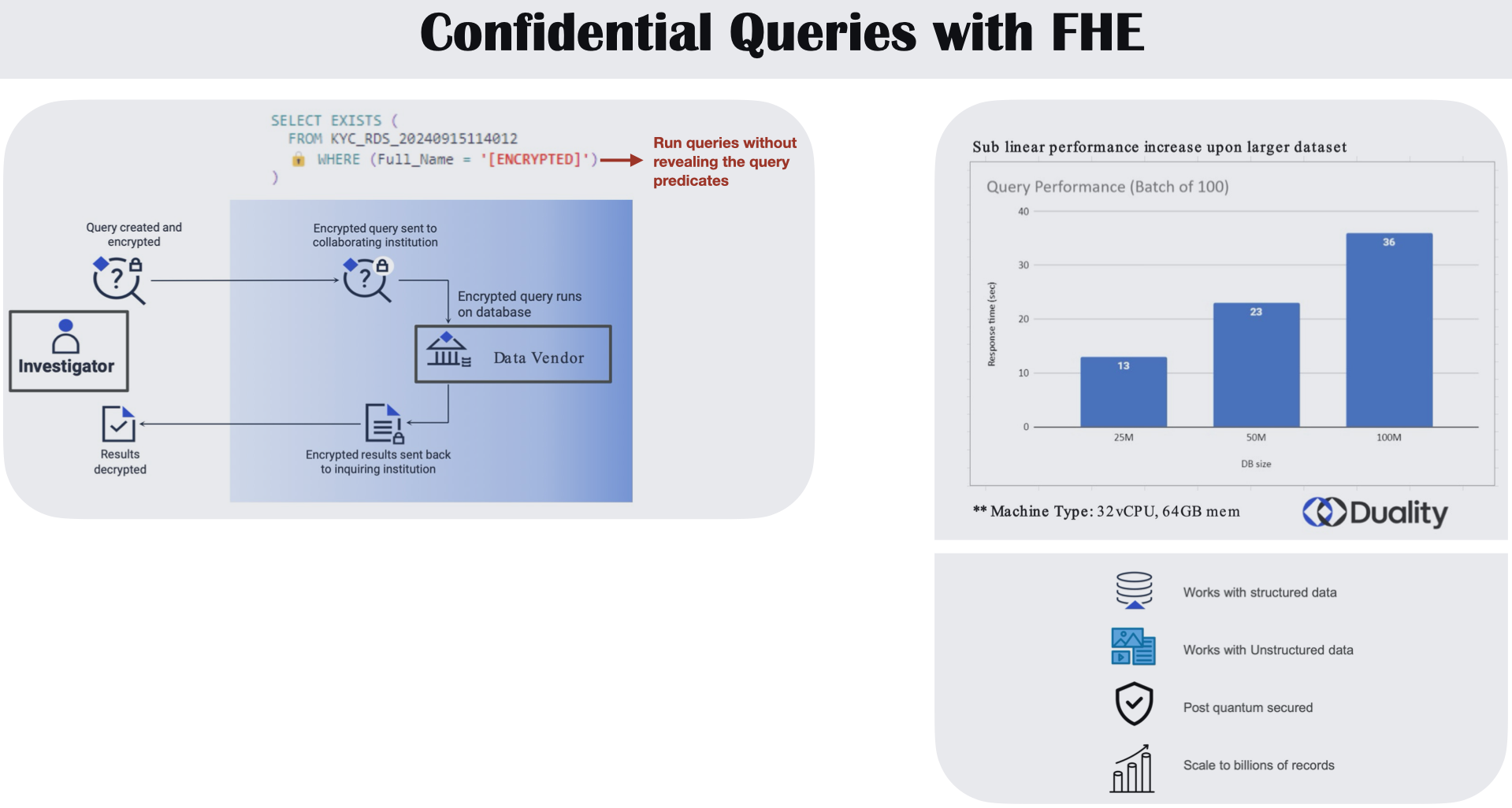
Duality is applying this technology across both relational databases and unstructured data like images and text. They’ve been able to scale these confidential queries to databases with billions of records while maintaining efficiency. It’s important to note that I haven’t directly worked with Duality’s PIR solution. While their approach seems to offer both privacy and performance, readers must determine if it aligns with their scalability, latency, and concurrency expectations.
Privacy and Retrieval-Augmented Generation
RAG is a methodology that enhances generative models by integrating them with external data sources, resulting in more accurate and contextually relevant outputs. The application of privacy-enhancing techniques like PIR to RAG systems presents an intriguing opportunity to ensure user privacy throughout the data retrieval process. This integration could be particularly valuable in scenarios where privacy is paramount, such as healthcare chatbots accessing sensitive patient records or financial planning AI applications retrieving confidential financial data. By implementing PIR, these systems could fetch necessary information without exposing the user’s specific queries or the details of the accessed data, thereby safeguarding user confidentiality.
The graphic below shows an early prototype from Duality where a large vector database is encrypted using FHE. Only a relevant subset of this encrypted data is then pulled into a Trusted Execution Environments (TEE) for secure RAG computation. This method ensures that sensitive information remains protected from cloud and LLM providers throughout the AI generation process. If all the data fits in a TEE, the FHE step can be skipped.

To the best of my knowledge, there are currently no deployed systems implementing the combination of PIR and RAG. However, companies like Duality Technologies are experimenting and developing early prototypes that utilize a combination of FHE and TEE. This hybrid approach aims to maintain privacy during processing while ensuring efficient computation. As this technology matures, it is likely to expand the range of AI applications, enabling solutions that are both highly personalized and privacy-preserving.
Integrating Privacy into RAG, Chatbots, and Agents
The discussion around integrating privacy technologies like PIR into AI applications remains ongoing, with varying perspectives on its importance. Some friends I’ve spoken with feel that users aren’t overly concerned about the privacy of their interactions with AI models. However, I believe that in use cases involving sensitive information—such as confidential medical consultations or personalized mental health support—the privacy safeguards provided by PIR are crucial. The market for such privacy-focused AI assistants and agents is likely to be significant. While challenges like computational complexity and latency exist, early progress by companies like Duality demonstrates that balancing privacy with performance is possible. Teams developing AI solutions should begin exploring these technologies now to stay ahead in a future where privacy becomes a key differentiator.


In practical terms, developers should focus on identifying high-value use cases where privacy concerns are top of mind and essential. By prototyping small-scale systems that combine privacy-enhancing tools with AI, they can begin to understand the trade-offs and limitations, positioning themselves ahead of future regulatory and market demands.
Given the demonstrated privacy risks in RAG systems highlighted by recent research, it’s imperative for AI teams to explore integrating technologies like PIR. While widespread adoption may take time, experimenting with these privacy-enhancing technologies now can create a competitive edge as privacy becomes a key differentiator in AI-driven products and services.

Explore the frontiers of applied AI at NODES 2024 next week. I’m thrilled to headline this free online event showcasing graph-based and generative AI breakthroughs.
Data Exchange Podcast
1. Cracking the Code: How Enterprises Are Adopting Generative AI. Tim Persons, AI Leader at PwC, discusses the current state of generative AI adoption in enterprises, covering budget trends, deployment challenges, and the importance of data strategy. He explores cross-functional collaboration, use cases, and the role of AI Centers of Excellence in driving innovation.
2. Monthly Roundup: AI Regulations, GenAI for Analysts, Inference Services, and Military Applications. This episode explores recent developments in AI technology, including Ray Compiled Graphs and Llama 3.2, while also discussing the veto of SB 1047 and its implications. The discussion covers emerging trends in RAG systems, the state of frontier model developers, and the ongoing debate about the “bigger-is-better” paradigm in AI.
If you enjoyed this post please support our work by encouraging your friends and colleagues to subscribe to our newsletter: