

A new survey from RAND sheds light on the root causes of failure for AI projects and offers insights into how they can succeed. AI is often touted as the next frontier in technology, promising to revolutionize industries and drive unprecedented efficiencies. Yet, the stark reality is that many AI projects fail. With the rapid proliferation of Generative AI technologies across industries, understanding why projects stumble—and how to avoid such pitfalls—is crucial for teams aiming to harness the power of AI effectively.
The goal of RAND’s survey was to peel back the layers of AI project failures, uncovering the root causes as experienced by industry practitioners. With over 50 industry experts and AI engineers contributing their firsthand accounts, the survey paints a picture of projects rife with misaligned priorities, unrealistic expectations, and underinvestment in critical infrastructure. The findings serve as a guide for leaders who need to recalibrate their strategies to ensure AI projects deliver real value.
Dissecting the Anatomy of Failure
The RAND survey identifies several key failure points across AI projects, starting with leadership-driven failures. Misalignment between business goals and technical execution is a recurring theme, with many projects faltering due to poor communication and shifting priorities. Leaders often harbor unrealistic expectations about AI’s capabilities, assuming it can autonomously solve complex problems or fully automate intricate processes. This overconfidence, coupled with a chronic underestimation of the time, data, and resources required, sets projects up for failure before they even begin.

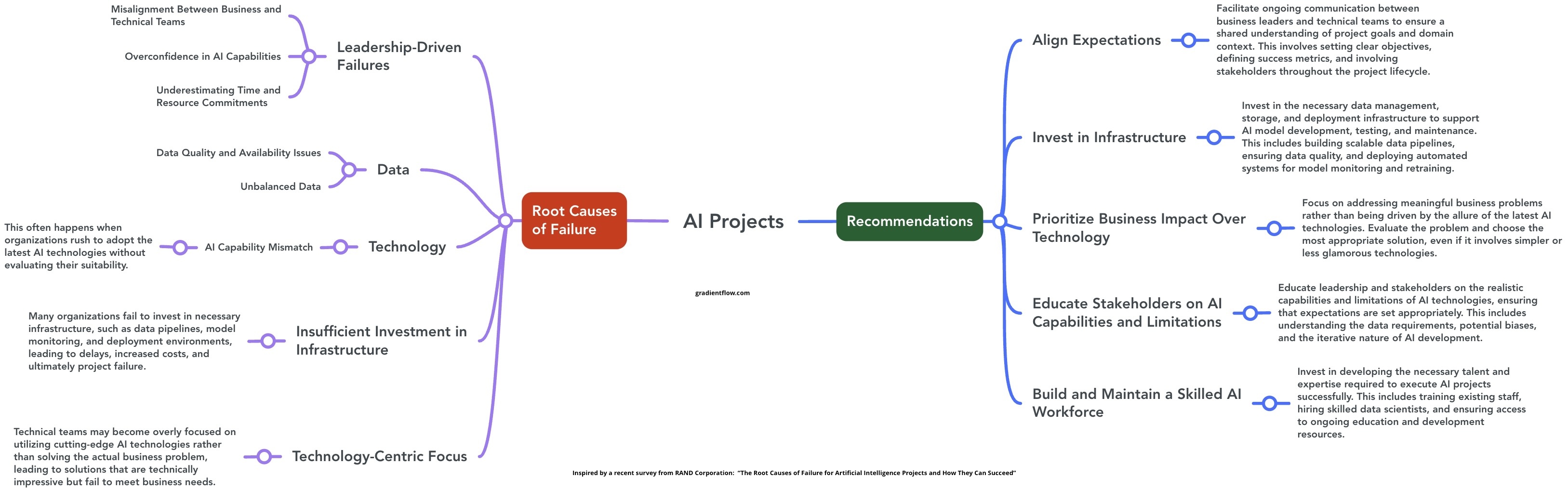
Data failures also loom large. AI is only as good as the data it’s trained on, yet issues like poor data quality, insufficient data, and unbalanced datasets plague many initiatives. These problems are often compounded by a lack of investment in the necessary infrastructure to support robust data management and AI deployment. Technology-driven failures occur when organizations rush to apply immature technologies to problems that exceed their current capabilities, leading to inevitable disappointments.
While the survey sheds light on key issues, it does come with some limitations. The sample size, while providing depth through interviews, is smaller compared to broader survey studies. Additionally, the results may skew towards highlighting leadership failures, given that most interviewees were non-managerial engineers rather than executives. Despite these caveats, the findings offer valuable food for thought for teams embarking on AI initiatives.
The Broader Context
Earlier this year, I highlighted how AI, particularly Generative AI, is quickly shifting from a cutting-edge experiment to a crucial business imperative. With adoption rates climbing, companies are increasingly recognizing the need to align their AI strategies with real-world business needs. However, the challenges highlighted in RAND’s survey are reflective of the ongoing struggles faced by many enterprises in their AI journeys.


While Generative AI is making headlines, the underlying issues of trust, data quality, and infrastructure investment are as relevant as ever. The survey underscores that the road to AI success is fraught with obstacles, many of which are self-inflicted through poor planning and misalignment. Organizations can overcome these AI challenges and unlock its transformative potential by embracing a more grounded, realistic approach.
This reality of AI project failures highlighted in the RAND survey also sheds light on why many tech-forward companies are opting to build custom AI platforms, as discussed in my recent article. The challenges of misaligned priorities, unrealistic expectations, and underinvestment in critical infrastructure are precisely what drive companies to create bespoke solutions. By developing custom AI platforms, these organizations aim to address their unique business requirements, ensure better integration with existing systems, and maintain greater control over their AI initiatives. This approach allows them to tailor their AI infrastructure to specific needs, potentially mitigating many of the failure points identified in the RAND study and positioning themselves for more successful AI implementations.

Related Content
- Why Your Generative AI Projects Are Failing
- Why Digital-First Companies Are Building Their Own AI Platforms
- Inside the Data Strategies of Top AI Labs
- Evangelos Simoudis → From Hype to Reality: The Current State of Enterprise Generative AI Adoption
If you enjoyed this post please support our work by encouraging your friends and colleagues to subscribe to our newsletter: