

Tesla, the pioneering electric vehicle (EV) manufacturer, finds itself at a crossroads as it confronts an increasingly complex and competitive global marketplace. Although the company has undoubtedly revolutionized the EV sector, it now faces a number of challenges that could threaten its continued growth.
To understand Tesla’s current predicament, it’s crucial to consider the global context. China, the world’s largest EV market, is grappling with overcapacity and hyper-competition, which is leading to increased exports and further pressure on global prices. Meanwhile, Europe is facing slowing growth and rising protectionism, while North America is shifting consumer interest towards hybrid and plug-in vehicles. Across all markets, government support and incentives remain critical for driving EV adoption. Adding to the complexity, the National Highway Traffic Safety Administration (NHTSA) is intensifying its focus on autonomous and driver-assist safety, creating new regulatory hurdles for Tesla and its peers.
Given these headwinds, a crucial question arises: where will Tesla’s future growth come from? The company faces slowing EV growth rates in the US and Europe, intense competition in China, and increasing pressure from traditional automakers entering the market. Furthermore, Tesla’s product lineup is aging, and the industry’s reliance on government incentives leaves it vulnerable to policy changes.
Declining resale values are putting pressure on lease prices, adding another layer of complexity to the financial landscape. This issue is particularly pronounced in Europe, where leasing plays a more significant role in the automotive market than in the United States. The impact of falling resale values on lease prices became apparent when Hertz, a major car rental company in the U.S., sought to offload a substantial portion of its electric vehicle (EV) fleet, underscoring the challenges faced by both consumers and businesses navigating the EV market.

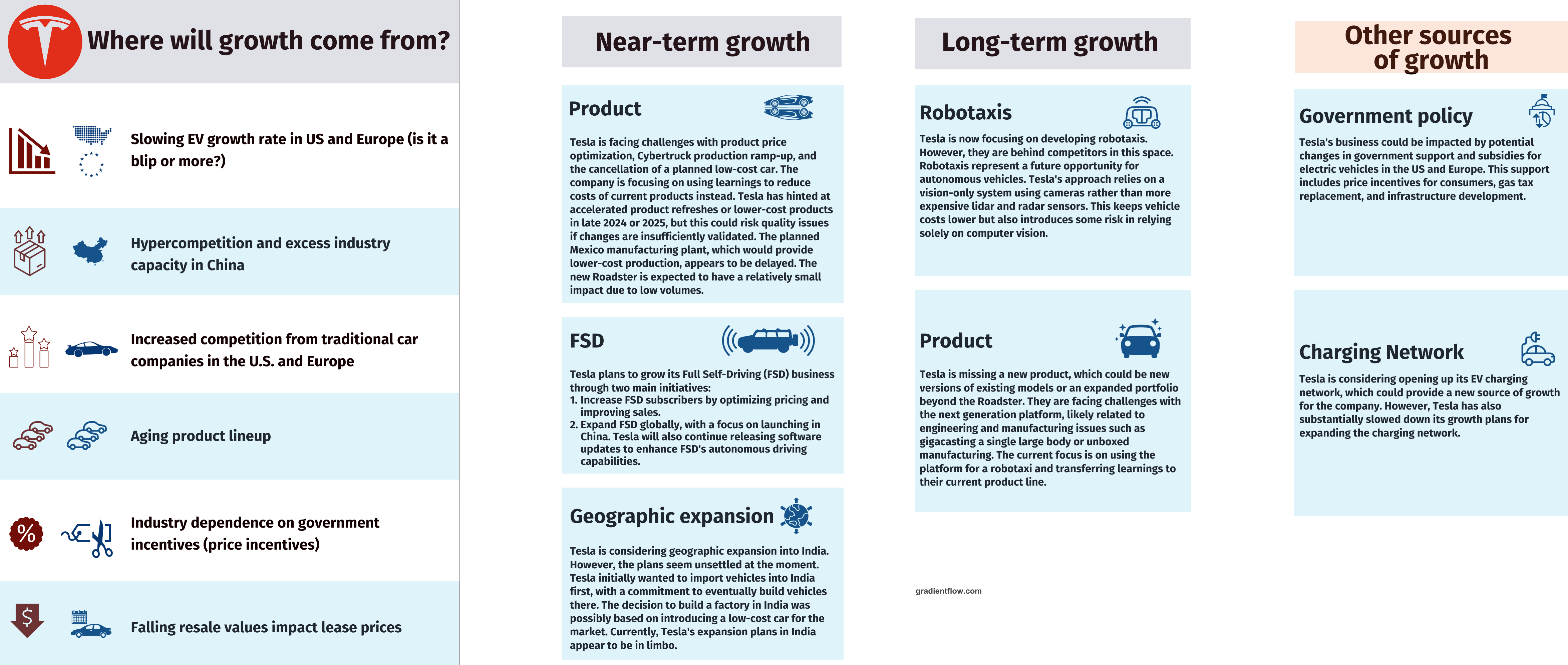
To sustain its growth trajectory, Tesla is pursuing several strategies in the near term. These include optimizing product pricing, accelerating the production of the Cybertruck (which has faced a very slow production ramp-up), potentially introducing the new Roadster, and exploring the development of lower-cost vehicles or refreshed models, possibly in 2025. Each of these initiatives presents its own set of challenges and risks.
Additionally, the company is focused on expanding the capabilities and adoption of its Full Self-Driving (FSD) system. China holds significant importance for Tesla due to its large vehicle population, which provides a wealth of data and revenue potential. With recent approvals, Tesla is making progress toward gaining FSD approval for use in China. While Autopilot functionality may already be available in China, FSD is not yet authorized.
Looking further ahead, Tesla’s long-term growth prospects hinge on the success of its robotaxi ambitions and the development of a next-generation platform. However, the company faces stiff competition in the autonomous vehicle space and may be grappling with engineering and manufacturing challenges related to its new platform.
Musk stated in January that Tesla is “between two major growth waves,” suggesting the company is currently in a transition phase. He said that the company “was very far along” in developing a next-generation low-cost vehicle platform, with production scheduled to commence at its Texas factory by the end of 2025. As often has been the case, Musk’s pronouncements and timelines have a history of evolving.


In January, Tesla was focused on next-generation, low-cost vehicles. By April, the focus had shifted to autonomous driving and robotaxis. While these announcements have helped stabilize Tesla’s stock price, it’s important to differentiate between aspirational visions and tangible progress. Concept demonstrations, while seemingly advanced, may not accurately reflect the technology’s readiness for real-world use. Concrete evidence of progress, such as investments in new facilities, confirmed production dates, and regulatory approvals for test fleets, are critical indicators that the concept is moving closer to reality.
A safe and reliable robotaxi fleet requires more than just advanced autonomous driving technology. While Waymo’s investments in perception systems, neural networks, and remote assistance capabilities are significant, its success ultimately hinges on a holistic approach that goes beyond the technology itself. This includes rigorous testing and validation to ensure the technology’s robustness, collaboration with local authorities and first responders to address potential challenges, tools for remote operators and assistance, robust fleet management and maintenance services to keep vehicles operational, and effective public communication strategies to foster trust and acceptance among both users and the wider community. This interconnected network of components is essential for building a successful robotaxi ecosystem.
Tesla’s robotaxi and fully autonomous driving ambitions remain aspirational, needing tangible evidence of progress
Tesla faces a complex future, navigating a rapidly evolving landscape marked by heightened competition, shifting consumer preferences, and evolving regulatory environments. While the company has a proven track record of innovation and disruption, it must now balance generating investor enthusiasm with delivering tangible results.
Tesla’s ambitious plans for robotaxis and fully autonomous driving remain aspirational, requiring demonstrable progress through the deployment of test fleets and the achievement of hands-free, eyes-off autonomous driving. This is a challenging task, evidenced by the limited success of numerous competitors. Tesla’s decision to rely solely on vision-based systems, eschewing advanced sensors like LiDAR, represents a bold gamble. The company’s vast dataset of road images could also be a significant asset in developing its autonomous driving technology. However, most experts believe achieving fully autonomous driving without LiDAR is currently impossible, and Tesla must prove them wrong.
Beyond technological hurdles, internal disruptions pose a potential risk. Recent leadership changes, senior management exits, and layoffs could impact Tesla’s ability to execute on its vision. As a car enthusiast, I will closely monitor Tesla’s adaptation and evolution in the face of these challenges. The question remains: can Tesla maintain its position as a leading electric vehicle manufacturer while simultaneously making meaningful progress on its ambitious autonomous driving and robotaxi goals?
If you enjoyed this post please support our work by encouraging your friends and colleagues to subscribe to our newsletter: