

Sora is a large-scale AI system from OpenAI capable of generating high-fidelity videos up to a minute long using just text prompts. It employs neural networks (“diffusion transformer architecture”) to acquire a diverse range of video simulation capabilities that could profoundly impact the entertainment and video production industry.
Sora’s capabilities include generating videos of diverse durations, aspect ratios, and resolutions, extending videos in time, editing input videos, and interpolating between videos. Notably, Sora showcases emergent simulation capabilities, such as 3D consistency and long-range coherence, setting a new standard for what AI can achieve in video production.

The Automation Wave and Its Implications
Sora’s release has accelerated competition in AI video generation, with tech giants like Google, Meta, and others working on similar systems. This rapid progress indicates an evolving landscape of creative AI tools for media production.
Despite progress, challenges persist in accurately simulating cause-and-effect relationships and maintaining coherent trajectories of objects over extended periods. Visible artifacts still persist in some Sora outputs, and more advancement is required before professional adoption for film or TV. Expectations should be calibrated, as Sora’s current capabilities do not realistically extend to replacing human creatives.
Concerns also exist around potential misuse, like deepfakes for propaganda, and lack of consent in training datasets. There are reasonable worries about automating jobs in location scouting, design, production, and acting. Sora could severely impact livelihoods even if it enhances efficiency.

Transforming Video Production: Opportunities and Challenges
I recently examined the multifaceted impact of Sora and similar AI technologies on the video production industry, delving into the potential for automation, the challenges and opportunities they present, and the ethical considerations they necessitate.
The impact of generative AI on video production will be profound, with implications across various aspects of the industry. From enhancing production processes to democratizing access to high-quality video creation, AI technologies like Sora promise to redefine the creative landscape. However, this shift also necessitates a recalibration of skills, with a growing emphasis on AI literacy and ethical content creation. As with other applications of generative AI, the future of video production will likely witness a symbiotic relationship between AI and human creativity, with AI augmenting the creative process while humans provide ethical and strategic guidance.

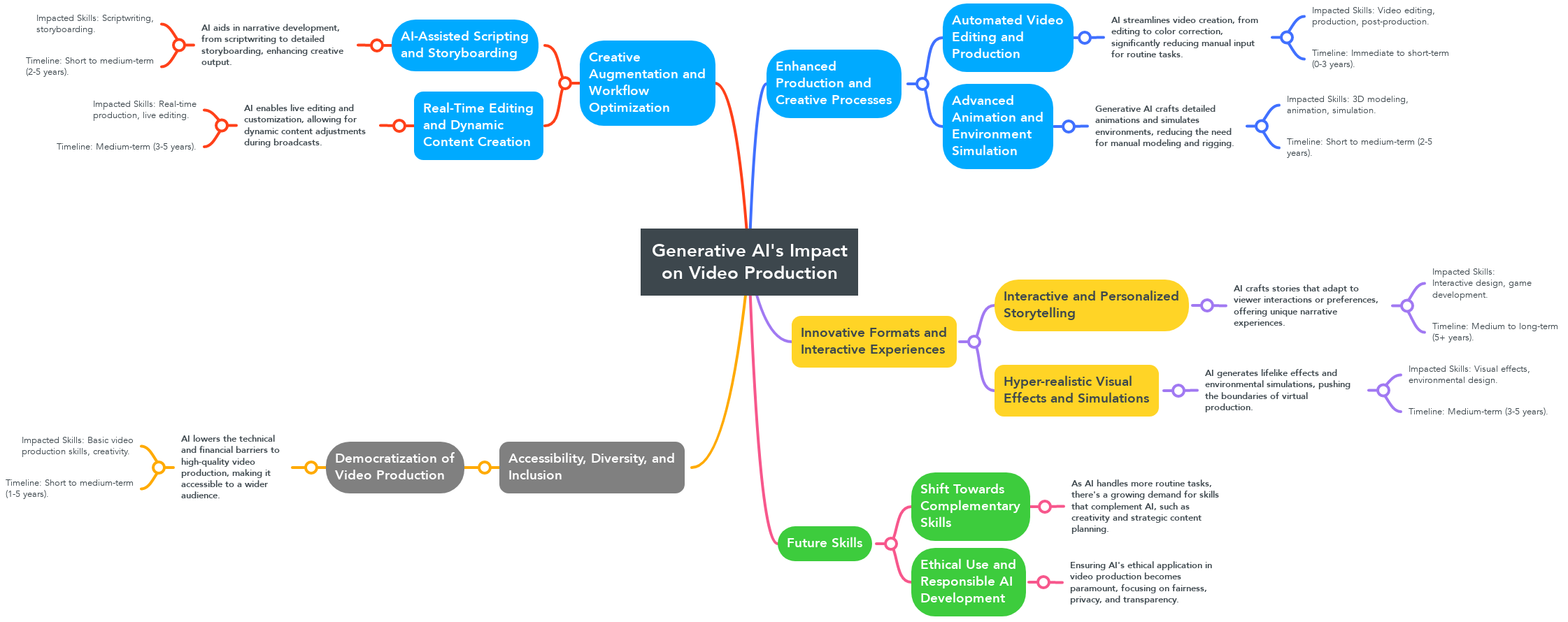
Navigating the Future with Caution and Optimism
Predicting AI’s societal impacts involves weighing complex factors. Video generation tools like Sora showcase impressive technical capabilities, yet also raise understandable concerns given the potential to disrupt industries reliant on human creativity. While video AI generation will keep rapidly improving, it’s unwise to make overly optimistic or pessimistic predictions about societal impact. Past experience shows predictions often miss the mark – for example, some early concerns about AI art generators’ role in disinformation has so far proved overstated. However, as Sora and similar tools grow more capable, vigilance around ethical risks remains prudent. With conscientious development and use, video AI could yield innovations to serve the public good.
Sora will spark a wave of creative AI models, akin to DALL-E’s impact on AI art generators
Sora represents just the initial wave of creative AI – its biggest disruption may be in spurring other models that unlock new generative possibilities like multimodal video-text-audio synthesis. Just as DALL-E unleashed a wave of AI art generators in its wake, Sora is likely the tip of the spear for a new generation of creative models.
Issues around copyright and IP also remain unsettled, and could hamper future innovation. There are reasonable fears about disproportionate job impacts even if productivity rises. As routine tasks get automated, uniquely human skills like creativity, ethics and strategic thinking will be increasingly valued. AI literacy and governance also become imperative to ensure responsible development.
In my view, unresolved issues around copyright and IP pose a serious threat that could severely hamper future innovation if not properly addressed. There are also reasonable fears about disproportionate job impacts even if overall productivity rises. As routine creative tasks get automated by AI, uniquely human skills like creativity, ethics and strategic thinking will be increasingly valued. However, the current education system seems unprepared to cultivate these skills. AI & Data literacy and governance also become imperative to ensure responsible development, but progress remains painfully slow on these fronts.
If you enjoyed this post please support our work by encouraging your friends and colleagues to subscribe to our newsletter: