The Vatican’s recent encyclical, Magnifica Humanitas, introduces a moral framework that challenges how technology leaders evaluate artificial intelligence. It treats AI as a test of human priorities. Its central question is not whether AI can make institutions faster, cheaper, or more scalable. The question is whether it helps people live with more dignity, freedom, responsibility, care, and trust. For those of us in tech, this is a useful shift in lens. AI systems should be judged not only by adoption, accuracy, cost savings, or revenue impact, but also by what they do to workers, users, children, communities, and public institutions.
The document is not anti-technology. It argues for AI that supports human judgment rather than replacing it in decisions that require context, compassion, and accountability. That distinction matters in areas such as hiring, education, health, credit, public services, workplace management, and military systems, where speed, scale, and automation can turn consequential judgments into unchallengeable decisions.
If this is useful, consider becoming a paid supporter 🙏
A Useful Warning for Builders
The encyclical has drawn a range of responses, and the most substantive ones share a common thread: the document is technically literate in a way that earlier institutional statements on AI were not. It engages with model opacity, private power concentration, the difference between machine output and human judgment, and the gap between alignment as a technical exercise and alignment as a social question. Critics who expected a generic moral appeal found something more specific, and that specificity is what has makes the document harder to dismiss.

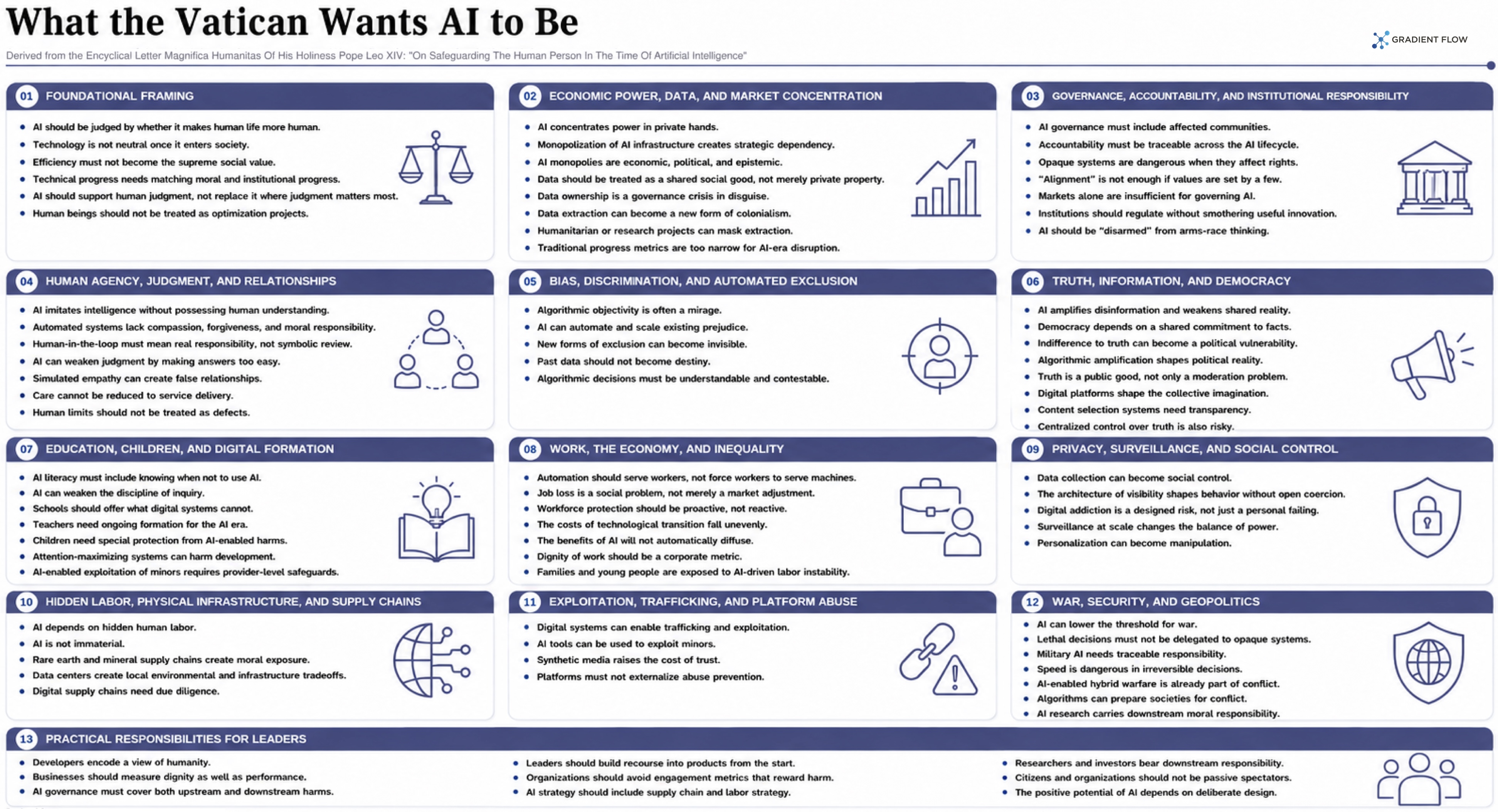
The sharpest pushback focuses on enforcement and geopolitics. Broad calls for accountability, transparency, and the restraint of autonomous weapons are easier to endorse than to operationalize, especially when unilateral restraint might leave a country vulnerable in a global arms race. Several observers noted that moral exhortation without a clear enforcement model tends to become a reference document rather than a lever for change. The document names the problem clearly but leaves the institutional architecture largely to others to design.
Where the document is most relevant to business leaders is in its treatment of responsibility as a system-level problem. It argues that AI’s social effects cannot be assigned only to engineers or product teams. Funders, executives, customers, regulators, educators, and civil society all shape how AI is deployed and who bears the costs. That framing shifts the conversation away from model-level safety reviews and toward procurement rules, vendor audits, worker protections, appeal mechanisms, and board-level accountability. The practical implication is that responsible AI is not a feature. It is an organizational posture that has to be built into strategy, supply chains, and governance before a product ships, not retrofitted after harm becomes visible.