I keep coming back to the same uncomfortable math on AI data centers: the money going in is piling up faster than any economic proof that it should. Usage of AI systems has reportedly been climbing seven to twenty times a year, while the revenue that usage produces has grown maybe three or four times, and the price customers pay per unit of compute keeps falling. That gap alone would give me pause. Layer on the fact that some companies most dependent on Nvidia now trade at a richer valuation than Nvidia itself, and you have a market pricing in a level of certainty nobody has actually earned yet.
What worries me more than the spending is how it’s being financed, and why it’s happening so fast. Something like a third of this buildout is running on borrowed money, a lot of it through leases and off-balance-sheet structures that don’t show up cleanly on any one company’s books. Add a web of equity stakes that chipmakers, cloud providers, and AI labs hold in each other in exchange for future compute purchases, and you get a system where it’s genuinely hard to tell where real demand ends and financial engineering begins. None of this is happening because it’s the economically optimal outcome. It’s happening because nobody wants to be the company that built too little, and being early matters more right now than getting the return math right. A downturn here wouldn’t even need AI to disappoint, healthy, growing customers simply trimming orders or renegotiating prices would be enough to hurt whoever built capacity assuming demand would keep climbing.
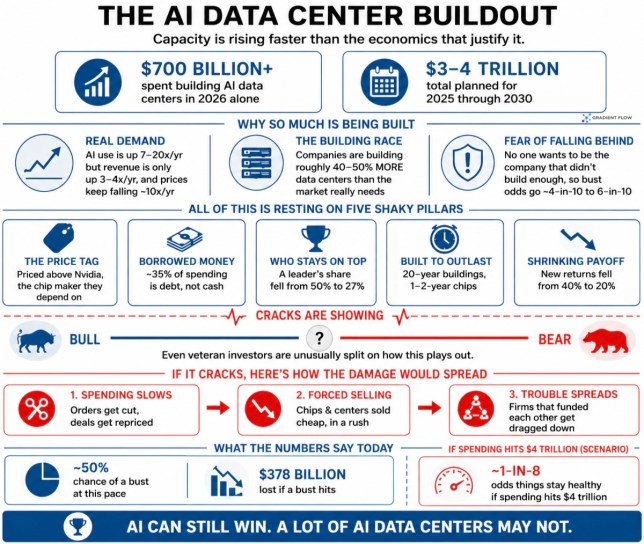
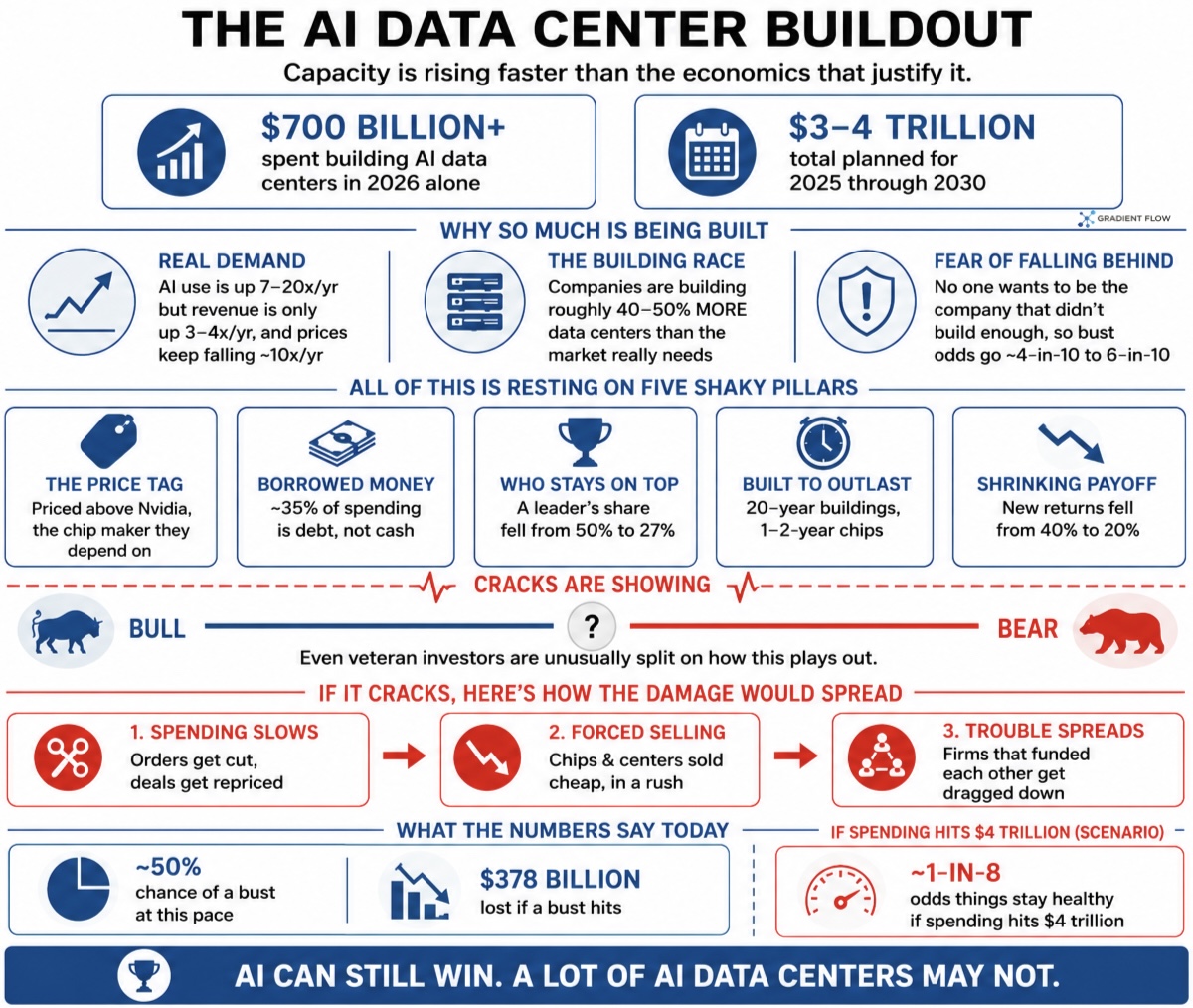
The other detail I can’t shake is the mismatch in how long these bets are supposed to last. A data center is a twenty-year asset, financed today off pricing that might only hold for a year or two, sitting on top of chips that lose their edge on an even shorter clock. That’s the same setup that has burned shale drillers and nineteenth-century railroad builders before, and it’s a big part of why the return on every new dollar being spent has already been cut roughly in half over the past eighteen months. I mapped an earlier version of this picture in a previous graphic, and if anything, the gap between people who think this ends fine and people who think it doesn’t has only gotten wider since then.
None of this means AI itself is a bad bet. I think it’s a good one. But whether AI turns out to matter and whether the specific data centers being built right now turn out to be good investments are two different questions. If you’re building on top of this infrastructure, that argues for staying portable rather than locking your roadmap to one supplier’s twenty-year bet. If you’re allocating capital into it, I’d spend less time reacting to the next big capacity announcement and more time watching utilization, contract cancellation terms, and how much of the spending behind it is actually borrowed.
Subscribe to our weekly newsletter
Appendix: Inside the AI Data Center Financing Machine
Here’s the part of this that took me a minute to wrap my head around: almost none of these data centers are financed by the company whose logo ends up on the building. Instead, that company spins up a special purpose vehicle, a separate legal entity whose only job is to own one project, the chips, the building, and the debt used to pay for all of it. That entity, not Meta or Microsoft or Oracle, is the one that actually signs the loan and the customer contract. It’s a normal financing tool borrowed from real estate and aviation, and on its own that’s not sinister. But it has a convenient side effect: because the parent company can argue it doesn’t technically control the entity, under accounting rules that leave far more room for judgment than you’d expect, none of that debt has to show up on its own books. One recent estimate puts this off-the-books debt across just five of these companies at $1.65 trillion, more than the $1.35 trillion they actually report.

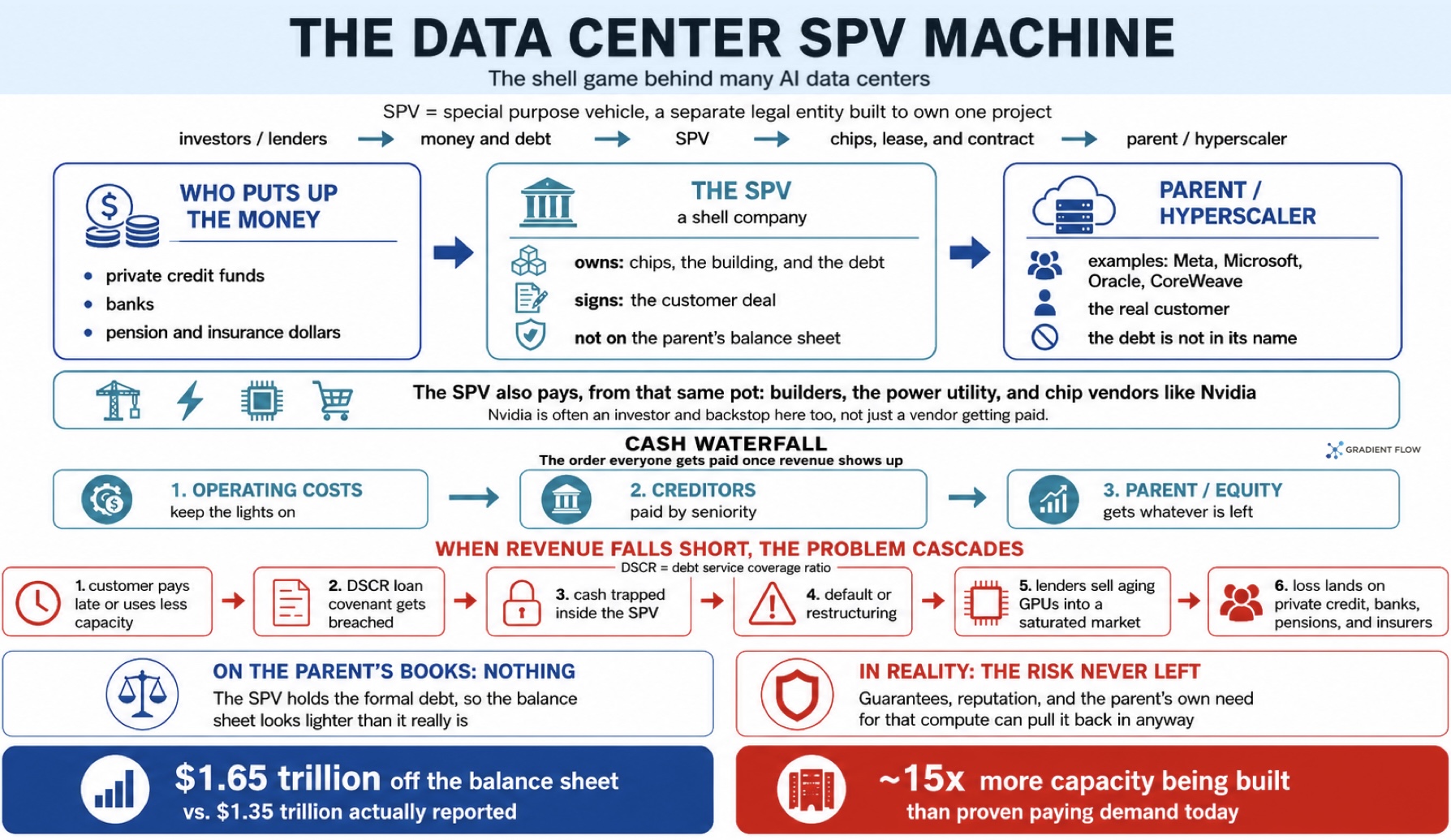
Why this matters isn’t the accounting trick itself, it’s the chain of dependency sitting underneath it. One customer’s ability to keep paying supports the loan. A private credit fund or bank supplies the capital behind that loan. Pension and insurance money often sits a layer behind that lender. And the collateral holding it all together is a pile of GPUs depreciating faster than anyone underwriting the deal probably assumed. Who actually guarantees this debt if the customer walks? Who gets paid first if the project falls short? Those questions rarely get answered in a press release. The basic shape of this, tranched debt, thin disclosure, and a lot of confidence that collateral holds its value, is close enough to the mortgage bonds behind 2008 that more than one accounting expert has openly compared it to Enron. I don’t think a repeat is guaranteed, these deals are usually tied to one named, creditworthy company rather than thousands of anonymous borrowers, but the risk is a lot more spread out, and a lot less visible, than a glance at any single balance sheet would suggest.
If you’re on the other side of one of these deals, signing a multi-year compute contract or sizing up the sector as an investor, the balance sheet in front of you probably isn’t the full picture. It’s worth asking who you’re actually contracted with, whether that entity carries a real parent guarantee, and how much of the revenue backing it has actually been collected rather than just promised.