The announcements at Google I/O 2026 landed today. I’ve gone through everything and pulled out what I think actually matters for people building products, running technical teams, or making bets on where AI is heading.
The short version: Google used this I/O to stake a claim on the agentic layer, and the ambition is wider than any single product. Persistent background agents, a new commerce protocol, an orchestration framework woven through Search, Chrome, Android, and Workspace, and a model lineup priced to compete hard on cost. The direction is clear: Google wants AI to move from answering questions to running surfaces, workflows, and agents across its entire ecosystem.
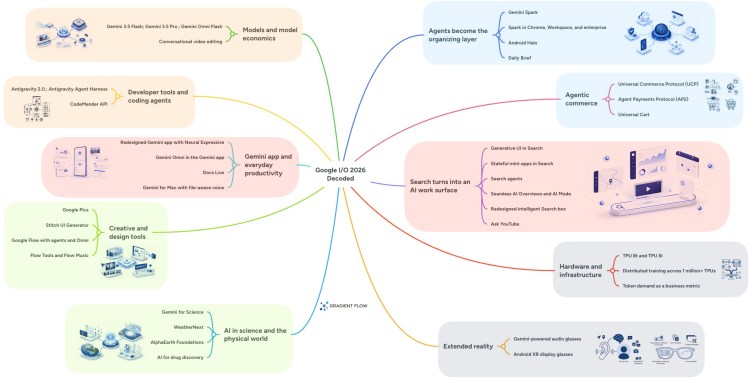
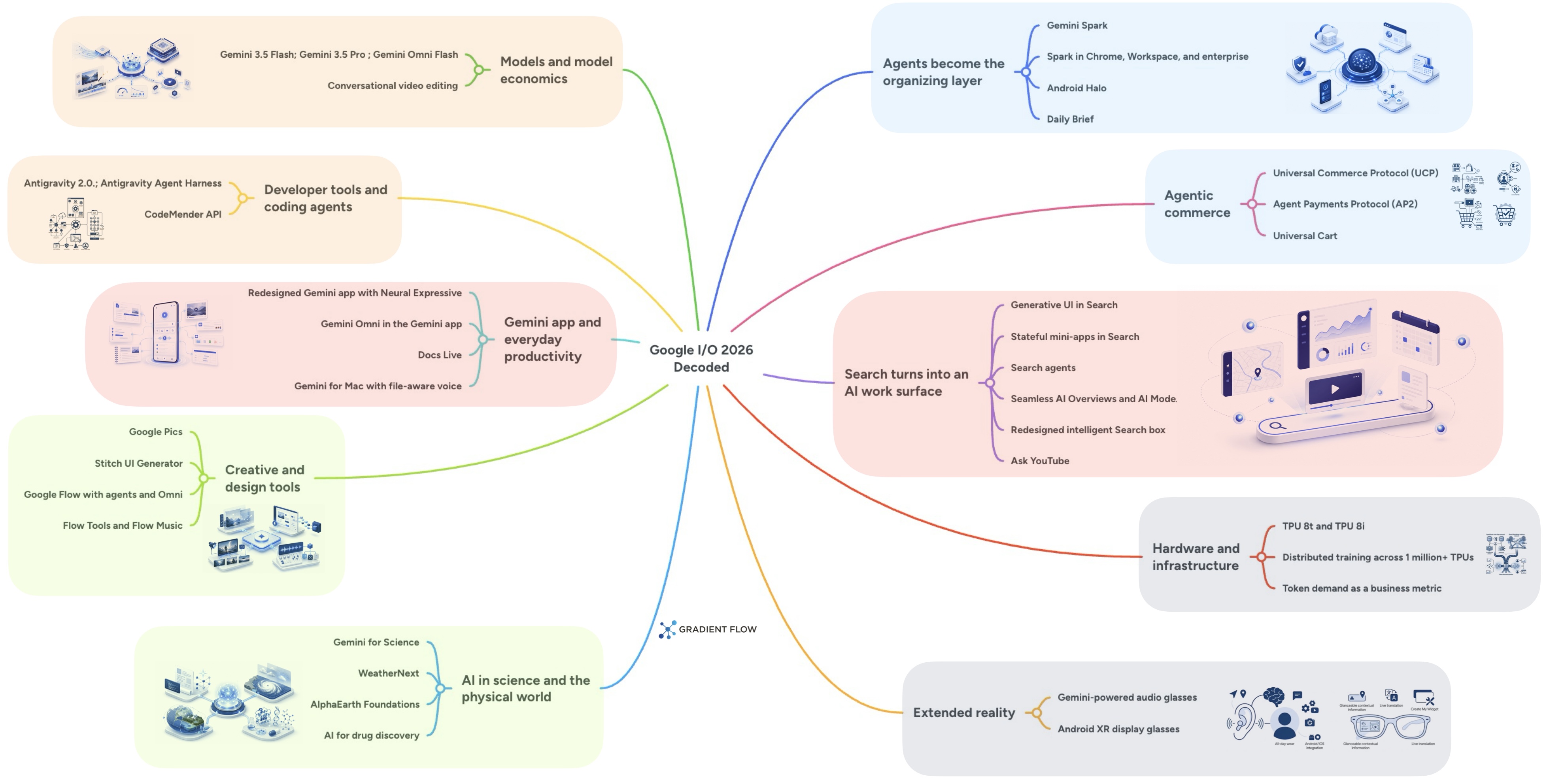
The announcements fall into a few natural buckets:
- Agents as a first-class product surface, with Google building the control panels, payment rails, and orchestration infrastructure to make them real.
- Search evolving from a retrieval tool into something closer to a runtime that generates interfaces, monitors the web, and kicks off workflows.
- A model lineup where cost and routing are the central engineering problem, not just benchmark performance.
- Developer tools and coding agents that are promising in theory but still drawing skepticism from practitioners.
- Longer-horizon bets in science, hardware, and extended reality worth tracking even if they’re not yet operational.
For builders, the opportunity is real. So is the pressure. If AI becomes the place where users search, plan, buy, create, and work, the question is no longer just whether your product uses AI. It’s whether your product still owns enough of the workflow to matter.
Agents become the organizing layer
Gemini Spark. Google’s biggest practical announcement. Spark is a personal AI agent that runs 24/7 on dedicated Google Cloud VMs, works in the background while your laptop is closed, integrates with Google’s own tools out of the box, and adds third-party connections through MCP (Model Context Protocol). The product pattern matters more than the demo tasks: persistent agents, tool access, background execution, and human approval as the default operating model. Rolling out to trusted testers this week, then to US Google AI Ultra subscribers ($100/month) next week.
- Analysis: The broader reaction to Gemini reliability and tool use is relevant. Commenters still see Gemini models as uneven in instruction following and tool interaction. That matters because persistent agents have less room for sloppy behavior than chatbots. If Spark is going to be useful in business settings, the control layer will matter as much as the model.
Spark in Chrome, Workspace, and enterprise. Spark expands into Chrome later this summer as an “agentic browser,” with versions also coming to Gemini Workspace and Gemini Enterprise. The consumer rollout is the warm-up. In business settings, the same pattern will need stronger controls around identity, audit logs, approvals, data access, and compliance — which is exactly where the enterprise opportunity sits.
Android Halo. A dedicated home base for managing agents on Android, coming later this year. This is more important than it sounds: agents need a place where users can see what’s running, pause or approve actions, check status, and recover from mistakes. For product teams, an agent is not just a model plus tools — it also needs a control panel.
Daily Brief. An out-of-the-box Gemini agent that pulls from inbox, calendar, and tasks to create a personalized morning digest, organized by topic with suggested next steps. A sensible wedge into agentic UX: start with low-risk work, summarize and prioritize, offer one-click actions before automating the action itself. Rolling out today to Google AI Plus, Pro, and Ultra subscribers in the US.
Search turns into an AI work surface
Generative UI in Search. Search can now use Gemini 3.5 Flash and the Antigravity coding harness to build custom interactive UI components on the fly for individual queries. A demo showed a fully interactive gravitational wave simulator generated in real time from a student’s astrophysics question. This is where Search starts to look like a runtime environment, not just an answer engine. I think this has obvious implications for anyone building analytics, education, planning, or commerce tools. Rolling out free to everyone this summer.
- Analysis: Early reactions expressed concern about control, attribution, and reliability. Users see AI-generated answers and interfaces as another step toward Google keeping users inside its own surface. For product teams, the risk is not simply less traffic. It is that parts of the product experience may be recreated upstream, inside Search, before users ever reach you.
Stateful mini-apps in Search. Search can now build persistent tools, trackers, dashboards, and planners that users return to over time. The weekend planner demo pulled from Gmail, Photos, Calendar, Maps, weather, and personal preferences. Google is treating Search as an app-generation surface, not merely an information surface. This creates both opportunity and pressure for products that currently live behind static web pages. Starting with subscribers in the coming months.
Search agents. Persistent background agents that monitor the web 24/7 for whatever you care about (stock criteria, apartment listings, sneaker drops) and push synthesized updates when something relevant changes. Multiple agents can run simultaneously. This is Search moving from retrieval to monitoring, filtering, and workflow initiation. Rolling out this summer.
AI Mode upgraded to Gemini 3.5. AI Mode has passed 1 billion monthly users and is now running on Gemini 3.5. Users are learning to bring long, specific, messy questions to Search, which means companies need to think less about isolated keywords and more about how their data, products, and services show up inside conversational AI flows.
- Analysis: The reaction here was sharply skeptical. Commenters complained that AI summaries can make a single weak source sound like broad consensus, or answer confidently when the source material does not really support the answer. The strongest concern was not just hallucination. It was false authority: an AI answer that sounds like a systematic review when it is really summarizing scattered or low-quality snippets.
Seamless AI Overviews and AI Mode. AI Overviews and AI Mode are merging into a single continuous experience on the main results page, with context carrying forward across follow-up questions. Search is becoming less like a page of links and more like an ongoing session. This changes how discovery, attribution, and customer acquisition work.
- Analysis: This is where the “Google Zero” anxiety shows up. Website owners and power users worry that Google will crawl and summarize the open web while sending less traffic back to the original sites. Traditional search was already degraded by SEO spam, so Google may see this as defensive self-disruption. Either way, the old bargain between websites and search engines looks weaker.
Redesigned intelligent Search box. The Search box now accepts text, images, files, and video simultaneously, with AI-powered suggestions that go beyond autocomplete to help users articulate complex questions. Users will increasingly express intent in rich, messy bundles rather than clean keywords.
- Analysis: Technical users are worried that precise search is being displaced by conversational search. The frustration is understandable. Sometimes users do not want an assistant to infer intent. They want a specific file, forum post, manual, or primary source. That distinction matters for product design: AI search needs a “just give me the sources” mode, not only a synthesized answer mode.
Ask YouTube. Turns YouTube search into a conversational experience with summaries, context-aware follow-ups, comparisons, and deep links to the most relevant parts of videos. Starting to test now, rolling out broadly in the US this summer. For builders, this shows how AI can make large unstructured content libraries useful by turning media into task-specific guidance.
Models and model economics
Gemini 3.5 Flash. The model announcement that matters most for builders. Frontier-level intelligence, four times faster than comparable frontier models, priced at less than half the cost. Google made the economics explicit: companies running a trillion tokens a day could save over a billion dollars annually by shifting 80% of workloads to Flash. Production AI is increasingly a routing and cost problem, not just a benchmark race. Available now via API and across Google products.
- Analysis: Developers focused less on Google’s performance claims and more on the price jump. Early reactions compared Gemini 3.5 Flash with earlier Flash models, Gemini Pro, and cheaper alternatives such as DeepSeek. One thing to note is that headline token pricing understates real cost because some benchmarks use more tokens per task. The mood was not “this is bad.” It was more specific: Flash may be impressive, but it no longer feels like the cheap default tier. For builders, the takeaway is clear: provider abstraction, caching, model routing, and cost observability are now core infrastructure
Gemini 3.5 Pro. Being used internally, arriving next month. The heavier complement to Flash. This is likely to matter for deeper reasoning, complex multimodal tasks, and workloads where quality matters more than latency or cost.
Gemini Omni Flash. First model in the new Omni family, available now. Omni is Google’s push toward any-input, any-output AI, combining Gemini with generative media models including Veo, Nano Banana, and Genie. The significance for builders is that video, image, text, and interactive simulation are being pulled into one conversational workflow. Omni Pro is coming soon.
Conversational video editing. Omni can edit video through natural language (style changes, added elements, camera angle changes, scene transformations) while preserving the original performance. The useful framing: video editing is starting to behave like software iteration. Describe the change, inspect the result, revise, and repeat. Implications for media tools, marketing workflows, training content, and simulation are significant.
- Analysis: I sense cautious interest rather than blanket enthusiasm. People recognize that AI is already useful in creative pipelines, but they remain skeptical of outputs that look plausible while quietly breaking realism. For teams, I would frame these tools as accelerators for drafts, variants, and low-risk edits, not as replacements for creative judgment or factual fidelity.
Developer tools and coding agents
Antigravity 2.0. Google’s agent-first development platform rebuilt as a standalone desktop app, centered on agent conversations, generated artifacts, and multi-agent orchestration. New additions include a CLI, SDK, native voice support, and integrations with Android, Firebase, and Google AI Studio. The shift is from AI as autocomplete to AI as a coordinated development system that can plan, generate, test, and iterate. Available globally today.
- Analysis: Developer reactions were lukewarm. Some liked the Antigravity harness and saw integration as Google’s advantage. Others described the coding experience as sloppy, especially for deeper systems work, and argued that Gemini still trails OpenAI and Anthropic on agentic coding and tool use. I would phrase this carefully: the orchestration story is promising, but practitioners will judge it by reliability inside real codebases.
Antigravity Agent Harness. The underlying orchestration framework powering both Antigravity and Gemini Spark, with new primitives: subagents, hooks, and async task management. Durable agent products need orchestration infrastructure, not just a prompt window. This harness is also what powers generative UI in Search: it’s becoming the connective tissue across Google’s product line.
Operating system demo. Antigravity and Gemini 3.5 Flash built the core of a functioning OS from an empty project in 12 hours, using 93 subagents, over 15,000 model requests, and 2.6 billion tokens, for under $1,000 in API credits. Not “agents replace engineers,” but a useful data point for what long-running, parallel, test-driven agent workflows now cost.
CodeMender API. Google’s code security agent (which automatically finds and fixes critical software vulnerabilities) is opening to external testers today, with broader launch coming soon. High-value, repetitive, measurable, and reviewable: a good fit for agentic AI applied carefully, with strong human review loops still in place.
Agentic commerce
Universal Commerce Protocol (UCP). An open-source standard for agentic shopping (think HTTP for commerce agents) covering product discovery, checkout, and shipment tracking. Amazon, Meta, Microsoft, Salesforce, and Stripe are now steering partners. Expanding to hotels, local food delivery, YouTube, and additional regions including Canada, Australia, and the UK. For commerce companies, this is the emerging interoperability layer that will determine where agents are allowed to transact.
Agent Payments Protocol (AP2). Google’s framework for letting agents make purchases under user-defined controls, with spending limits, approved brands, privacy-preserving payment handling, and tamper-proof digital mandates linking user, merchant, and payment processor. Agentic commerce doesn’t work unless users and merchants can prove what the agent was authorized to do. This is potentially the accountability infrastructure that makes it viable. Rolling out to Google products in coming months, starting with Gemini Spark.
Universal Cart. A cross-merchant shopping cart working across Search, Gemini, YouTube, and Gmail. Tracks price drops, price history, restocks, compatibility issues, and card-specific offers through Google Wallet. The agent manages an ongoing purchase context instead of merely recommending products. Rolling out in the US across Search and Gemini this summer.
Gemini app and everyday productivity
Redesigned Gemini app with Neural Expressive. The Gemini app has been rebuilt from scratch with a new design language. Responses move beyond walls of text into dynamic layouts with interactive images, timelines, and embedded videos: the same generative UI approach as Search, applied to the assistant. The product lesson: AI assistants increasingly need to generate the right interface for the task, not just the right answer. Rolling out globally on Android, iOS, and web now.
Gemini Omni in the Gemini app. Available today for Google AI Plus, Pro, and Ultra subscribers. Supports text, image, and video inputs, turning Gemini into a multimodal creative workbench rather than a general chat assistant.
Docs Live. Voice-first document creation for Google Docs. Brain-dump whatever’s on your mind; Gemini pulls context from Drive and Gmail, drafts content, formats tables, and edits in real time. Messy voice input becomes structured work product. Rolling out to Pro and Ultra subscribers this summer, with similar voice capabilities coming to Gmail and Keep.
Personal Intelligence expanded globally. Rolled out last week. Lets users securely connect Gmail, Photos, and other apps for personalized help across Gemini. Agent quality depends heavily on private context and cross-app access, this is one of the more important platform moves even if it didn’t get top billing.
Gemini for Mac with file-aware voice. The Mac app (built with Antigravity, 100+ features in under 100 days) is getting new voice capabilities this summer: select files in Finder, hold the Function key, dictate a rough instruction, and Gemini uses multimodal understanding to process PDFs, images, and voice input together. Local context plus voice instruction equals structured output, a pattern worth watching.
NotebookLM at 1.5 billion outputs. NotebookLM has been used to create more than 1.5 billion notebooks, podcasts, slide decks, and other outputs. Less flashy than autonomous agents, but document-grounded AI remains one of the strongest near-term enterprise use cases: easier to trust and easier to deploy.
Creative and design tools
Google Pics. A new Workspace image creation and editing tool powered by Nano Banana. Understands object relationships in your canvas, lets you remove or resize elements, edit and translate text, with all outputs SynthID watermarked. Lightweight creative production is moving directly into productivity software. Rolling out this summer.
Stitch UI Generator. Generates UI designs from text or voice prompts, allows real-time collaborative refinement, and exports to code or launches directly as a website. The world used Stitch to generate over 100 million UI screens in the past year. Design-to-code workflows are moving into mainstream prototyping. It won’t replace good product judgment, but it compresses the time from idea to testable interface. Updates rolling out globally today.
Google Flow with agents and Omni. Flow gets Gemini Omni, a new multi-action agent, custom tool creation, and music remixing. The agent can now take multiple actions simultaneously: generating 16 camera angles from a single image, or transforming lighting across an entire scene. Creative AI is shifting from one-shot generation to managed production workflows.
Flow Tools and Flow Music. Flow Tools lets users create custom creative tools with natural language inside Flow. Flow Music turns rough musical ideas into more complete demos and remixes. The broader idea: users will not only generate media assets — they’ll generate the tools and workflows used to make those assets.
Trust, provenance, and safety
SynthID and Content Credentials in Search and Chrome. SynthID has now watermarked 100 billion images and videos. Google is expanding it to Search and Chrome, where you can right-click any image and ask whether it was AI-generated. Content Credentials Verification goes further, showing whether content came from a camera or AI and whether it was subsequently edited with generative tools. Provenance is becoming a product feature, not just a policy debate.
Cross-industry SynthID adoption. OpenAI, Kakao, and Eleven Labs are now adopting SynthID, joining NVIDIA. Watermarking only works at scale if enough major providers participate (this cross-industry adoption is the real news). For teams building generative media products, provenance standards may become part of vendor selection and platform compliance.
AI in science and the physical world
Gemini for Science. A new suite of AI tools and Labs prototypes for research workflows: tracking newly published papers, converting research goals into runnable code, generating hypotheses. Still early, but the broader point is that defensible AI products are likely to be domain-specific: an assistant has to understand the work, not just summarize the text around it.
WeatherNext. Google’s hurricane forecasting model predicted a Category 5 storm striking Jamaica three days early during the 2025 hurricane season, with greater accuracy than traditional models. The National Hurricane Center is now treating it as part of their standard forecast toolkit. A concrete, real-world deployment of AI simulation that’s already saving lives.
AlphaEarth Foundations. Google’s closest approximation to a digital twin of the planet, designed to model complex systems like deforestation and food security. Points to an important application pattern: AI as a simulator for domains where direct experimentation is slow, expensive, or impossible.
AI for drug discovery. AlphaFold and AlphaGenome are already standard research tools for millions of scientists. Isomorphic Labs is now in pre-clinical stage with multiple projects, including potential treatments for immune disorders and cancer. Pre-clinical is early, but the strategic message is clear: Google wants AI positioned as discovery infrastructure for science and medicine, not just a productivity layer.
Hardware and infrastructure
TPU 8t and TPU 8i. Google’s eighth-generation TPUs take a dual-chip approach for the first time: 8t optimized for large-scale pretraining, 8i optimized for low-latency inference. Training and inference economics are diverging enough to justify specialized hardware. The 8i hits nearly 1,500 tokens per second in demos; both chips deliver up to 2x better performance per watt.
Distributed training across 1 million+ TPUs. JAX and Pathways now let Google distribute training across multiple data centers, scaling across more than 1 million TPUs globally. Frontier model training is becoming a distributed systems problem: the bottleneck isn’t just chips, it’s networking, scheduling, reliability, and coordination.
Token demand as a business metric. Google’s services now process 3.2 quadrillion tokens per month, with model APIs handling around 19 billion tokens per minute and 8.5 million developers building with its models monthly. Token budgets, model routing, caching, batching, and task design are becoming core operating disciplines for companies deploying AI at scale.
Extended reality
Gemini-powered audio glasses. Launching this fall, in partnership with Samsung (hardware), Warby Parker, and Gentle Monster (design). Audio-only, no display: private Gemini help spoken into your ear all day, for navigation, messaging, app control, and photography. Pairs with both Android and iOS. The live demo showed Gemini navigating to a location from memory, placing a DoorDash order by voice, summarizing missed messages, and adding a calendar event. For teams building voice-first or ambient computing experiences, this is the first real consumer hardware to pay attention to in the Android XR ecosystem.
Android XR display glasses. Display glasses with a small in-lens display are in developer preview, with the Trusted Tester Program expanding later this year. Features include glanceable contextual information, live translation, and custom widgets via a “Create My Widget” feature. For builders, this is the agent story moving from screens into physical context: hands-free, glanceable, and ambient.