

Quantum technologies are entering an industrialization phase. A recent CNAS report argues that over the next three to five years, quantum sensors and computers will begin moving from laboratories into deployable systems with real economic and national-security value. But the United States’ ability to benefit will depend less on science alone and more on whether it can manufacture, source, integrate, and deploy quantum systems at scale. The report frames this as a supply-chain and industrial-base problem: quantum systems depend on specialized inputs such as precision lasers, cryogenics, photonic materials, isotopes, wafer-scale fabrication, and testing infrastructure, many of which remain thin, foreign-dependent, or optimized for research rather than production.

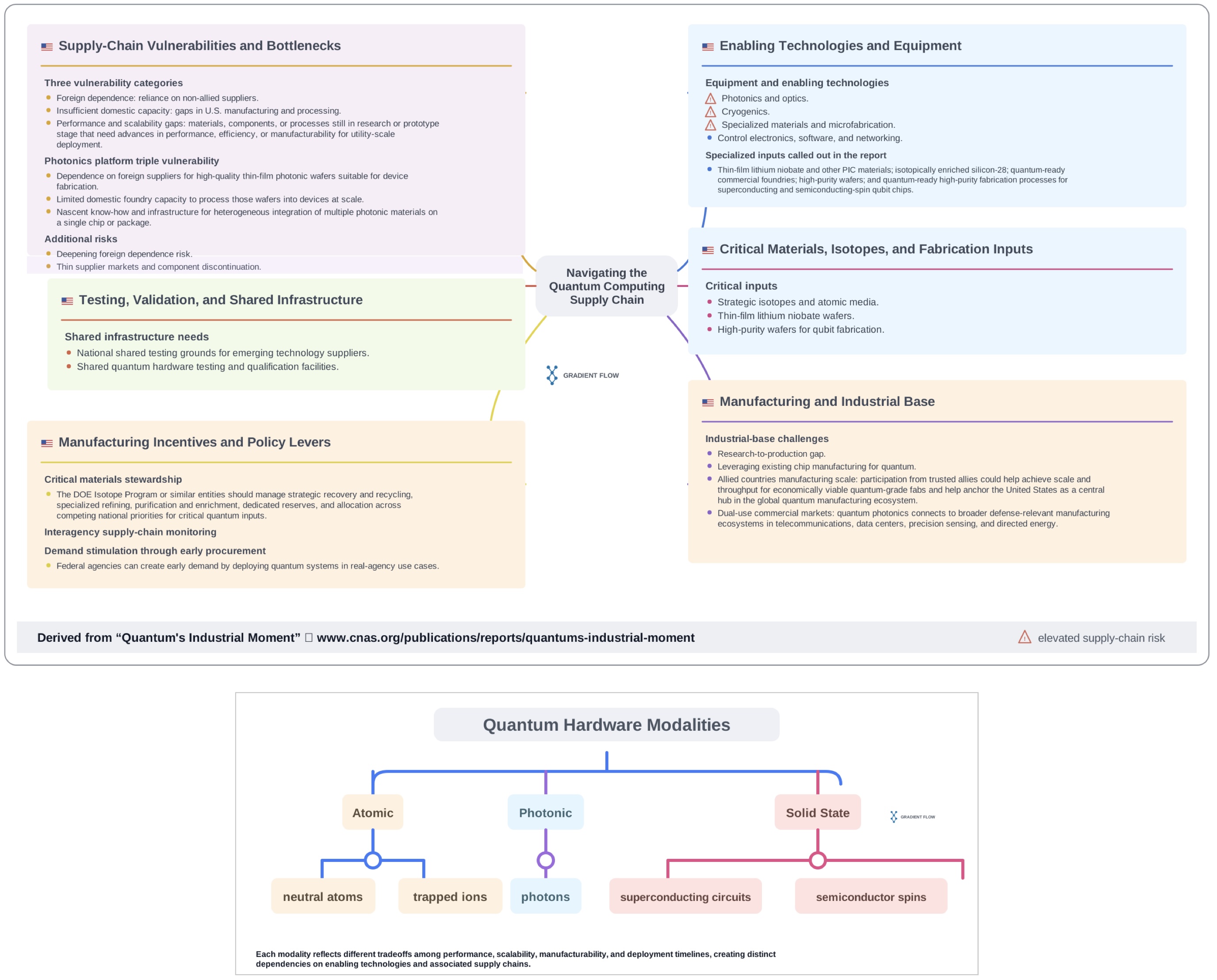
The central warning is that the US has a strong quantum innovation ecosystem but no coherent industrial strategy for converting that lead into durable advantage. Markets are still too small and fragmented to support the specialized supplier base quantum systems require. Federal funding has leaned toward basic research and complete quantum systems rather than the enabling technologies and manufacturing processes that underpin them. Meanwhile, China’s state-backed industrial push is creating competitive pressure in lasers, cryogenics, and materials. The report recommends a portfolio approach: treat enabling technologies as first-order priorities, use procurement and pilot programs to stimulate demand, build shared test and manufacturing infrastructure, secure critical isotopes and materials, coordinate with trusted allies, and calibrate trade policy carefully to avoid undermining US and allied supply chains.
If you read often, consider becoming a paid supporter 🙏