

A recent article, “Why the AI Boom Is Hitting a Reset Wall,” makes an argument I think is more useful than the usual debate over whether AI is a bubble. The question is not whether AI demand is real. It is whether the financing structure supporting the buildout can handle the moment when enormous compute commitments start turning into actual bills. Unlike a valuation argument, these contracts put a date on the question.
Subscribe to our weekly newsletter
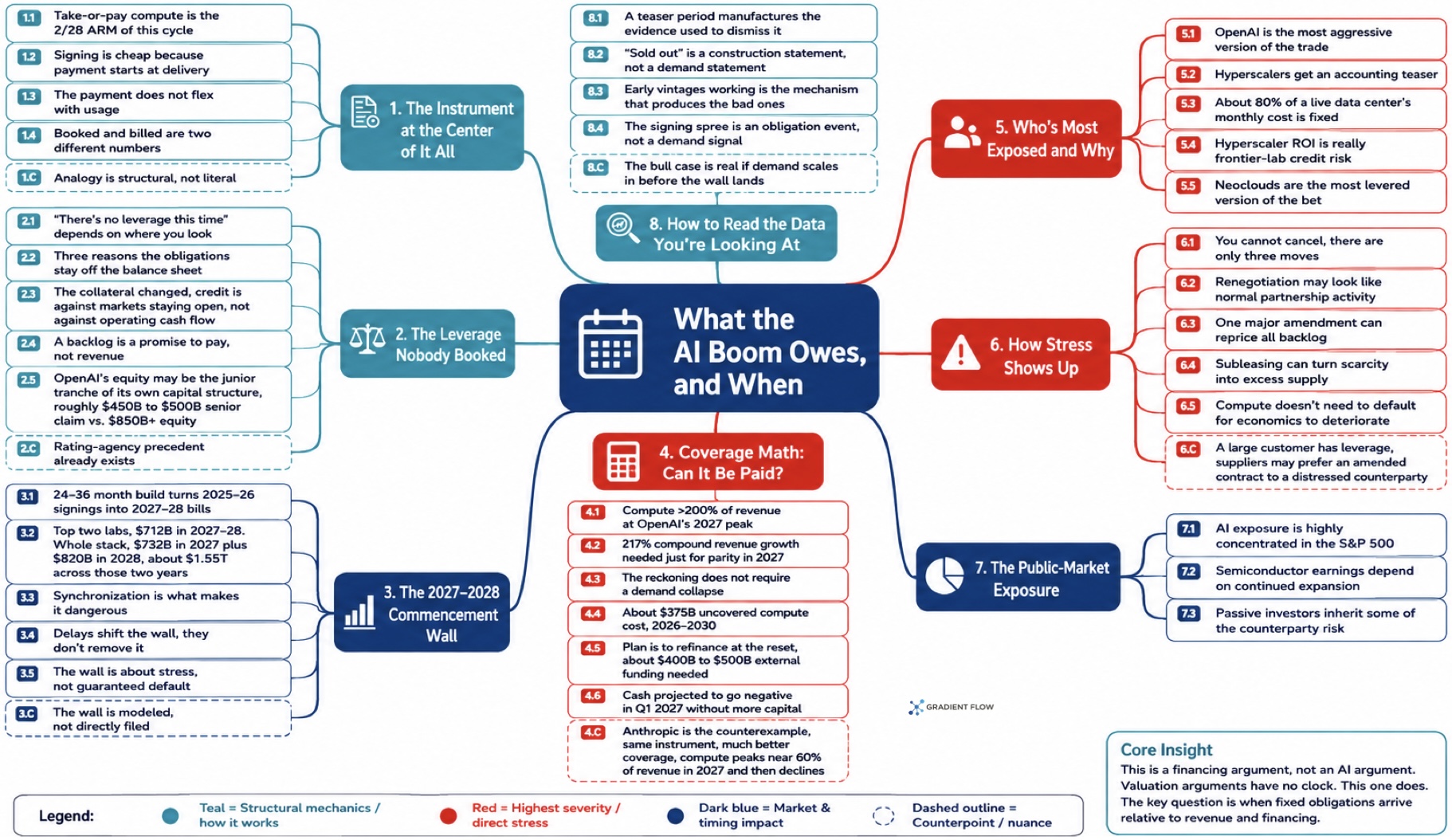
The key is the take-or-pay contract. A frontier lab can commit to years of compute today, but payments generally start when the capacity is delivered. Building a gigawatt-scale data center can take 24 to 36 months. So the contracts signed during the 2025 and 2026 boom have something resembling a teaser period. The commitment is real, but much of the cash cost does not arrive until 2027 and 2028. Once the capacity goes live, the bill does not fall just because utilization or revenue comes in below plan.
There is another change that I think matters just as much. In the earlier cloud era, a large enterprise usually paid its cloud commitment out of an existing operating business. Today’s biggest compute commitments increasingly depend on future revenue and future fundraising. At the same time, providers can report huge contracted backlogs while buyers have not yet incurred the full cost of capacity still under construction. Booked compute and billed compute are very different numbers.

The coverage math is what got my attention. Under OpenAI’s own revenue plan, committed compute alone rises above 200% of revenue at the 2027 peak. Getting compute spending merely down to 100% of revenue would require revenue to compound at roughly 217% annually from the 2025 base. The analysis estimates about $375 billion in uncovered compute costs from 2026 through 2030, implying roughly $400 billion to $500 billion of external funding once the rest of the business is included. Without new capital, cash is projected to turn negative in the first quarter of 2027. The important nuance is that demand does not have to collapse. It only has to grow more slowly than assumed when the contracts were signed.
What does stress look like if that happens? Probably not a sudden default. A take-or-pay customer has three basic options: raise more capital, renegotiate, or sublease capacity it no longer needs. Renegotiation may be the one to watch most closely. A volume deferral can be described as capacity rephasing, and a lower rate can look like a new partnership arrangement. But once a major contract is amended, investors can no longer assume that every dollar of contracted backlog will arrive exactly as written. The early signal may not be a headline. It may be a change in the terms.

Related content